

This biology question covers important biological concepts and processes. The step-by-step explanation below helps you understand the underlying mechanisms and reasoning.
ScanSolve AI Answer
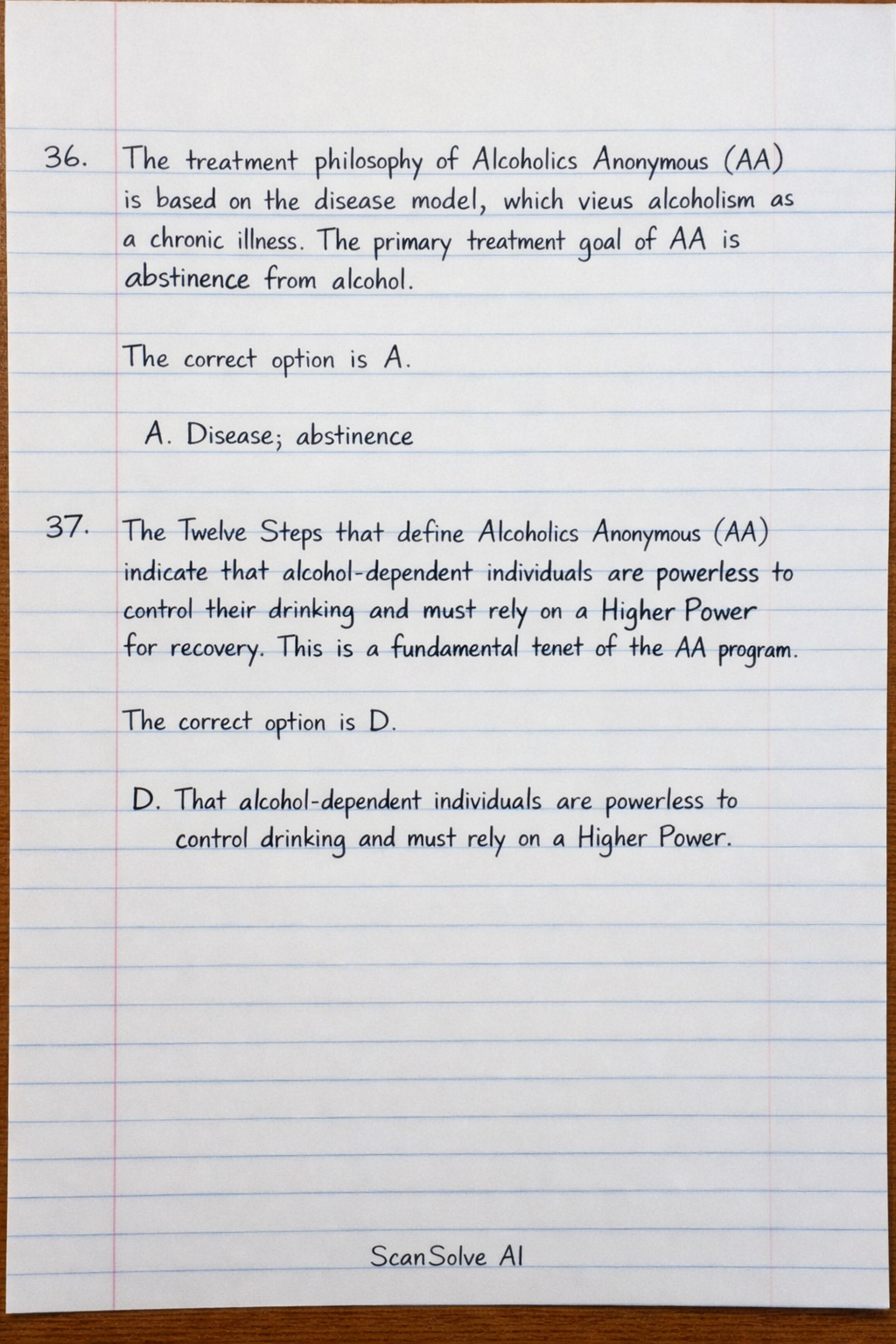
36. The treatment philosophy of Alcoholics Anonymous (AA) is based on the disease model, which views alcoholism as a chronic illness. The primary treatment goal of AA is abstinence from alcohol. The correct option is A. A. Disease; abstinence 37. The Twelve Steps that define Alcoholics Anonymous (AA) indicate that alcohol-dependent individuals are powerless to control their drinking and must rely on a Higher Power for recovery. This is a fundamental tenet of the AA program. The correct option is D. D. That alcohol-dependent individuals are powerless to control drinking and must rely on a Higher Power 38. According to behavioral tolerance, an individual's body learns to compensate for the effects of a drug in a familiar environment. This means that to achieve the same effect, the individual would need to use more of the drug in the familiar setting. Therefore, Elliot finds that he uses more heroin at home compared with when he is visiting the home of a new friend (an unfamiliar environment where tolerance mechanisms might be less active). The correct option is B. B. Behavioral tolerance; more 39. Classical conditioning approaches to the treatment of alcoholism generally attempt to associate alcohol with unpleasant stimuli. This is known as aversive conditioning, where the consumption of alcohol is paired with an undesirable experience (e.g., nausea induced by a drug like Antabuse). The correct option is B. B. Attempt to associate alcohol with unpleasant stimuli 40. Operant conditioning approaches to the treatment of alcohol use disorders are based on contingency management. This involves providing rewards for desired behaviors (like abstinence or reduced drinking) and can be used with the goal(s) of complete abstinence, or moderated drinking, depending on the specific program and individual goals. The correct option is C. C. Contingency management; complete abstinence, or moderated drinking