
We read your photo as:
Write 5 examples of modified parts of flowering plants with their modifications and explain the phases of Photosynthesis.
ScanSolve AI Answer
Here are the answers to the questions you've provided:
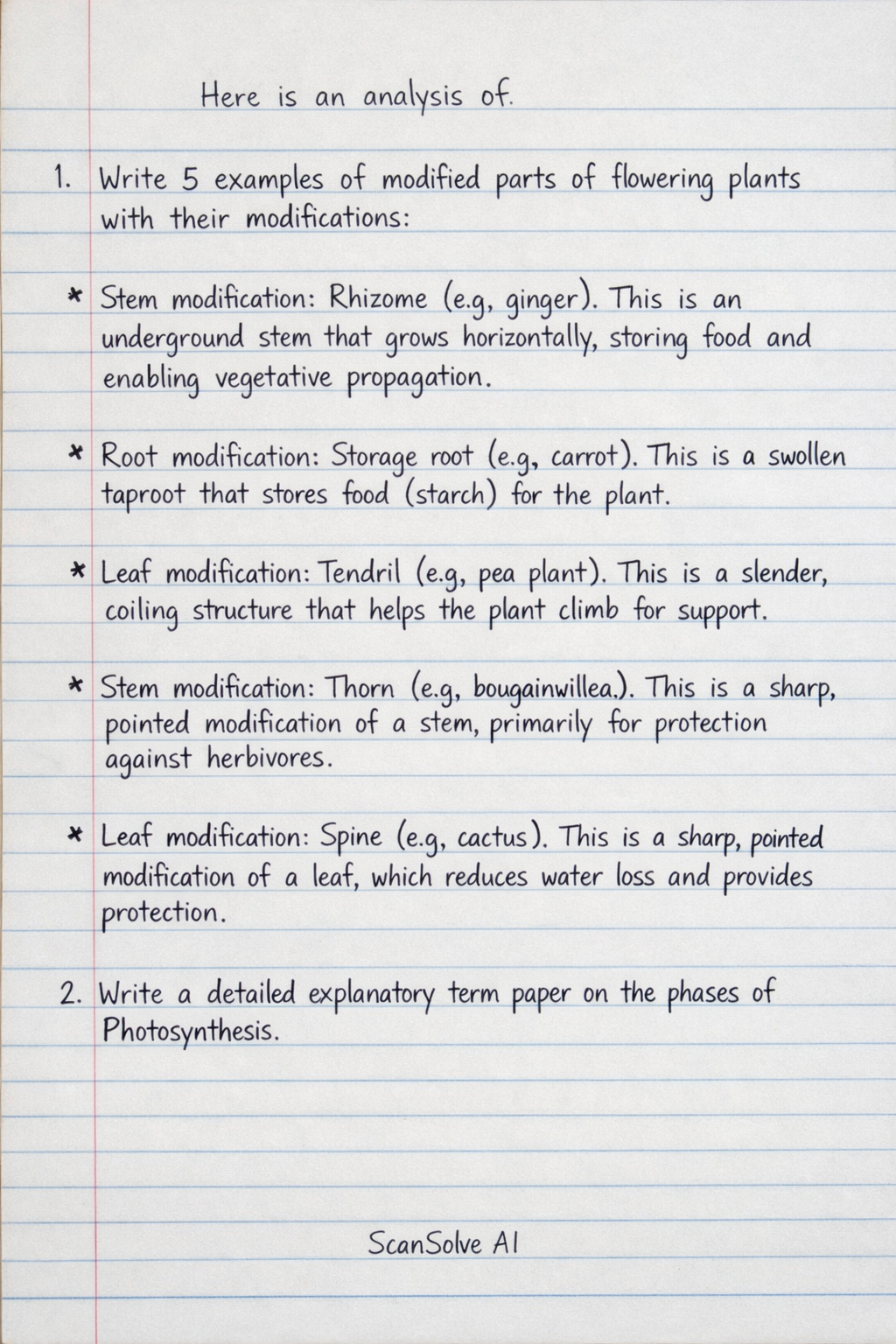
1. Write 5 examples of modified parts of flowering plants with their modifications.
- Stem modification: Rhizome (e.g., ginger). This is an underground stem that grows horizontally, storing food and enabling vegetative propagation.
- Root modification: Storage root (e.g., carrot). This is a swollen taproot that stores food (starch) for the plant.
- Leaf modification: Tendril (e.g., pea plant). This is a slender, coiling structure that helps the plant climb for support.
- Stem modification: Thorn (e.g., bougainvillea). This is a sharp, pointed modification of a stem, primarily for protection against herbivores.
- Leaf modification: Spine (e.g., cactus). This is a sharp, pointed modification of a leaf, which reduces water loss and provides protection.
2. Write a detailed explanatory term paper on the phases of Photosynthesis.
Photosynthesis is the process by which green plants and some other organisms use sunlight to synthesize foods with the help of chlorophyll. It occurs in two main phases:
-
Light-dependent reactions: These reactions occur in the thylakoid membranes of chloroplasts. Chlorophyll absorbs light energy, which excites electrons. This energy is used to split water molecules () into oxygen (), protons (), and electrons. The electrons move through an electron transport chain, generating ATP (adenosine triphosphate) and NADPH (nicotinamide adenine dinucleotide phosphate). Oxygen is released as a byproduct.
-
Light-independent reactions (Calvin Cycle): These reactions occur in the stroma of chloroplasts and do not directly require light, but they depend on the ATP and NADPH produced during the light-dependent reactions. In this cycle, carbon dioxide () from the atmosphere is fixed and converted into glucose () using the energy from ATP and the reducing power of NADPH. The cycle involves a series of enzymatic reactions to regenerate the starting molecule, RuBP (ribulose-1,5-bisphosphate).
Still stuck on this one?
Ask a follow-up, and the answer starts from this question.
More Biology Questions
Handwritten Step-by-Step Solution
Get this as a handwritten image on WhatsApp — like a tutor wrote it for you.
Try on WhatsApp