
We read your photo as:
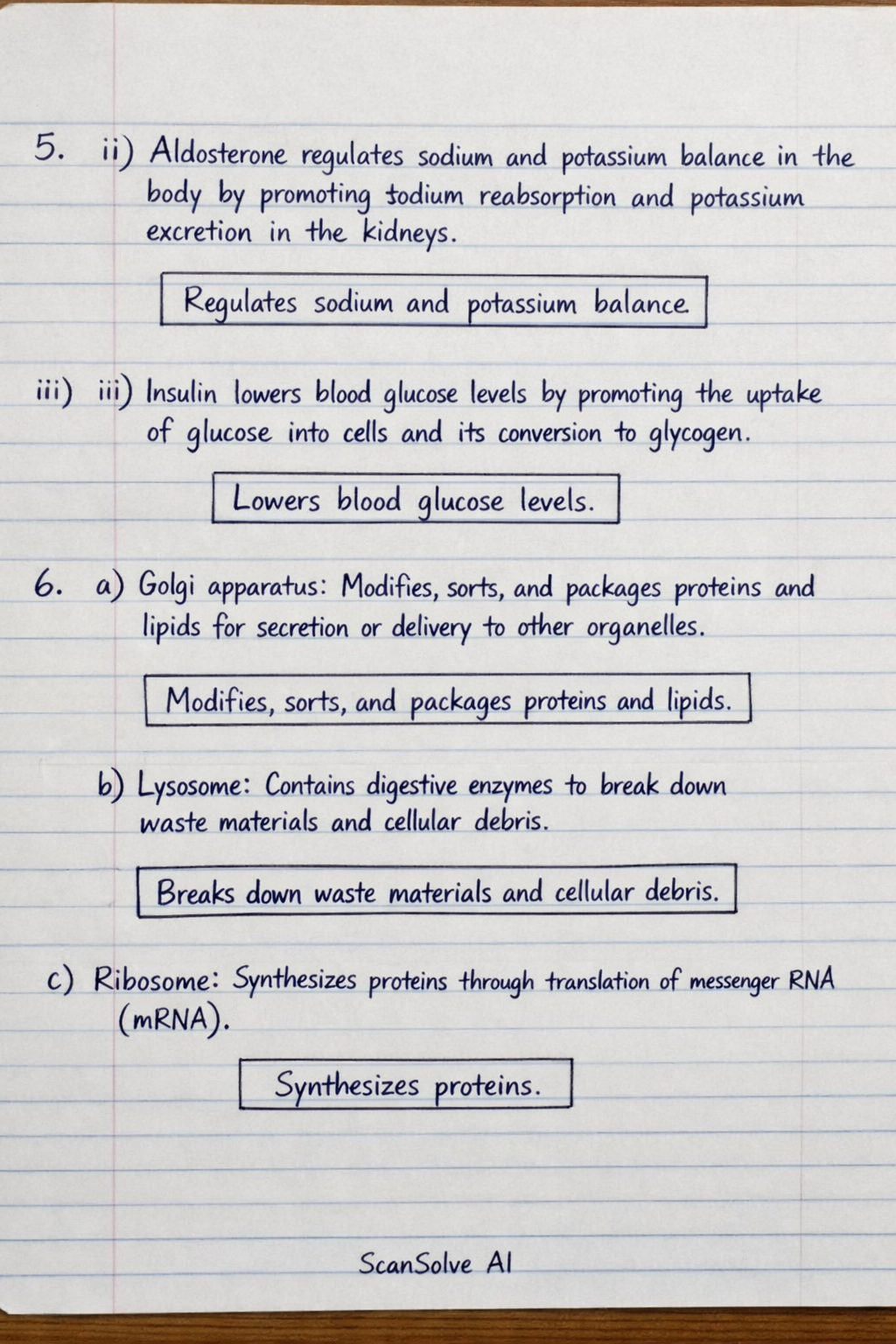
Ii) Aldosterone regulates sodium and potassium balance in the body by promoting sodium reabsorption and potassium excretion in the kidneys.
ScanSolve AI Answer
-
ii) Aldosterone regulates sodium and potassium balance in the body by promoting sodium reabsorption and potassium excretion in the kidneys.
iii) Insulin lowers blood glucose levels by promoting the uptake of glucose into cells and its conversion to glycogen.
-
a) Golgi apparatus: Modifies, sorts, and packages proteins and lipids for secretion or delivery to other organelles.
b) Lysosome: Contains digestive enzymes to break down waste materials and cellular debris.
c) Ribosome: Synthesizes proteins through translation of messenger RNA (mRNA).
-
Two biotic factors that would affect an antelope living in Maasai Mara are:
- Predators (e.g., lions, cheetahs)
- Competitors for food (e.g., zebras, wildebeest)
- Parasites and diseases
- Vegetation (food source)
-
a) Two enzymes produced in their precursor form are:
- Pepsinogen (precursor to pepsin)
- Trypsinogen (precursor to trypsin)
- Chymotrypsinogen (precursor to chymotrypsin)
b) The substance that converts these enzymes to their active forms is hydrochloric acid (for pepsinogen) or enteropeptidase/trypsin (for trypsinogen/chymotrypsinogen).
-
Three ways through which energy is lost from one trophic level to another in a food chain are:
- Metabolic processes: Energy is used for respiration, movement, and other life activities, releasing heat.
- Undigested food: Not all consumed food is assimilated; some energy is lost as waste products (feces).
- Incomplete consumption: Not all parts of an organism are consumed by the next trophic level.
Still stuck on this one?
Ask a follow-up, and the answer starts from this question.
More Biology Questions
Handwritten Step-by-Step Solution
Get this as a handwritten image on WhatsApp — like a tutor wrote it for you.
Try on WhatsApp