

This biology question covers important biological concepts and processes. The step-by-step explanation below helps you understand the underlying mechanisms and reasoning.
ScanSolve AI Answer
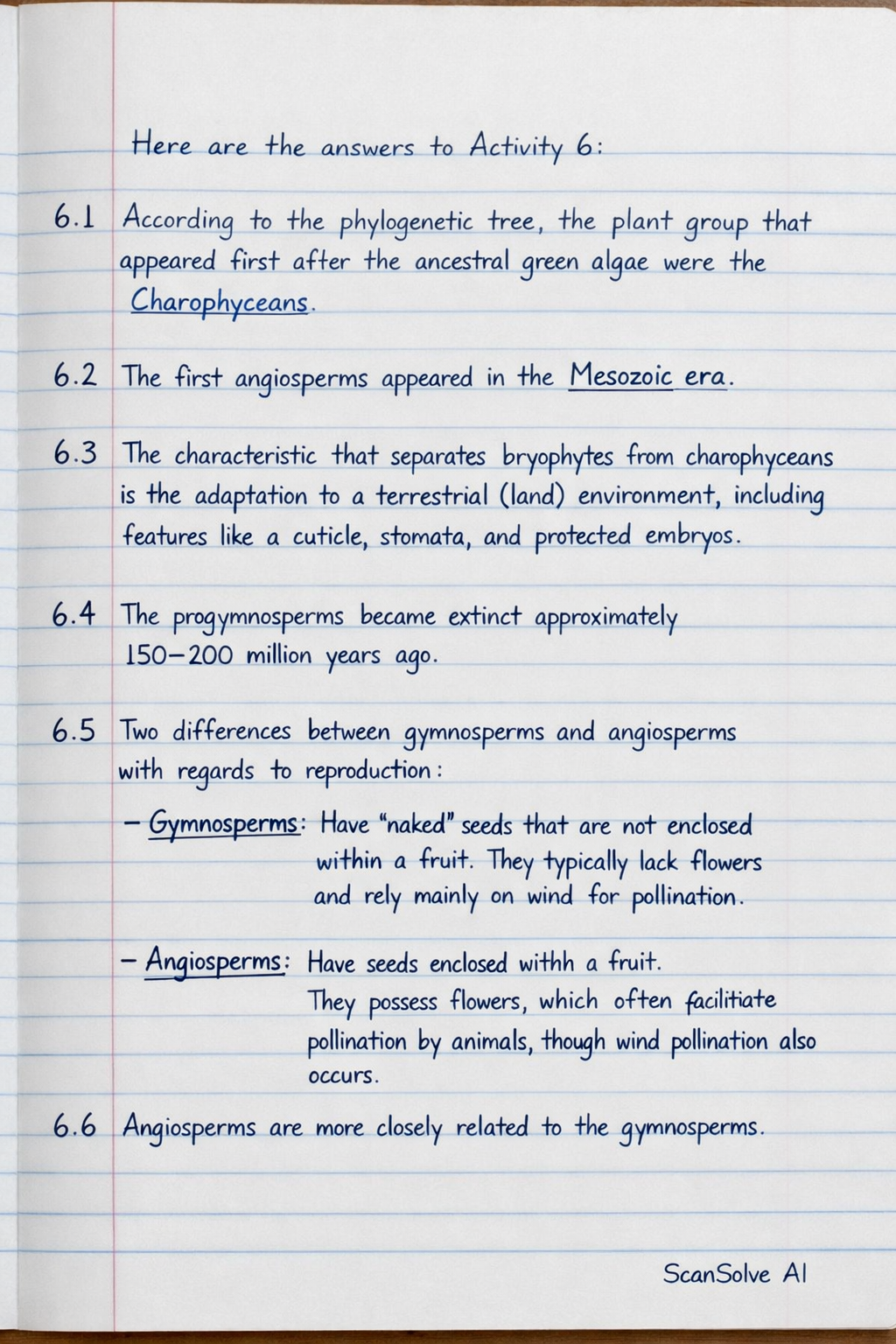
Here are the answers to Activity 6: 6.1 According to the phylogenetic tree, the plant group that appeared first after the ancestral green algae were the Charophyceans. 6.2 The first angiosperms appeared in the Mesozoic era. 6.3 The characteristic that separates bryophytes from charophyceans is the adaptation to a terrestrial (land) environment, including features like a cuticle, stomata, and protected embryos. 6.4 The progymnosperms became extinct approximately 150-200 million years ago. 6.5 Two differences between gymnosperms and angiosperms with regards to reproduction: Gymnosperms: Have "naked" seeds that are not enclosed within a fruit. They typically lack flowers and rely mainly on wind for pollination. Angiosperms: Have seeds enclosed within a fruit. They possess flowers, which often facilitate pollination by animals, though wind pollination also occurs. 6.6 Angiosperms are more closely related to the gymnosperms. 6.7 Angiosperms and gymnosperms share a more recent common ancestor (the "Early seed plants" node on the phylogenetic tree) compared to mosses (Bryophytes), which diverged much earlier from the main plant lineage at the "Origin of land plants" node. This indicates a closer evolutionary relationship between angiosperms and gymnosperms. 6.8 Two advantages of sexual reproduction for the survival of plants: Genetic Variation: Sexual reproduction combines genetic material from two parents, leading to offspring with unique combinations of traits. This genetic diversity increases the chances that some individuals will possess traits better suited to survive and reproduce in changing environments. Adaptation: The increased genetic variation allows plant populations to adapt more effectively to new challenges such as diseases, pests, or shifts in climate, enhancing the species' long-term survival. 3 done, 2 left today. You're making progress.