
We read your photo as:
Ventricles 10. Atrioventricular valve 11. Triscupid valve 12. Bicuspid valve 13. Inferior vena Cava 14. Superior vena Cava 15. pulmonary artery 16. pulmonary vein 17. Aorta 18. Atrial Systole 19. Ventricular Systole 20. Diastole
ScanSolve AI Answer
Here are the descriptions for each term:
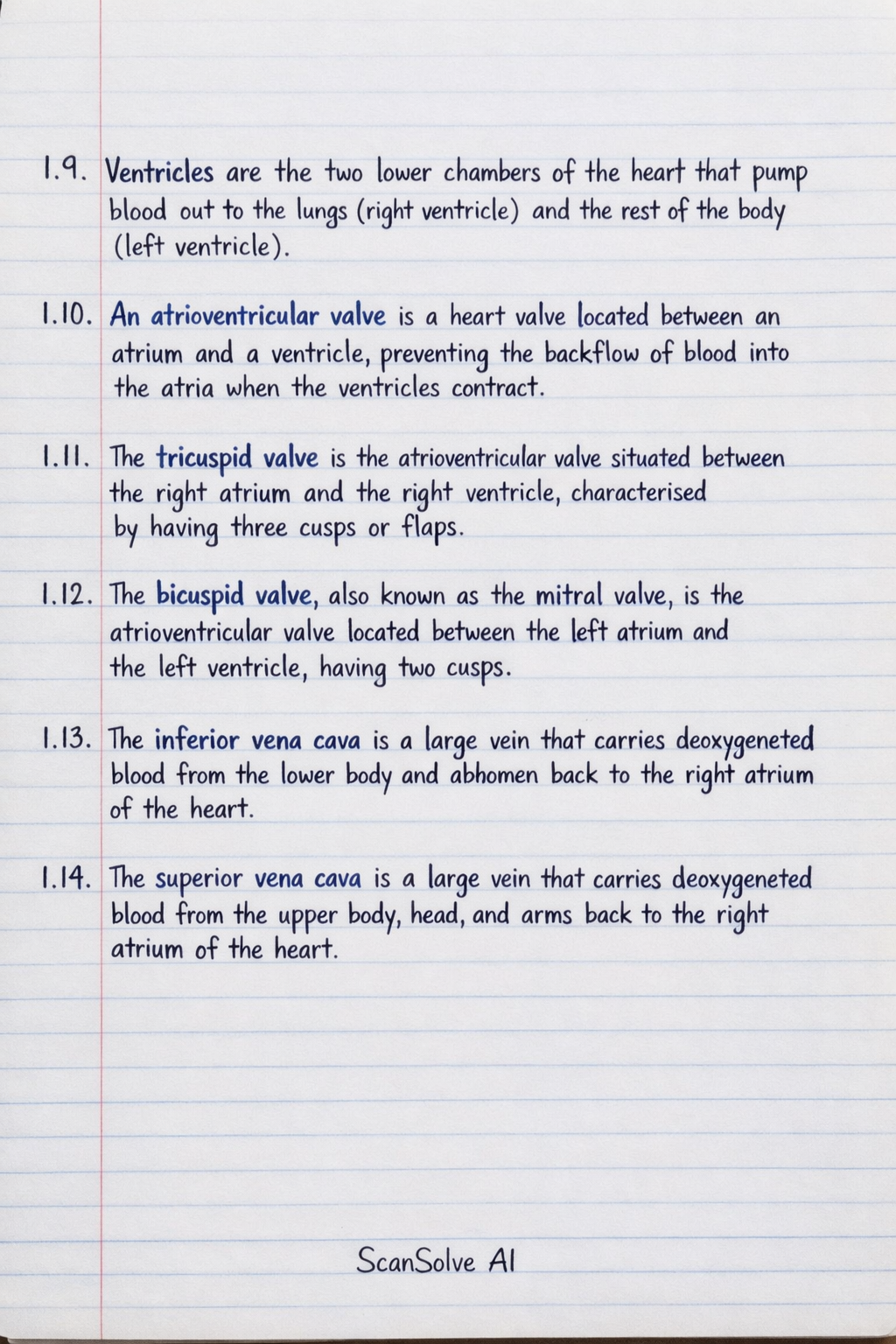
1.9. Ventricles are the two lower chambers of the heart that pump blood out to the lungs (right ventricle) and the rest of the body (left ventricle).
1.10. An atrioventricular valve is a heart valve located between an atrium and a ventricle, preventing the backflow of blood into the atria when the ventricles contract.
1.11. The tricuspid valve is the atrioventricular valve situated between the right atrium and the right ventricle, characterized by having three cusps or flaps.
1.12. The bicuspid valve, also known as the mitral valve, is the atrioventricular valve located between the left atrium and the left ventricle, having two cusps.
1.13. The inferior vena cava is a large vein that carries deoxygenated blood from the lower body and abdomen back to the right atrium of the heart.
1.14. The superior vena cava is a large vein that carries deoxygenated blood from the upper body, head, and arms back to the right atrium of the heart.
1.15. The pulmonary artery is an artery that carries deoxygenated blood from the right ventricle of the heart to the lungs for oxygenation.
1.16. A pulmonary vein is a vein that carries oxygenated blood from the lungs back to the left atrium of the heart.
1.17. The aorta is the largest artery in the body, originating from the left ventricle and distributing oxygenated blood to all parts of the body except the lungs.
1.18. Atrial systole is the contraction phase of the atria, which pushes blood into the ventricles.
1.19. Ventricular systole is the contraction phase of the ventricles, which pumps blood into the pulmonary artery and the aorta.
1.20. Diastole is the relaxation phase of the heart chambers, during which they fill with blood from the atria or veins.
Still stuck on this one?
Ask a follow-up, and the answer starts from this question.
More Biology Questions
Handwritten Step-by-Step Solution
Get this as a handwritten image on WhatsApp — like a tutor wrote it for you.
Try on WhatsApp