

This biology question covers important biological concepts and processes. The step-by-step explanation below helps you understand the underlying mechanisms and reasoning.
ScanSolve AI Answer
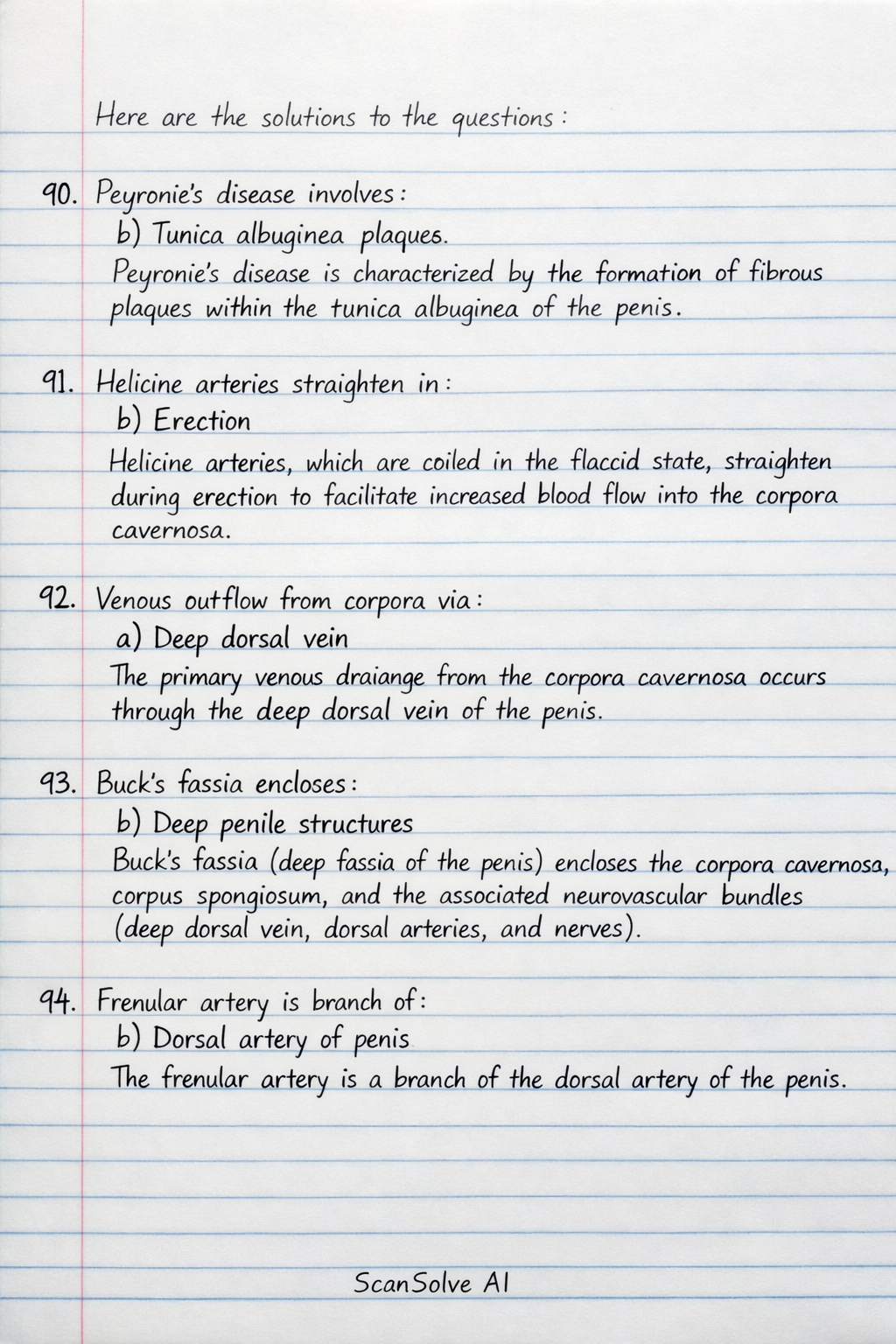
Here are the solutions to the questions: 90. Peyronie's disease involves: b) Tunica albuginea plaques Peyronie's disease is characterized by the formation of fibrous plaques within the tunica albuginea of the penis. 91. Helicine arteries straighten in: b) Erection Helicine arteries, which are coiled in the flaccid state, straighten during erection to facilitate increased blood flow into the corpora cavernosa. 92. Venous outflow from corpora via: a) Deep dorsal vein The primary venous drainage from the corpora cavernosa occurs through the deep dorsal vein of the penis. 93. Buck's fascia encloses: b) Deep penile structures Buck's fascia (deep fascia of the penis) encloses the corpora cavernosa, corpus spongiosum, and the associated neurovascular bundles (deep dorsal vein, dorsal arteries, and nerves). 94. Frenular artery is branch of: b) Dorsal artery of penis The frenular artery is a branch of the dorsal artery of the penis. 95. Lymph of glans drains mainly to: a) Deep inguinal Lymphatic drainage from the glans penis primarily goes to the deep inguinal lymph nodes. 96. Skin of penis lymph drains to: b) Superficial inguinal Lymphatic drainage from the skin of the penis (and scrotum) primarily goes to the superficial inguinal lymph nodes. 97. Deep dorsal vein communicates with: a) Prostatic plexus The deep dorsal vein of the penis drains into the prostatic venous plexus. 98. Circumcision removes: c) Prepuce Circumcision is the surgical removal of the prepuce (foreskin) of the penis. 99. Sensory innervation of glans via: b) Dorsal nerve of penis The glans penis receives its primary sensory innervation from the dorsal nerve of the penis, a branch of the pudendal nerve. 100. Artery to bulb supplies: b) Corpus spongiosum/proximal urethra The artery to the bulb of the penis supplies the bulb of the penis, the proximal part of the corpus spongiosum, and the urethra. 101. Testicular artery accompanies: b) Pampiniform plexus The testicular artery descends within the spermatic cord alongside the pampiniform plexus of veins, the vas deferens, and nerves. 102. Cremasteric artery arises from: a) Inferior epigastric The cremasteric artery is a branch of the inferior epigastric artery. 103. External pudendal arteries supply: b) Scrotal skin The external pudendal arteries supply the skin of the scrotum and the superficial perineum. 104. Internal pudendal gives all EXCEPT: c) Testicular artery The internal pudendal artery gives rise to the deep artery of the penis, dorsal artery of the penis, and perineal artery. The testicular artery arises directly from the abdominal aorta. 105. Prostatic venous plexus drains to: b) Internal iliac The prostatic venous plexus drains primarily into the internal iliac veins.