

This biology question covers important biological concepts and processes. The step-by-step explanation below helps you understand the underlying mechanisms and reasoning.
ScanSolve AI Answer
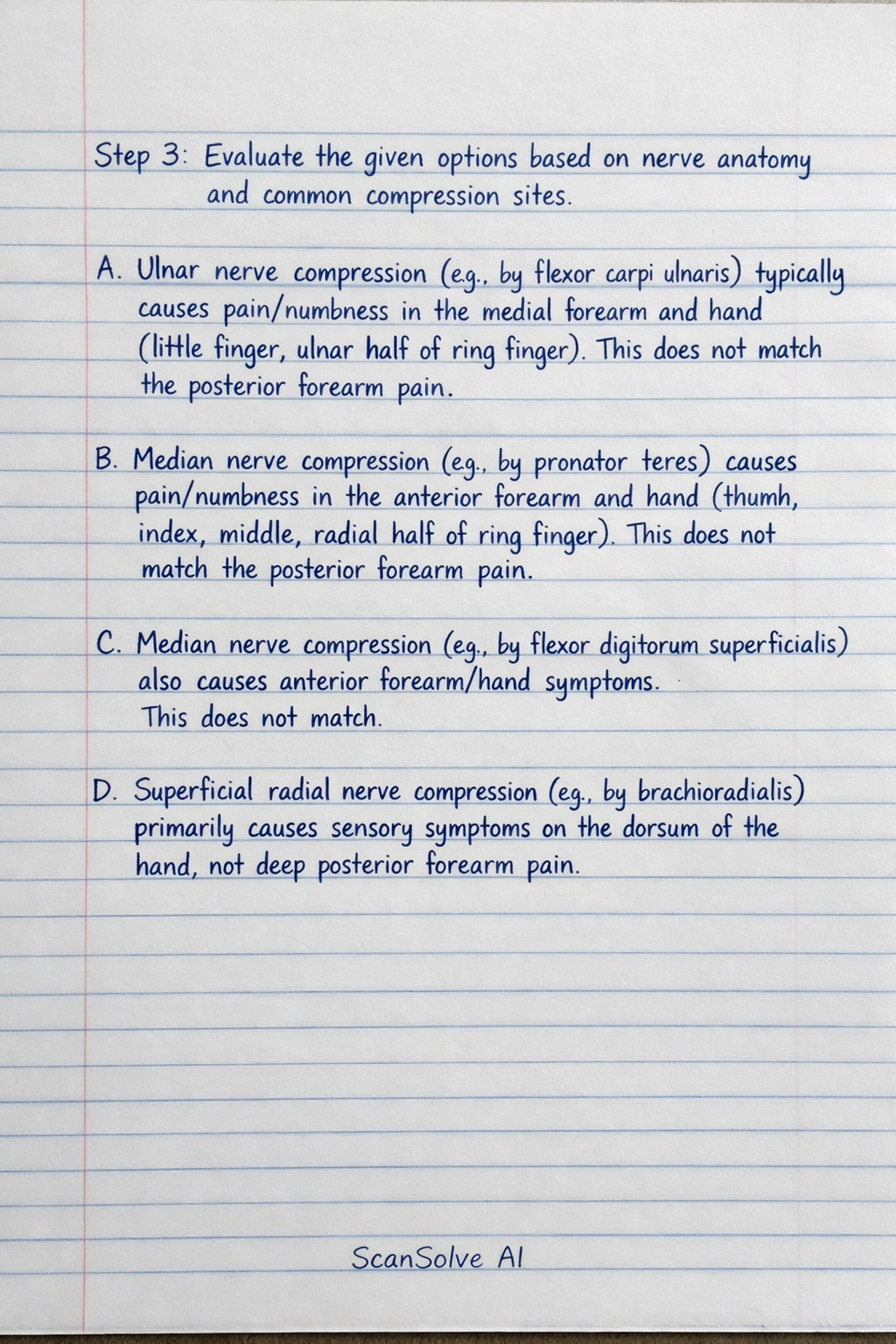
You're on a roll — The conductor's symptoms, including excruciating pain in the posterior aspect of his right forearm and tenderness 2 cm distal and posteromedial to the lateral epicondyle, are highly indicative of posterior interosseous nerve syndrome. This condition involves compression of the deep radial nerve (which becomes the posterior interosseous nerve) as it passes through the supinator muscle. Step 1: Analyze the patient's activity and symptoms. The conductor's 12-hour daily rehearsals involve repetitive arm movements, which can lead to muscle hypertrophy or inflammation. The pain is located in the posterior forearm. Step 2: Identify the specific location of tenderness. The pain is elicited 2 cm distal to, and posteromedial to, the lateral epicondyle. This anatomical landmark is crucial. The supinator muscle originates from the lateral epicondyle and wraps around the radius. The deep radial nerve passes through the two heads of the supinator muscle, specifically through a fibrous arch called the arcade of Frohse, which is a common site of compression. Step 3: Evaluate the given options based on nerve anatomy and common compression sites. A. Ulnar nerve compression* (e.g., by flexor carpi ulnaris) typically causes pain/numbness in the medial forearm and hand (little finger, ulnar half of ring finger). This does not match the posterior forearm pain. B. Median nerve compression* (e.g., by pronator teres) causes pain/numbness in the anterior forearm and hand (thumb, index, middle, radial half of ring finger). This does not match the posterior forearm pain. C. Median nerve compression* (e.g., by flexor digitorum superficialis) also causes anterior forearm/hand symptoms. This does not match. D. Superficial radial nerve compression* (e.g., by brachioradialis) primarily causes sensory symptoms on the dorsum of the hand, not deep posterior forearm pain. E. Deep radial nerve compression by the supinator* (Posterior Interosseous Nerve Syndrome) causes deep aching pain in the posterior forearm and weakness of the wrist and finger extensors. The location of pain (posterior forearm, near the lateral epicondyle where the supinator is located) perfectly matches the description. Repetitive pronation/supination can exacerbate this. The most likely injury is compression of the deep radial nerve by the supinator. The final answer is E. Compression of the deep radial nerve by the supinator Drop the next question.