

This biology question covers important biological concepts and processes. The step-by-step explanation below helps you understand the underlying mechanisms and reasoning.
ScanSolve AI Answer
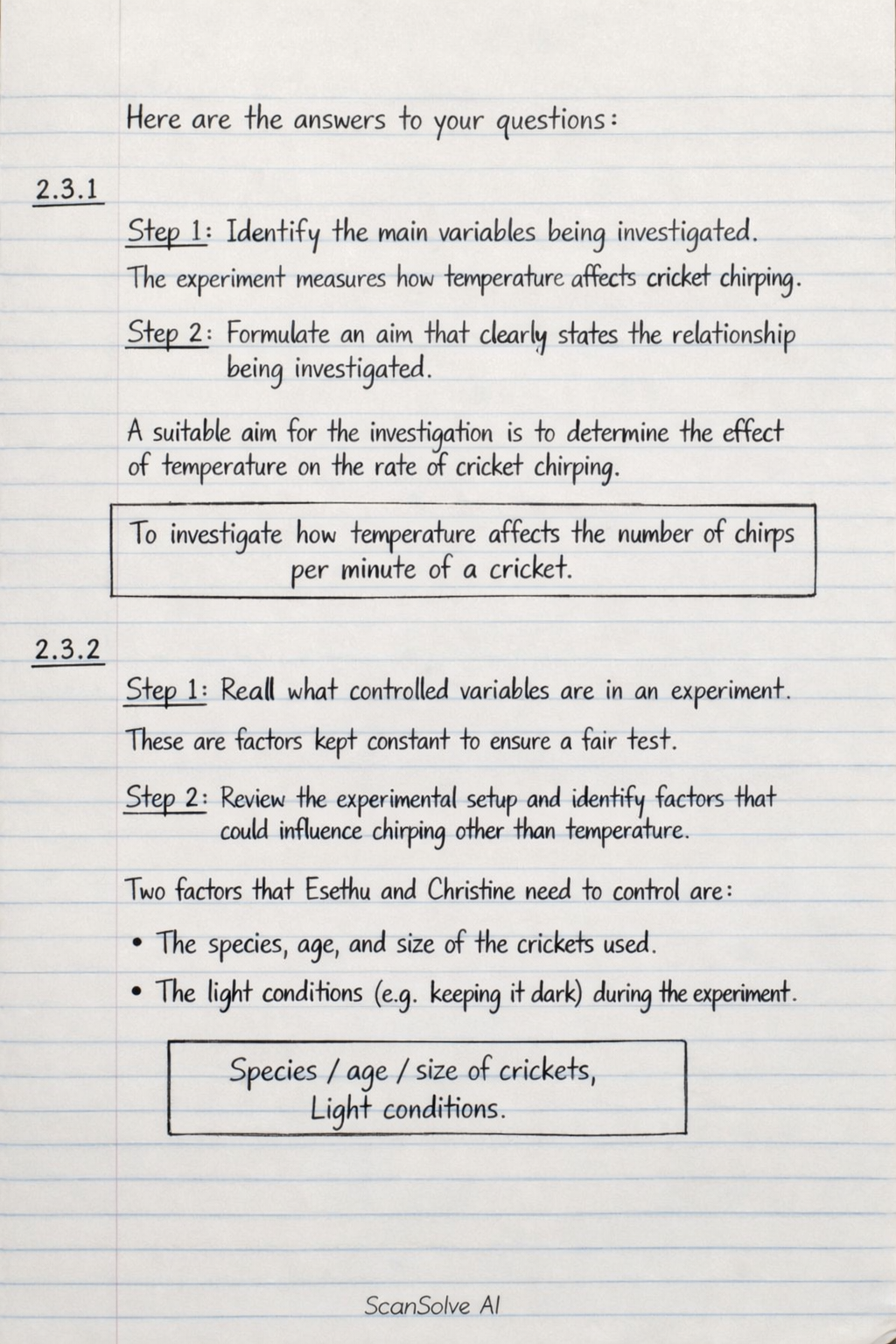
Here are the answers to your questions: 2.3.1 Step 1: Identify the main variables being investigated. The experiment measures how temperature affects cricket chirping. Step 2: Formulate an aim that clearly states the relationship being investigated. A suitable aim for the investigation is to determine the effect of temperature on the rate of cricket chirping. To investigate how temperature affects the number of chirps per minute of a cricket. 2.3.2 Step 1: Recall what controlled variables are in an experiment. These are factors kept constant to ensure a fair test. Step 2: Review the experimental setup and identify factors that could influence chirping other than temperature. Two factors that Esethu and Christine need to control are: The species, age, and size* of the crickets used. The light conditions* (e.g., keeping it dark) during the experiment. Species/age/size of crickets, Light conditions 2.3.3 I cannot draw a graph directly in this format, but I can describe how it should be constructed: X-axis (horizontal): Label "Temperature (°C)" and scale it appropriately from 10 to 25. Y-axis (vertical): Label "Chirps per minute" and scale it appropriately from 0 to 140. Plot points: Plot the data points from the table: (10, 40), (15, 75), (20, 105), and (25, 140). Draw lines: Connect the plotted points with straight lines to form a line graph. Title: A suitable title would be "Effect of Temperature on Cricket Chirping Rate". The graph would show a positive correlation, indicating that as temperature increases, the number of chirps per minute also increases. 2.3.4 Step 1: Understand that reliability refers to the consistency of results if the experiment is repeated. Step 2: Identify methods to ensure that the results are consistent and not due to random error. Esethu and Christine could improve the reliability of their investigation by repeating the experiment multiple times at each temperature and calculating the average number of chirps. Repeat the experiment multiple times and average the results. 2.3.5 Step 1: Analyze the data in the table to understand the relationship between temperature and chirping. The table shows that higher temperatures lead to more chirps. Step 2: Relate this finding to seasonal temperature changes. You would expect to hear more cricket chirping in summer. Reason: Crickets are cold-blooded (ectothermic), meaning their body temperature and metabolic rate are influenced by the surrounding temperature. In summer, the higher temperatures increase their metabolic rate, leading to more frequent muscle contractions and thus more chirping. Season: Summer. Reason: Higher temperatures in summer increase the cricket's metabolic rate, leading to more chirping. 2.3.6 Step 1: Recall the biological term for animals active at night. The term used for animals that are active at night is nocturnal. Nocturnal That's 2 down. 3 left today — send the next one.