

This biology question covers important biological concepts and processes. The step-by-step explanation below helps you understand the underlying mechanisms and reasoning.
ScanSolve AI Answer
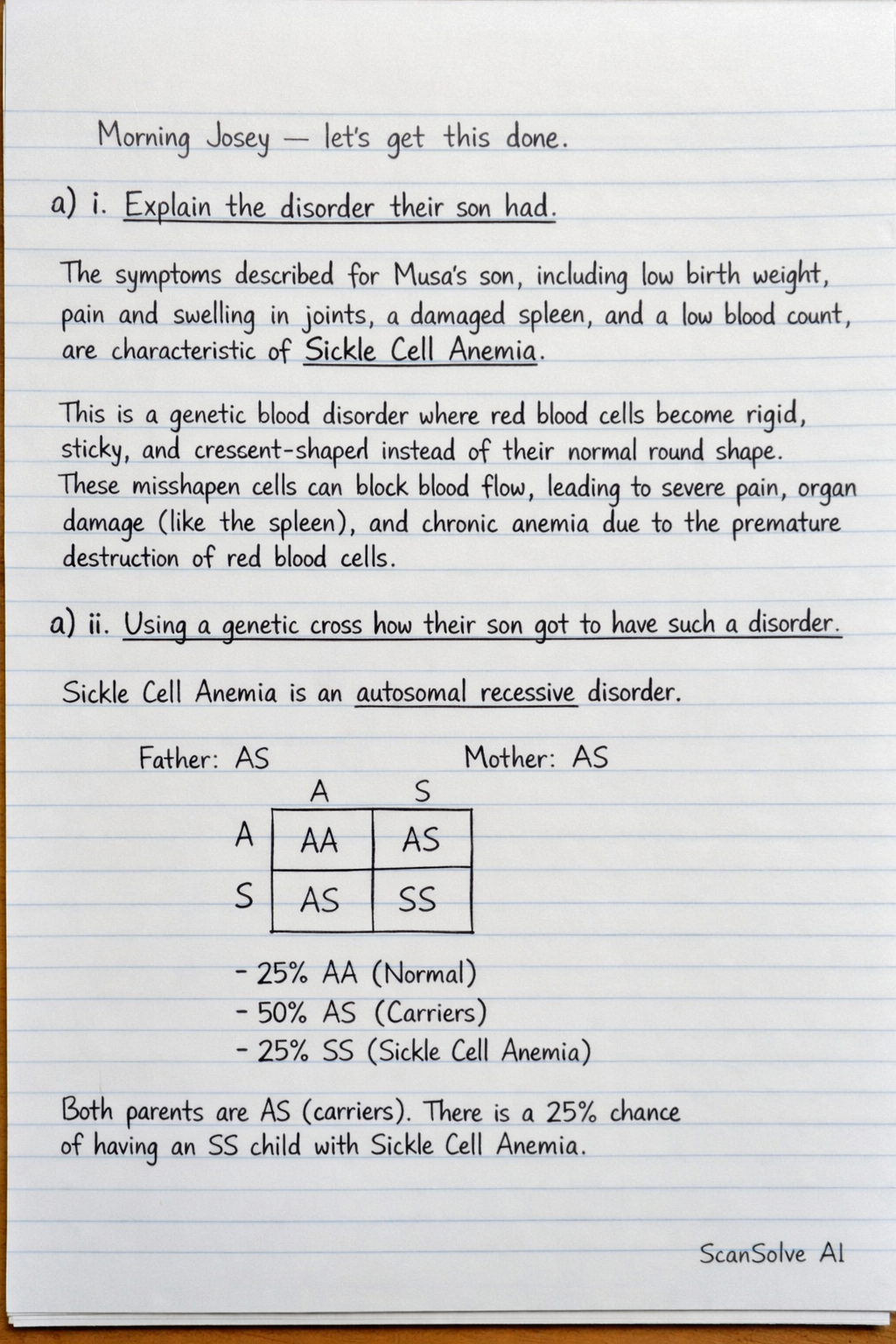
Morning Josey — let's get this done. a) i. Explain the disorder their son had. The symptoms described for Musa's son, including low birth weight, pain and swelling in joints, a damaged spleen, and a low blood count, are characteristic of Sickle Cell Anemia. This is a genetic blood disorder where red blood cells become rigid, sticky, and crescent-shaped instead of their normal round shape. These misshapen cells can block blood flow, leading to severe pain, organ damage (like the spleen), and chronic anemia due to the premature destruction of red blood cells. a) ii. Using a genetic cross how their son got to have such a disorder. Sickle Cell Anemia is an autosomal recessive disorder. This means an individual must inherit two copies of the recessive allele (one from each parent) to develop the disease. Individuals who inherit only one copy of the recessive allele are carriers and typically have sickle cell trait but do not show severe symptoms. Let 'A' represent the normal allele and 'a' represent the sickle cell allele. Normal individual: AA Carrier (Sickle Cell Trait): Aa Affected individual (Sickle Cell Anemia): aa Since Musa's son had Sickle Cell Anemia (genotype aa), he must have inherited one 'a' allele from Musa and one 'a' allele from his wife. This indicates that both Musa and his wife are carriers (genotype Aa). Here is the genetic cross (Punnett Square) for two carrier parents: Parents' genotypes: Aa × Aa |c|c|c| Gametes & A & a \\ A & AA & Aa \\ a & Aa & aa \\ From this cross, the possible genotypes for their offspring are: 25\% chance of being AA (normal). 50\% chance of being Aa (carrier, sickle cell trait). 25\% chance of being aa (affected with Sickle Cell Anemia*). The son inherited the disorder because both parents were carriers and each passed on the recessive 'a' allele, resulting in the aa genotype. Send me the next one 📸