
This biology question covers important biological concepts and processes. The step-by-step explanation below helps you understand the underlying mechanisms and reasoning.
ScanSolve AI Answer
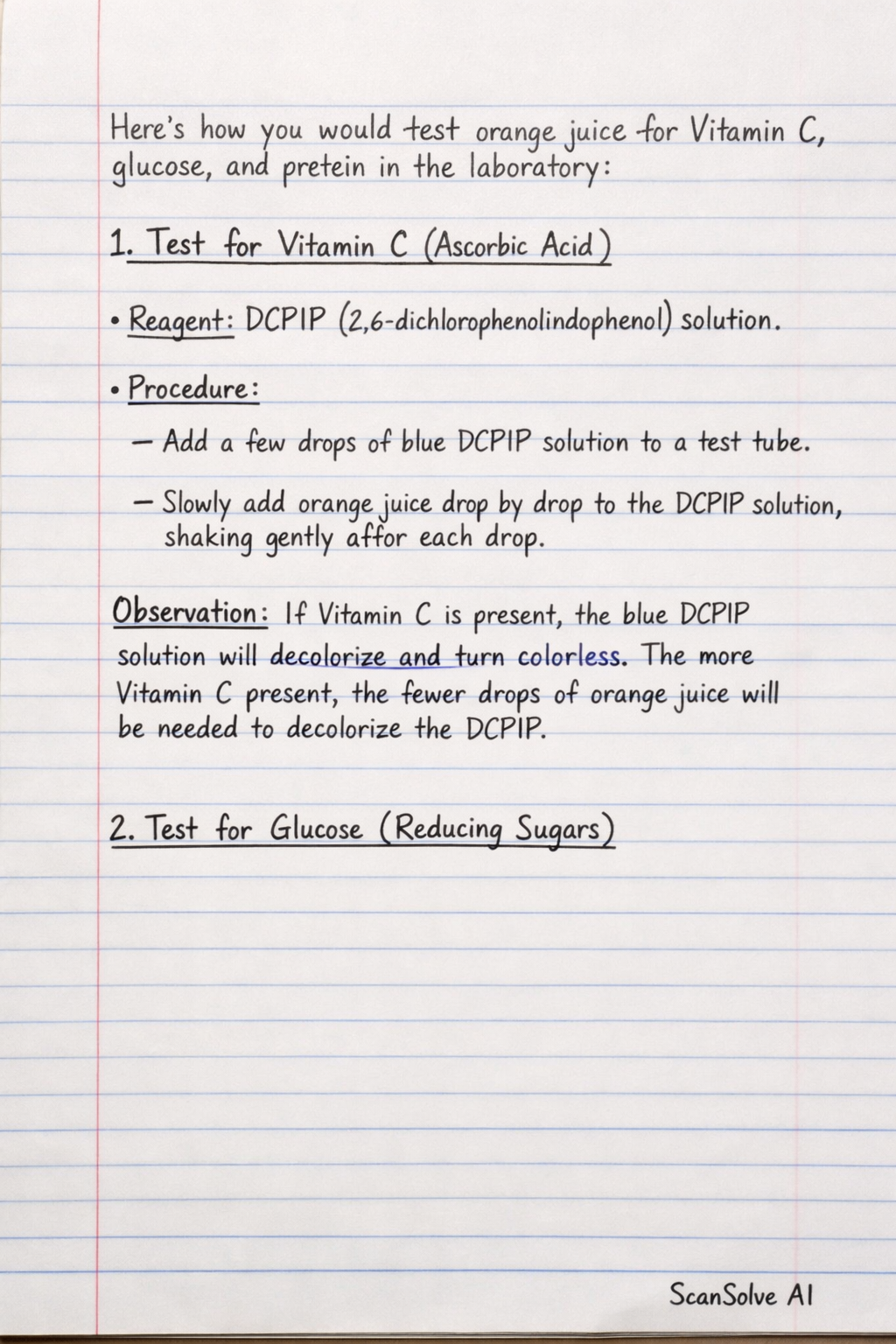
Here's how you would test orange juice for Vitamin C, glucose, and protein in the laboratory: 1. Test for Vitamin C (Ascorbic Acid) Reagent: DCPIP (2,6-dichlorophenolindophenol) solution. Procedure: • Add a few drops of blue DCPIP solution to a test tube. • Slowly add orange juice drop by drop to the DCPIP solution, shaking gently after each drop. Observation: If Vitamin C is present, the blue DCPIP solution will decolorize and turn colorless. The more Vitamin C present, the fewer drops of orange juice will be needed to decolorize the DCPIP. 2. Test for Glucose (Reducing Sugars) Reagent: Benedict's solution. Procedure: • Add about 2 mL of orange juice to a test tube. • Add an equal volume (about 2 mL) of Benedict's solution to the test tube. • Heat the test tube gently in a hot water bath (around 80^ C) for 5-10 minutes. Observation: If glucose (a reducing sugar) is present, the blue Benedict's solution will change color, forming a precipitate that can range from green, yellow, orange, to brick-red, depending on the concentration of glucose. 3. Test for Protein Reagents: Sodium hydroxide (NaOH) solution and copper(II) sulfate (CuSO_4) solution. Procedure: • Add about 2 mL of orange juice to a test tube. • Add an equal volume (about 2 mL) of sodium hydroxide solution to the test tube and mix well. • Add a few drops of dilute copper(II) sulfate solution to the mixture and shake gently. Observation: If protein is present, the solution will turn violet or purple. If no protein is present, the solution will remain blue (the color of the copper(II) sulfate). That's 2 down. 3 left today — send the next one.