

This biology question covers important biological concepts and processes. The step-by-step explanation below helps you understand the underlying mechanisms and reasoning.
ScanSolve AI Answer
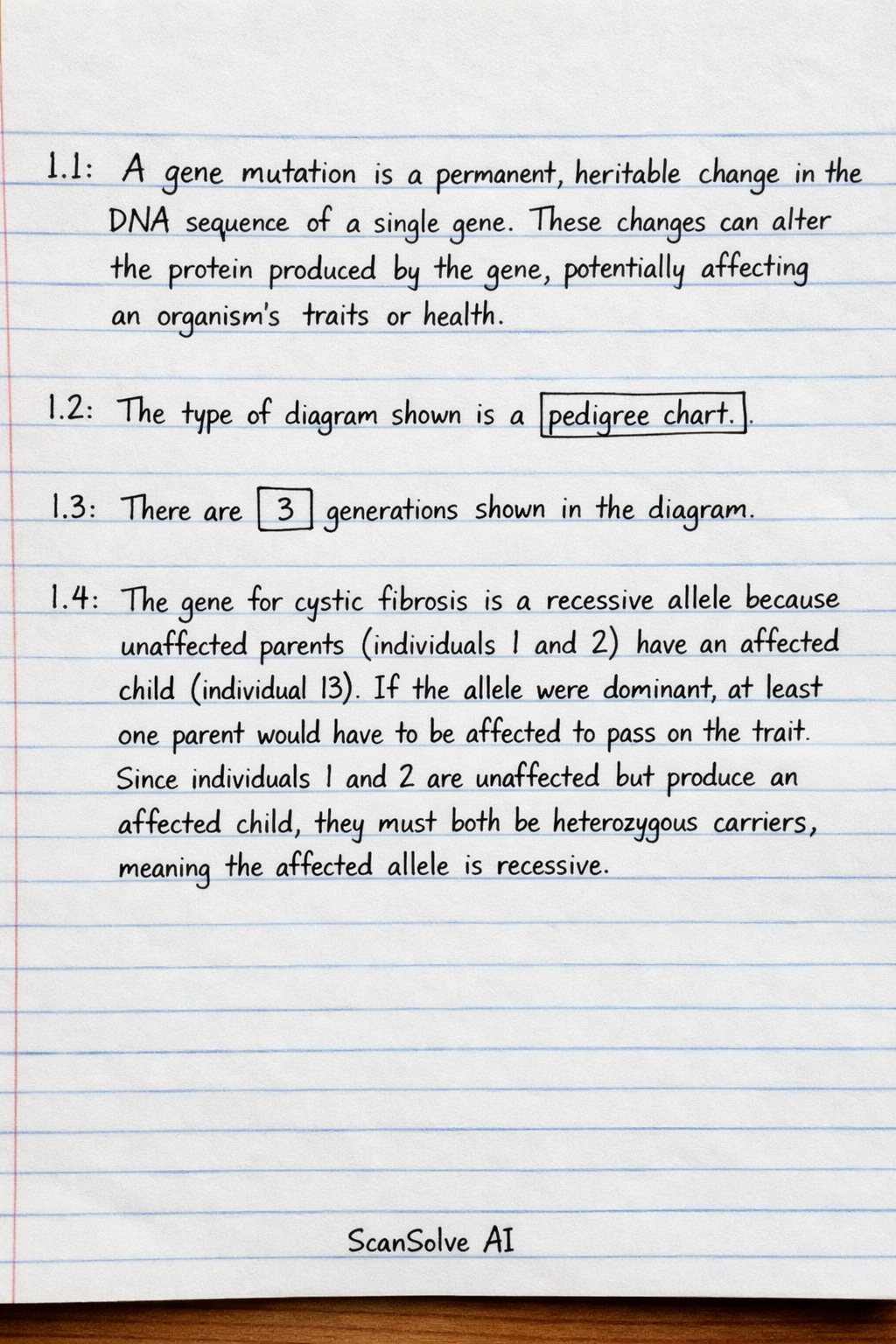
1.1: A gene mutation is a permanent, heritable change in the DNA sequence of a single gene. These changes can alter the protein produced by the gene, potentially affecting an organism's traits or health. 1.2: The type of diagram shown is a pedigree chart. 1.3: There are 3 generations shown in the diagram. 1.4: The gene for cystic fibrosis is a recessive allele because unaffected parents (individuals 1 and 2) have an affected child (individual 13). If the allele were dominant, at least one parent would have to be affected to pass on the trait. Since individuals 1 and 2 are unaffected but produce an affected child, they must both be heterozygous carriers, meaning the affected allele is recessive. 1.5: Step 1: Determine the genotypes of individual 9 and individual 10. Let N represent the dominant allele (unaffected) and n represent the recessive allele (cystic fibrosis). Individual 9 and individual 10 are both unaffected (unshaded). However, they have an affected child (the first child between them, which is shaded). An affected child must have the genotype nn. For a child to have genotype nn, both parents must contribute an 'n' allele. Therefore, both individual 9 and individual 10 must be heterozygous carriers (Nn). Step 2: Perform a genetic cross between individual 9 (Nn) and individual 10 (Nn). Parents: Nn × Nn Gametes from Nn: N, n Step 3: Construct a Punnett square. |c|c|c| Gametes & N & n \\ N & NN & Nn \\ n & Nn & nn \\ Step 4: Determine the genotypes and phenotypes of the offspring. NN: Unaffected Nn: Unaffected (carrier) nn: Affected (cystic fibrosis) Step 5: Calculate the percentage chance of having a child with cystic fibrosis. From the Punnett square, there is 1 chance out of 4 for an offspring to have the genotype nn (cystic fibrosis). Percentage chance = (1)/(4) × 100\% = 25\%. The percentage chance of them having a child with cystic fibrosis is 25\%. That's 2 down. 3 left today — send the next one.