
We read your photo as:
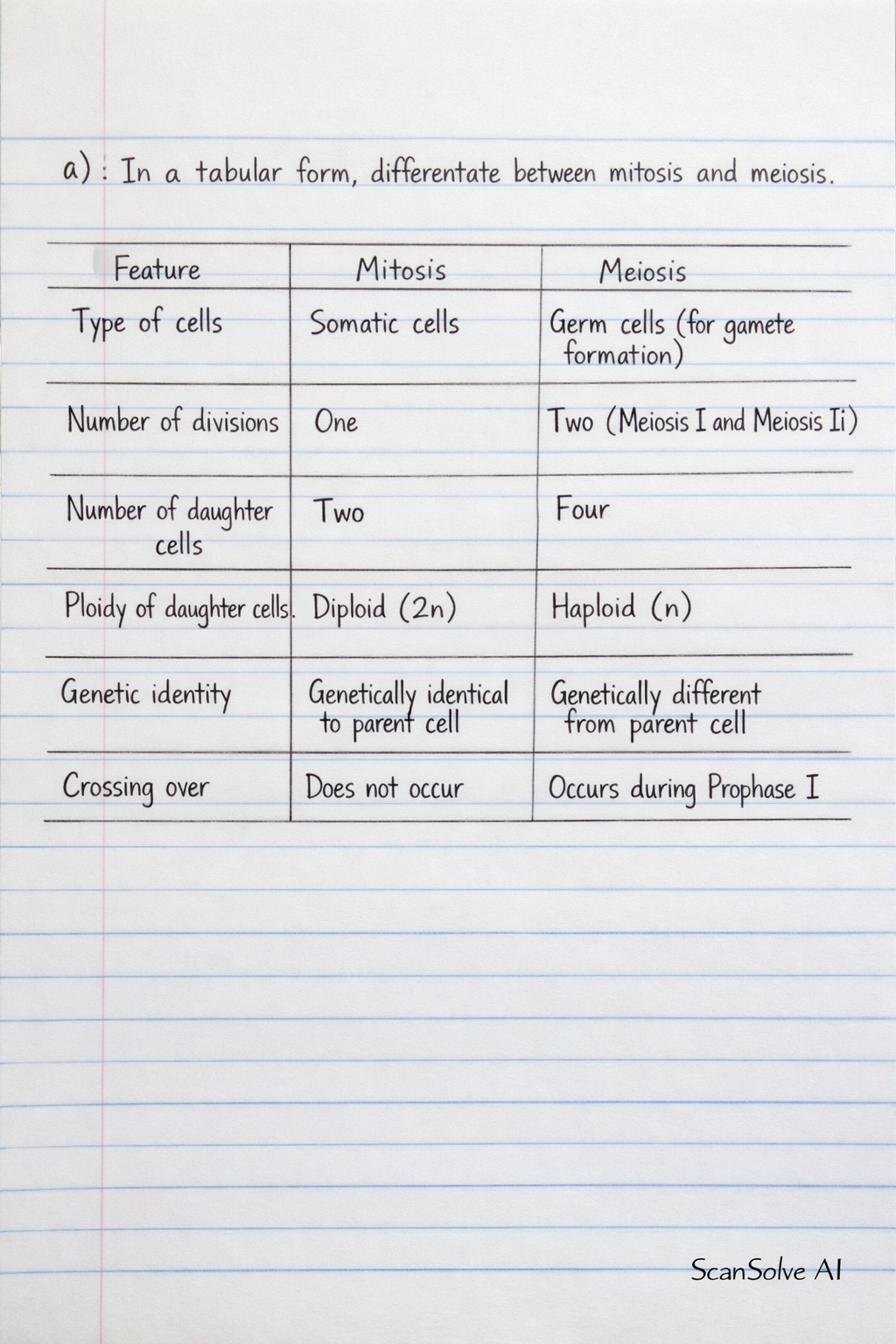
A) In a tabular form, differentiate between mitosis and meiosis.
ScanSolve AI Answer
Step-by-step solution
3 stepsPart a
In a tabular form, differentiate between mitosis and meiosis.
| Feature | Mitosis | Meiosis |
|---|---|---|
| Type of cells | Somatic cells | Germ cells (for gamete formation) |
| Number of divisions | One | Two (Meiosis I and Meiosis II) |
| Number of daughter cells | Two | Four |
| Ploidy of daughter cells | Diploid () | Haploid () |
| Genetic identity | Genetically identical to parent cell | Genetically different from parent cell |
| Crossing over | Does not occur | Occurs during Prophase I |
| Purpose | Growth, repair, asexual reproduction | Sexual reproduction (gamete formation), genetic variation |
Part b
State the secondary sexual characteristics in human females.
- Development of breasts.
- Widening of hips.
- Growth of pubic and axillary (armpit) hair.
- Onset of menstruation (menarche).
- Increase in body fat deposition, particularly around hips and thighs.
Part c· 3 steps
Using genetic symbols and diagrams, determine the genotypes and phenotypes of the offspring of a man and a woman who both have the sickle cell trait (heterozygous).
Let represent the allele for normal hemoglobin.
Let represent the allele for sickle cell hemoglobin.
Parents' genotypes: Both are heterozygous for the sickle cell trait, so their genotype is .
Determine the gametes produced by each parent.
Each parent () can produce two types of gametes: and .
Construct a Punnett square to show the possible genotypes of the offspring.
Determine the genotypes and phenotypes of the offspring.
-
Genotypes:
- : 1 out of 4, or 25%
- : 2 out of 4, or 50%
- : 1 out of 4, or 25%
-
Phenotypes:
- Normal (no sickle cell trait or disease): - 25%
- Sickle Cell Trait (carrier, generally healthy): - 50%
- Sickle Cell Anemia (affected): - 25%
-
Still stuck on this one?
Ask a follow-up, and the answer starts from this question.
More Biology Questions
Handwritten Step-by-Step Solution
Get this as a handwritten image on WhatsApp — like a tutor wrote it for you.
Try on WhatsApp