
We read your photo as:
A) Make a large labeled diagram of the mammalian ear. b) Trace the events that occur in the enable you to hear the sound of morning vehicles outdoors. c) How is the pitch of the sound determined? d) D
ScanSolve AI Answer
Here are the solutions to the questions:
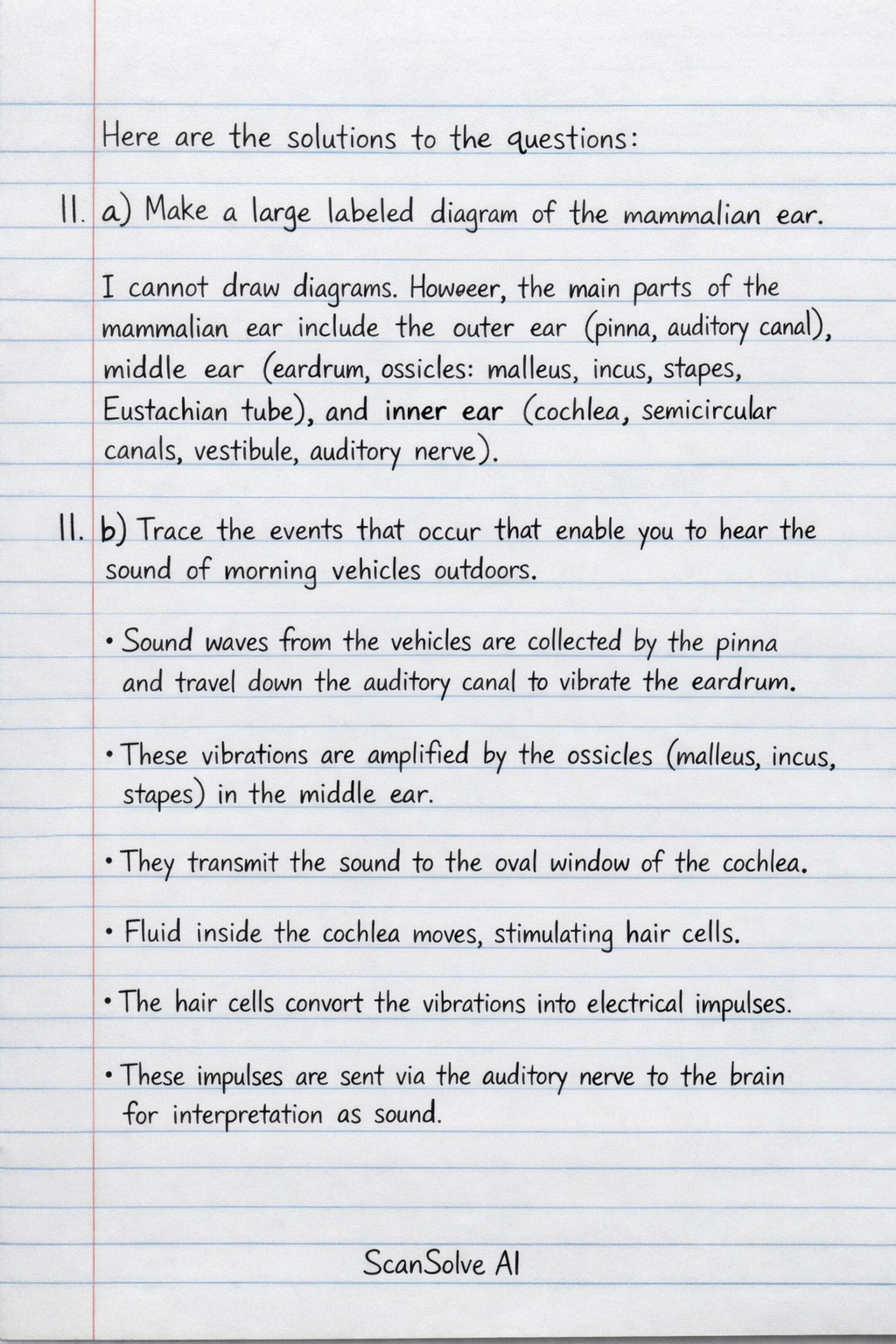
11. a) Make a large labeled diagram of the mammalian ear.
I cannot draw diagrams. However, the main parts of the mammalian ear include the outer ear (pinna, auditory canal), middle ear (eardrum, ossicles: malleus, incus, stapes, Eustachian tube), and inner ear (cochlea, semicircular canals, vestibule, auditory nerve).
11. b) Trace the events that occur in the enable you to hear the sound of morning vehicles outdoors.
Sound waves from the vehicles are collected by the pinna and travel down the auditory canal to vibrate the eardrum. These vibrations are amplified by the ossicles (malleus, incus, stapes) in the middle ear, which then transmit them to the oval window of the cochlea. Fluid inside the cochlea moves, stimulating hair cells that convert mechanical vibrations into electrical impulses. These impulses are sent via the auditory nerve to the brain for interpretation as sound.
11. c) How is the pitch of the sound determined?
The pitch of a sound is determined by the frequency of the sound waves. High-frequency sounds cause vibrations near the base of the basilar membrane in the cochlea, while low-frequency sounds cause vibrations near the apex. The brain interprets the location of these vibrations as different pitches.
11. d) Describe the causes of two named ear defects.
- Deafness: Can be caused by damage to the eardrum, ossicles (conductive deafness), or to the cochlea or auditory nerve (sensorineural deafness). Causes include loud noise exposure, infections, aging, or genetic factors.
- Tinnitus: Characterized by a ringing, buzzing, or hissing sound in the ears without an external source. It is often caused by damage to the hair cells in the inner ear, exposure to loud noise, earwax blockage, or certain medications.
12. a) What is a nerve impulse?
A nerve impulse, also known as an action potential, is a rapid, temporary reversal of the electrical potential across the membrane of a neuron. It is an electrochemical signal that travels along the axon, transmitting information.
12. b) Describe how a nerve impulse is initiated along a neuron.
A nerve impulse is initiated when a stimulus causes the membrane potential to reach a threshold. This triggers the rapid opening of voltage-gated sodium channels, leading to an influx of positive sodium ions into the cell, causing depolarization. If the depolarization reaches the threshold, an action potential is generated and propagates along the axon.
12. c) How can this impulse be transmitted across a synapse?
When a nerve impulse reaches the axon terminal of a presynaptic neuron, it triggers the release of neurotransmitters into the synaptic cleft. These neurotransmitters diffuse across the cleft and bind to receptors on the postsynaptic neuron's membrane, causing ion channels to open and generating a new electrical signal (either excitatory or inhibitory) in the postsynaptic neuron.
12. d) Differentiate between nervous and hormonal coordination.
The nervous system uses electrical impulses and neurotransmitters for rapid, short-lived, and localized responses. The endocrine system uses chemical messengers (hormones) transported via the bloodstream for slower, longer-lasting, and widespread effects.
13. a) Define the following:
(i) Vernalisation: The process by which plants require a period of cold temperature exposure to induce or accelerate flowering.
(ii) Photoperiodism: The physiological response of organisms, especially plants, to the length of day or night (photoperiod).
13. b) Describe the effects of photoperiods on plants.
Photoperiods significantly influence various plant processes, most notably flowering. Short-day plants flower when the night period is long, while long-day plants flower when the night period is short. Photoperiods also affect seed germination, dormancy, and the formation of tubers and bulbs.
13. c) How is the speed of nervous impulse across the nerve fibre affected by
(i) Diameter of axon: A larger axon diameter increases the speed of nerve impulse transmission because there is less resistance to the flow of ions, allowing the depolarization to spread more quickly.
(ii) Myelin sheath: The myelin sheath acts as an electrical insulator around the axon. It allows the impulse to "jump" from one Node of Ranvier to the next (saltatory conduction), significantly increasing the speed of transmission compared to unmyelinated axons.
13. d) Briefly describe the transmission of a nervous impulse across the synapse.
(See 12.c) for the answer)
14. a) Make a fully labelled drawing of the cross section of the human eye.
I cannot draw diagrams. However, the main parts of the human eye include the cornea, iris, pupil, lens, ciliary body, suspensory ligaments, retina (containing rods and cones), fovea, optic nerve, choroid, and sclera.
14. b) Identify the problems involved in the following eye defects and their methods of correction
(i) Long sightedness (hypermetropia): The eyeball is too short or the lens is too flat, causing light to focus behind the retina. Correction involves using convex lenses to converge light rays before they enter the eye.
(ii) Short sightedness (myopia): The eyeball is too long or the lens is too curved, causing light to focus in front of the retina. Correction involves using concave lenses to diverge light rays before they enter the eye.
14. c) Explain the mechanism of color vision in humans.
Color vision in humans is primarily mediated by three types of cone cells in the retina, each containing a different photopigment sensitive to specific wavelengths of light: red, green, and blue. The brain interprets the relative stimulation of these three cone types to perceive a wide spectrum of colors.
15. a) (i) What is accommodation with respect to vision?
Accommodation is the process by which the eye's lens changes shape to adjust its focal length, allowing the eye to focus on objects at different distances, bringing them into sharp focus on the retina.
15. a) (ii) Describe how mammals regulate the amount of light entering the eye.
Mammals regulate the amount of light entering the eye through the pupillary reflex. The iris, a pigmented muscular diaphragm, controls the size of the pupil. In bright light, circular muscles in the iris contract, constricting the pupil to reduce light entry. In dim light, radial muscles contract, dilating the pupil to allow more light in.
15. b) How is colour blindness brought about in man?
Color blindness is typically a hereditary condition, most commonly an X-linked recessive trait, meaning it is more prevalent in males. It results from a deficiency or absence of one or more types of cone cells (photoreceptors) in the retina, particularly those sensitive to red or green light.
15. c) Differentiate between rods and cones.
- Rods: Are highly sensitive to dim light and are responsible for black-and-white vision (scotopic vision) and peripheral vision. They are more numerous and concentrated in the periphery of the retina.
- Cones: Are less sensitive to light but are responsible for color vision (photopic vision) and high visual acuity. They are concentrated in the fovea (center of the retina).
16. a) Outline the sequence of events that occur during the formation of a nerve impulse.
(See 12.b) for the answer)
16. b) How are nerve impulses transmitted from one neuron to another?
(See 12.c) for the answer)
16. c) Briefly explain how the hypothalamus controls the pituitary gland in coordination.
The hypothalamus controls the pituitary gland through the release of specific releasing hormones and inhibiting hormones. These hormones travel through a portal system to the anterior pituitary, stimulating or inhibiting the secretion of its own hormones. The hypothalamus also produces ADH and oxytocin, which are stored and released by the posterior pituitary.
17. a) Describe the following processes that take place in the transmission of an impulse
(i) Resting potential: The electrical potential difference across the membrane of a neuron when it is not transmitting an impulse, typically around -70mV, maintained by the sodium-potassium pump and selective ion permeability.
(ii) Action potential: A rapid, transient depolarization and repolarization of the neuron's membrane potential, propagating as an electrical signal along the axon.
(iii) Threshold of a stimulus: The minimum intensity of a stimulus required to trigger an action potential in a neuron. If the stimulus does not reach this threshold, no action potential will be generated.
(iv) Repolarization: The process during an action potential where the membrane potential returns to its negative resting state. This occurs due to the inactivation of sodium channels and the opening of voltage-gated potassium channels, allowing potassium ions to flow out of the cell.
(v) Absolute refractory period: A brief period immediately following an action potential during which a neuron is completely unable to generate another action potential, regardless of the strength of the stimulus. This ensures unidirectional impulse propagation.
(vi) Saltatory conduction: The jumping of an action potential from one Node of Ranvier to the next along a myelinated axon. This significantly increases the speed of nerve impulse transmission.
17. b) Using suitable illustrations, describe the mechanism of impulse transmission across the synapse.
I cannot provide illustrations. However, the mechanism is as follows:
- An action potential arrives at the presynaptic terminal.
- This depolarizes the terminal membrane, opening voltage-gated calcium channels, allowing calcium ions to flow into the presynaptic neuron.
- The influx of calcium triggers the fusion of synaptic vesicles (containing neurotransmitters) with the presynaptic membrane.
- Neurotransmitters are released into the synaptic cleft via exocytosis.
- Neurotransmitters diffuse across the cleft and bind to specific receptors on the postsynaptic membrane.
- This binding causes ion channels on the postsynaptic membrane to open, leading to a change in its membrane potential (either depolarization, an excitatory postsynaptic potential, or hyperpolarization, an inhibitory postsynaptic potential).
- If the postsynaptic potential reaches the threshold, a new action potential is generated in the postsynaptic neuron.
- Neurotransmitters are then rapidly removed from the synaptic cleft (e.g., by enzymatic degradation or reuptake) to terminate the signal.
Still stuck on this one?
Ask a follow-up, and the answer starts from this question.
More Biology Questions
Handwritten Step-by-Step Solution
Get this as a handwritten image on WhatsApp — like a tutor wrote it for you.
Try on WhatsApp