
We read your photo as:
A neonate presents with anemia, jaundice, and hepatosplenomegaly. Lab results show elevated HbA2 and very low HbA. Explain the lab findings and diagnosis.
ScanSolve AI Answer
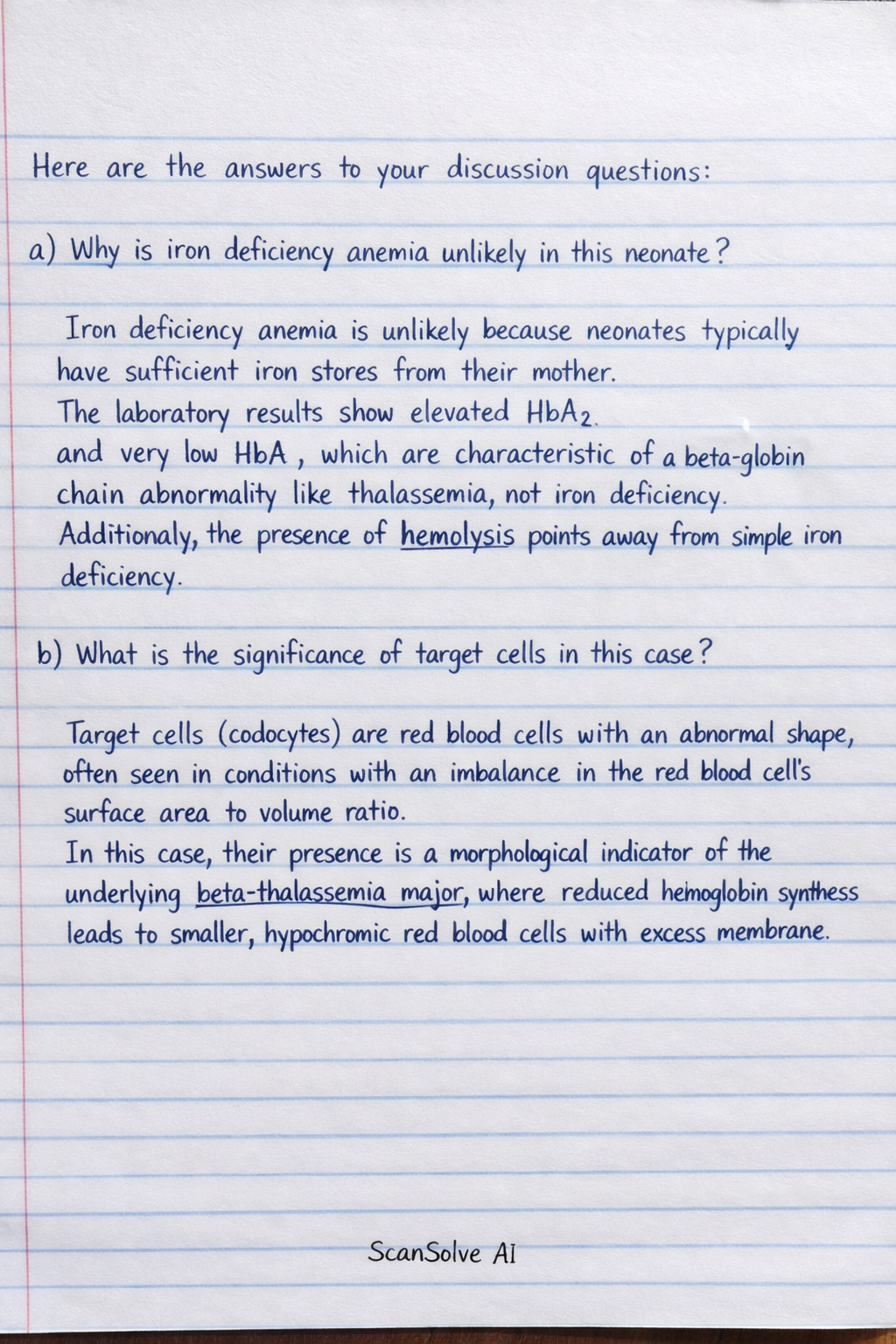
Here are the answers to your discussion questions:
a) Why is iron deficiency anemia unlikely in this neonate?
Iron deficiency anemia is unlikely because neonates typically have sufficient iron stores from their mother. The laboratory results show elevated HbA2 and very low HbA, which are characteristic of a beta-globin chain abnormality like thalassemia, not iron deficiency. Additionally, the presence of hemolysis points away from simple iron deficiency.
b) What is the significance of target cells in this case?
Target cells (codocytes) are red blood cells with an abnormal shape, often seen in conditions with an imbalance in the red blood cell's surface area to volume ratio. In this case, their presence is a morphological indicator of the underlying beta-thalassemia major, where reduced hemoglobin synthesis leads to smaller, hypochromic red blood cells with excess membrane.
c) How does hemoglobin electrophoresis confirm the diagnosis?
Hemoglobin electrophoresis confirms the diagnosis by revealing an abnormal pattern of hemoglobin types. In this neonate, the results show very high HbF (92%), very low HbA (3%), and elevated HbA2 (5%). This specific pattern—significantly reduced adult hemoglobin (HbA) and increased minor adult hemoglobin (HbA2) alongside persistent high fetal hemoglobin (HbF)—is diagnostic for beta-thalassemia major, indicating impaired beta-globin chain synthesis.
d) Why is the Coombs test important in this workup?
The Coombs test (Direct Antiglobulin Test) is important to rule out immune-mediated hemolysis as a cause or contributing factor to the severe anemia and hemolysis observed. While thalassemia itself is not an autoimmune condition, a negative Coombs test helps to exclude other causes of hemolysis, such as hemolytic disease of the newborn or autoimmune hemolytic anemia, thereby strengthening the diagnosis of thalassemia as the primary cause of non-immune hemolysis.
e) What additional molecular tests could be done to confirm the diagnosis?
To definitively confirm the diagnosis of beta-thalassemia major, molecular genetic testing of the HBB gene (which codes for the beta-globin chain) would be performed. This test involves DNA analysis to identify specific mutations (e.g., point mutations, deletions, or insertions) within the gene that are responsible for the reduced or absent beta-globin chain production.
Still stuck on this one?
Ask a follow-up, and the answer starts from this question.
More Biology Questions
Handwritten Step-by-Step Solution
Get this as a handwritten image on WhatsApp — like a tutor wrote it for you.
Try on WhatsApp