
We read your photo as:
A set of questions regarding cell division (mitosis and meiosis), digestion, and related biological processes.
ScanSolve AI Answer
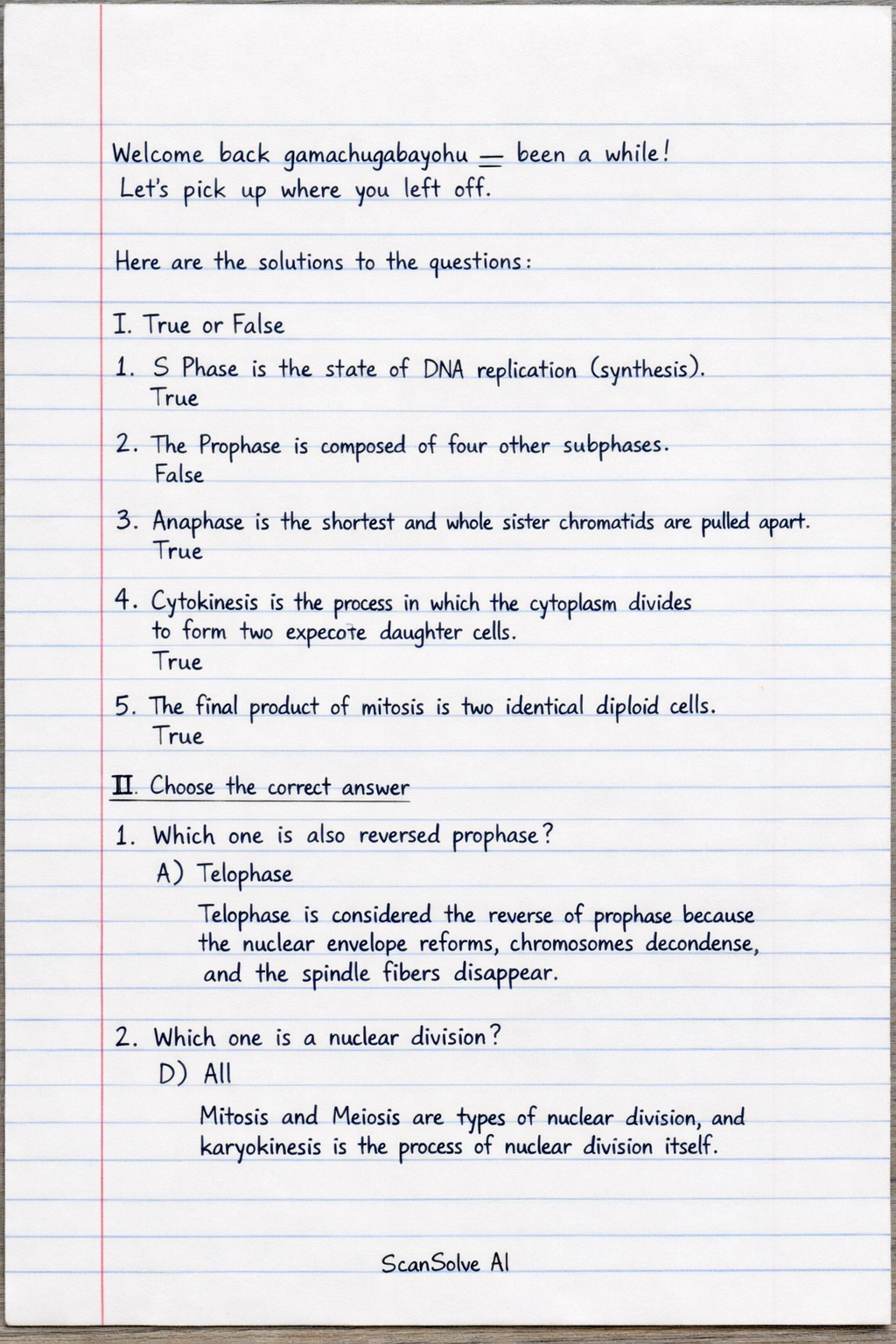
Here are the solutions to the questions:
I. True or False
- S Phase is the state of DNA replication (synthesis).
- True
- The Prophase is composed of four other subphases.
- False
- Anaphase is the shortest and whole sister chromatids are pulled apart to the poles.
- True
- Cytokinesis is the process in which the cytoplasm divides to form two separate daughter cells.
- True
- The final product of mitosis is two identical diploid cells.
- True
II. Choose the correct answer
-
Which one is also reversed prophase?
- A) Telophase Telophase is considered the reverse of prophase because the nuclear envelope reforms, chromosomes decondense, and the spindle fibers disappear.
-
Which one is a nuclear division?
- D) All Mitosis and Meiosis are types of nuclear division, and karyokinesis is the process of nuclear division itself.
-
Which one is the removal of food waste from the body?
- C) Egestion Egestion is the process of eliminating undigested food material (feces) from the body.
-
Which one is a part of the small intestine?
- D) All The small intestine consists of three parts: the duodenum, jejunum, and ileum.
-
Which one is important to prevent the watery fluid bile to regurgitate?
- B) Pyloric The pyloric sphincter controls the flow of chyme from the stomach into the duodenum and helps prevent duodenal contents (including bile) from refluxing back into the stomach.
-
Which one is important to prevent the watery fluid chyme to regurgitate?
- A) Cardiac The cardiac (or lower esophageal) sphincter prevents stomach contents (chyme) from flowing back into the esophagus.
-
The two chromatids are maternal or paternal chromosomes linked to each other by centromere on the centromere.
- B) Sister chromatids Sister chromatids are identical copies of a chromosome joined together by a centromere, formed after DNA replication.
-
Which one is about protein synthesis extended from the nucleus?
- C) Ribosomes Protein synthesis occurs on ribosomes, which translate
Still stuck on this one?
Ask a follow-up, and the answer starts from this question.
More Biology Questions
Handwritten Step-by-Step Solution
Get this as a handwritten image on WhatsApp — like a tutor wrote it for you.
Try on WhatsApp