
We read your photo as:
A) Substance X is Potassium Hydroxide (KOH) or Sodium Hydroxide (NaOH). Its role is to absorb carbon dioxide produced by the grasshopper during respiration.
ScanSolve AI Answer
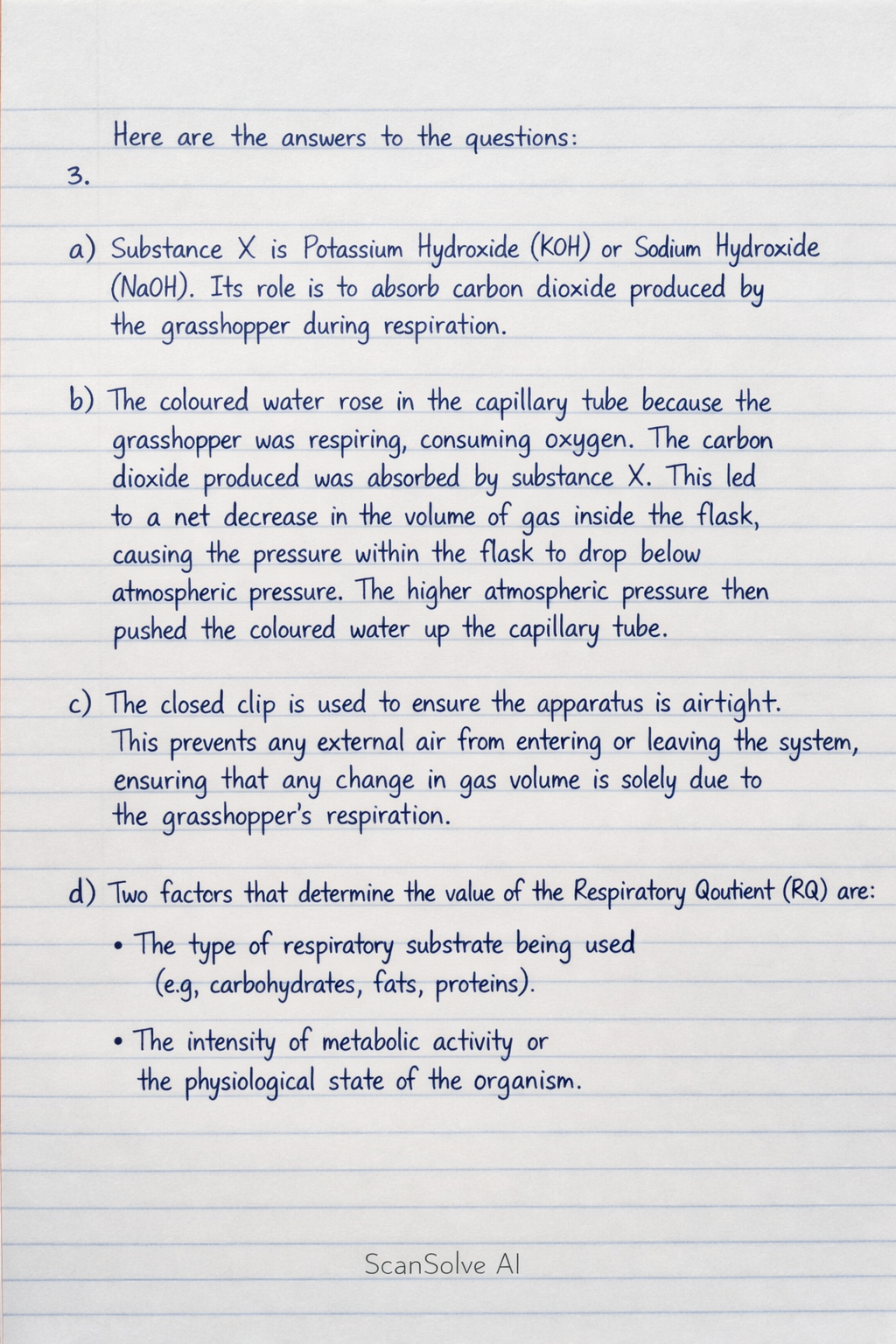
Here are the answers to the questions:
3.
a) Substance X is Potassium Hydroxide (KOH) or Sodium Hydroxide (NaOH). Its role is to absorb carbon dioxide produced by the grasshopper during respiration.
b) The coloured water rose in the capillary tube because the grasshopper was respiring, consuming oxygen. The carbon dioxide produced was absorbed by substance X. This led to a net decrease in the volume of gas inside the flask, causing the pressure within the flask to drop below atmospheric pressure. The higher atmospheric pressure then pushed the coloured water up the capillary tube.
c) The closed clip is used to ensure the apparatus is airtight. This prevents any external air from entering or leaving the system, ensuring that any change in gas volume is solely due to the grasshopper's respiration.
d) Two factors that determine the value of the Respiratory Quotient (RQ) are:
- The type of respiratory substrate being used (e.g., carbohydrates, fats, proteins).
- The intensity of metabolic activity or the physiological state of the organism.
4.
a)
Description of Inhalation in man:
During inhalation, the diaphragm muscle contracts and flattens, moving downwards. Simultaneously, the external intercostal muscles contract, pulling the rib cage upwards and outwards. These actions increase the volume of the thoracic cavity. As the volume increases, the pressure inside the lungs decreases to below atmospheric pressure. This pressure difference causes air to rush into the lungs through the respiratory passages until the pressure inside and outside the lungs equalizes.
Description of Exhalation in man:
During exhalation, the diaphragm muscle relaxes and moves upwards, returning to its dome shape. The external intercostal muscles relax, allowing the rib cage to move downwards and inwards. These actions decrease the volume of the thoracic cavity. As the volume decreases, the pressure inside the lungs increases to above atmospheric pressure. This pressure difference forces air out of the lungs until the pressure inside and outside the lungs equalizes. During forced exhalation, the internal intercostal muscles and abdominal muscles also contract to further reduce thoracic volume.
b) The leaf of a terrestrial plant is adapted to perform its function (photosynthesis and gas exchange) in several ways:
- Large surface area: Leaves are typically broad and flat, maximizing the surface area exposed to sunlight for photosynthesis and for efficient gas exchange.
- Thinness: Leaves are thin, which provides a short diffusion distance for carbon dioxide to reach the photosynthetic cells and for oxygen to exit. It also allows light to penetrate easily to all photosynthetic cells.
- Presence of chlorophyll: The palisade mesophyll layer contains numerous chloroplasts with chlorophyll, which are specialized to absorb light energy for photosynthesis.
- Stomata: The epidermis of the leaf contains small pores called stomata, primarily on the lower surface. These allow for the efficient intake of carbon dioxide and release of oxygen and water vapor. Their opening and closing are regulated by guard cells.
- Air spaces: The spongy mesophyll layer has large intercellular air spaces that facilitate the rapid diffusion of gases (carbon dioxide, oxygen, water vapor) to and from the photosynthetic cells.
- Vascular bundles (veins): A network of veins containing xylem and phloem runs throughout the leaf. Xylem transports water and mineral salts to the photosynthetic cells, while phloem transports manufactured sugars (food) away from the leaf to other parts of the plant.
- Waxy cuticle: A thin, transparent, waxy layer covers the upper and lower epidermis. It reduces water loss through transpiration while allowing light to pass through to the photosynthetic cells.
Still stuck on this one?
Ask a follow-up, and the answer starts from this question.
More Biology Questions
Handwritten Step-by-Step Solution
Get this as a handwritten image on WhatsApp — like a tutor wrote it for you.
Try on WhatsApp