
We read your photo as:
A) The functions of the skeletal system are:
Biology
ScanSolve AI Answer
Here are the answers to question 2:
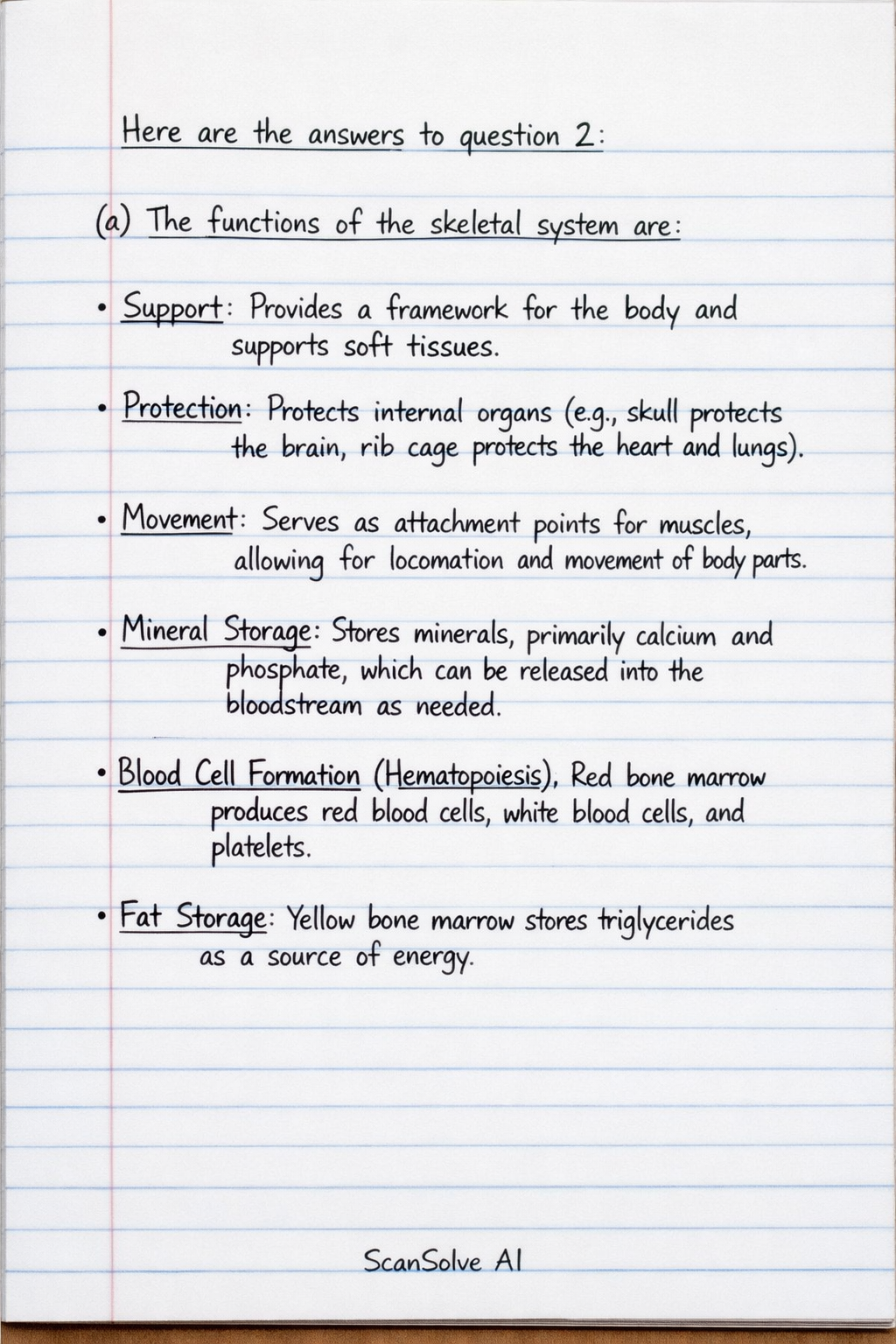
a) The functions of the skeletal system are:
- Support: Provides a framework for the body and supports soft tissues.
- Protection: Protects internal organs (e.g., skull protects the brain, rib cage protects the heart and lungs).
- Movement: Serves as attachment points for muscles, allowing for locomotion and movement of body parts.
- Mineral Storage: Stores minerals, primarily calcium and phosphate, which can be released into the bloodstream as needed.
- Blood Cell Formation (Hematopoiesis): Red bone marrow produces red blood cells, white blood cells, and platelets.
- Fat Storage: Yellow bone marrow stores triglycerides as a source of energy.
b) The different bones of the Upper Limb (UL) are:
- Pectoral Girdle: Clavicle, Scapula
- Arm: Humerus
- Forearm: Radius, Ulna
- Wrist (Carpals): Scaphoid, Lunate, Triquetrum, Pisiform, Trapezium, Trapezoid, Capitate, Hamate
- Hand (Metacarpals): Five metacarpal bones
- Fingers (Phalanges): Fourteen phalanges (proximal, middle, and distal for digits 2-5; proximal and distal for digit 1/thumb)
c) The components of the cardiovascular system are:
- Heart: Pumps blood throughout the body.
- Blood Vessels: A network of tubes that transport blood, including arteries, arterioles, capillaries, venules, and veins.
- Blood: The fluid connective tissue that circulates, carrying oxygen, nutrients, hormones, and waste products.
Was this helpful?
Still stuck on this one?
Ask a follow-up, and the answer starts from this question.
Got a different question?Ask your own question
More Biology Questions
QWhat are the main functions of the skeletal system?QWhat are the main functions of the skeleton of vertebrates?QA) State the functions of the mammalian skeleton. 1. b) Describe how movement is brought about at…QThe diagram below shows part of the human skeleton. 3.1 Name: (a) The part labelled X (b) The part…QTypes of bones and their functions
Browse by topic:Anatomy
Handwritten Step-by-Step Solution
Get this as a handwritten image on WhatsApp — like a tutor wrote it for you.
Try on WhatsApp