
A well labelled flowering plant
Biology
ScanSolve AI Answer
Answer
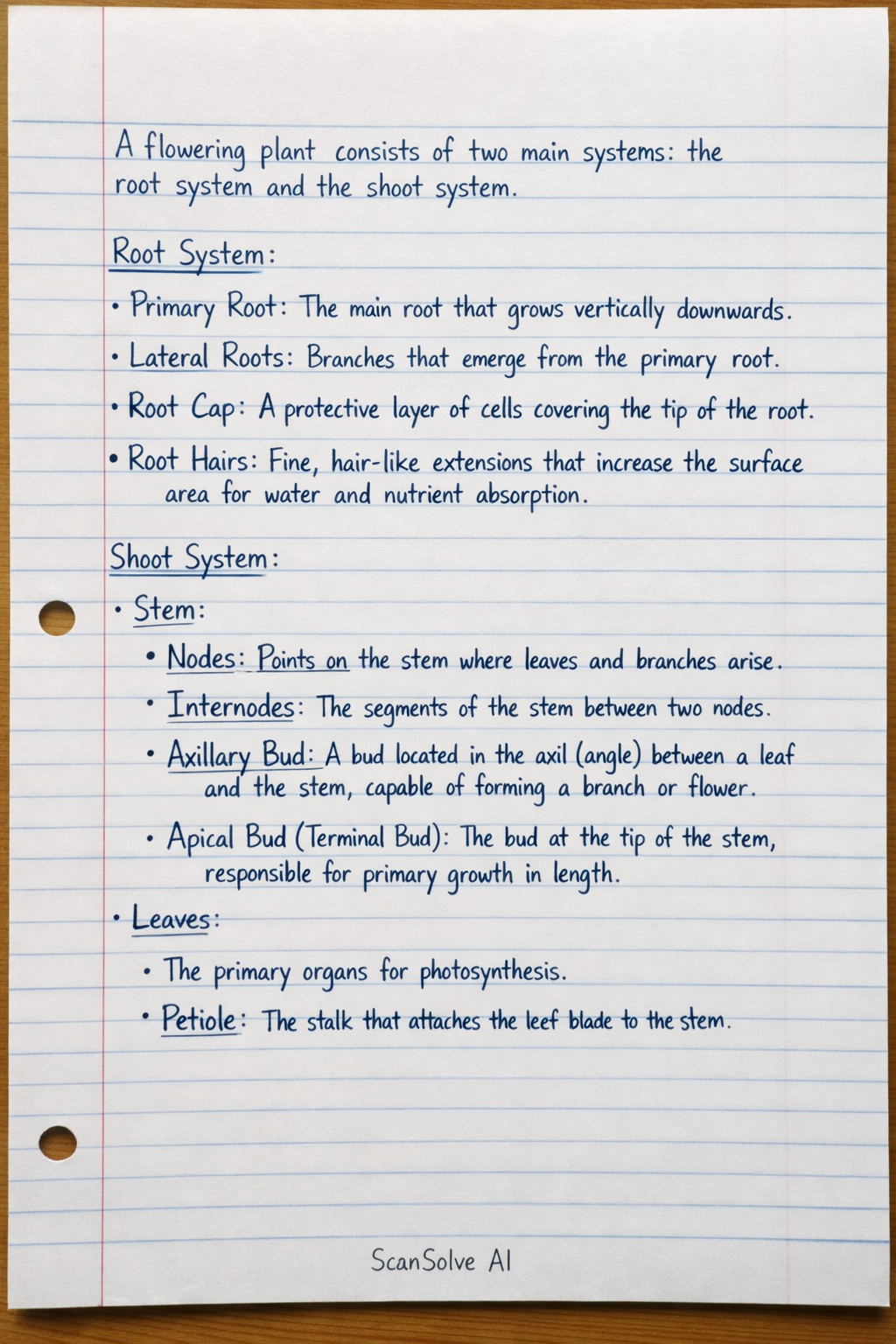
A flowering plant consists of two main systems: the root system and the shoot system.
Root System:
- Primary Root: The main root that grows vertically downwards.
- Lateral Roots: Branches that emerge from the primary root.
- Root Cap: A protective layer of cells covering the tip of the root.
- Root Hairs: Fine, hair-like extensions that increase the surface area for water and nutrient absorption.
Shoot System:
- Stem: The main axis of the plant, supporting leaves, flowers, and fruits.
- Nodes: Points on the stem where leaves and branches arise.
- Internodes: The segments of the stem between two nodes.
- Axillary Bud: A bud located in the axil (angle) between a leaf and the stem, capable of forming a branch or flower.
- Apical Bud (Terminal Bud): The bud at the tip of the stem, responsible for primary growth in length.
- Leaves: The primary organs for photosynthesis.
- Petiole: The stalk that attaches the leaf blade to the stem.
- Lamina (Leaf Blade): The broad, flat part of the leaf.
- Midrib: The central vein of the leaf.
- Veins: Vascular bundles within the leaf that transport water and nutrients.
- Stipules: Small, leaf-like appendages at the base of the petiole (not always present).
- Flower: The reproductive structure of the plant.
- Sepals: Leaf-like structures that enclose and protect the bud.
- Petals: Often brightly colored, attracting pollinators.
- Stamen (Male Reproductive Part):
- Anther: Produces pollen.
- Filament: Supports the anther.
- Pistil/Carpel (Female Reproductive Part):
- Stigma: Receptive tip for pollen.
- Style: Connects the stigma to the ovary.
- Ovary: Contains ovules, develops into the fruit after fertilization.
- Ovules: Contain the female gametes, develop into seeds after fertilization.
- Fruit: The mature ovary, enclosing the seeds.
- Seed: The mature ovule, containing an embryo and food reserves, capable of developing into a new plant.
Was this helpful?
Still stuck on this one?
Ask a follow-up, and the answer starts from this question.
Got a different question?Ask your own question
More Biology Questions
Handwritten Step-by-Step Solution
Get this as a handwritten image on WhatsApp — like a tutor wrote it for you.
Try on WhatsApp