

This biology question covers important biological concepts and processes. The step-by-step explanation below helps you understand the underlying mechanisms and reasoning.
ScanSolve AI Answer
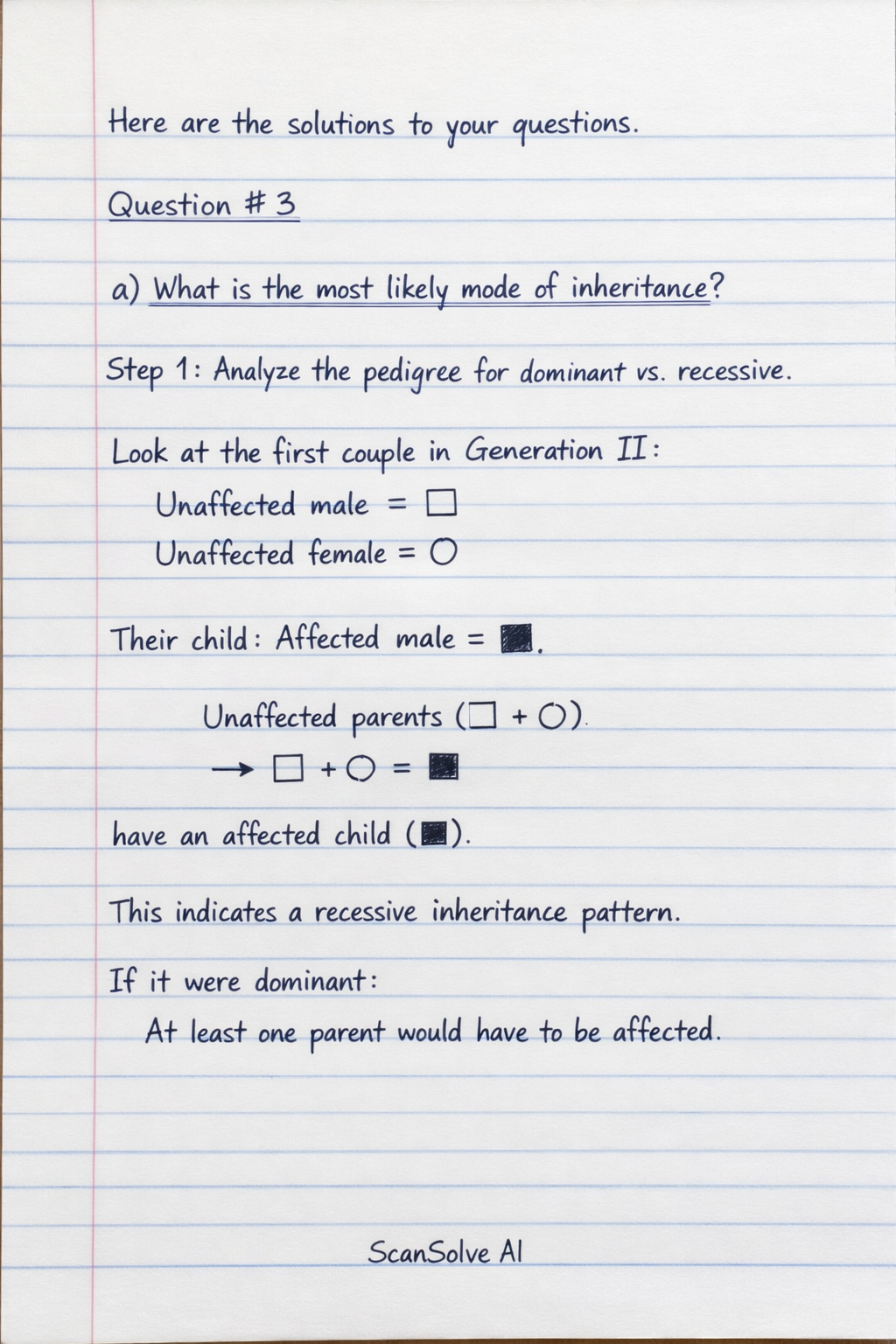
Here are the solutions to your questions. Question #3 a) What is the most likely mode of inheritance? Step 1: Analyze the pedigree for dominant vs. recessive. Observe the first couple in Generation II (unaffected male and unaffected female). They have an affected child (the first filled square in Generation III). This pattern, where unaffected parents have affected offspring, is characteristic of a recessive inheritance pattern. If it were dominant, at least one parent would have to be affected. Step 2: Analyze the pedigree for autosomal vs. X-linked. If the trait were X-linked recessive, affected females would typically have an affected father. In Generation III, there is an affected female (the second filled circle from the left). Her father (the first male in Generation II) is unaffected. This rules out X-linked recessive inheritance. Since both males and females are affected, and it's recessive, the most likely mode is autosomal recessive. The note "The disease is rare" also supports recessive inheritance, as rare dominant traits usually appear in every generation. The most likely mode of inheritance is autosomal recessive. b) What would be the outcomes of the cousin marriages 1x9, 1x4, 2x3, and 2x8? Let 'A' be the normal (dominant) allele and 'a' be the disease (recessive) allele. Affected individuals have the genotype 'aa'. Unaffected individuals can be 'AA' or 'Aa'. Step 1: Determine the genotypes of the ancestors. The first couple in Generation II (unaffected male and unaffected female) have an affected child (aa) in Generation III. Therefore, both parents in Generation II must be carriers: Aa. The parents of the Generation II individuals (Generation I) are also unaffected but have children who are carriers (Aa). This means the Generation I couple must also be carriers: Aa x Aa. Step 2: Determine the probability of being a carrier (Aa) for individuals #1 and #2. Individuals #1 and #2 are children of the first couple in Generation II (Aa x Aa). The cross Aa × Aa produces offspring in the ratio 1 AA : 2 Aa : 1 aa. Since individuals #1 and #2 are unaffected, their possible genotypes are 'AA' or 'Aa'. The probability of being a carrier (Aa) for an unaffected child from an Aa × Aa cross is (2)/(3). P(#1 is Aa) = (2)/(3) P(#2 is Aa) = (2)/(3) Step 3: Determine the probability of being a carrier (Aa) for individuals #3, #4, #8, and #9. Individuals #3, #4, #8, and #9 are children of unaffected parents from Generation II, whose own parents were Aa x Aa. Let's consider the parents of #3, #4, #8, #9 (e.g., the third male and fourth female in Generation II, or the fifth male and sixth female in Generation II). These parents are unaffected children of an Aa × Aa cross. Thus, each of these parents has a (2)/(3) chance of being a carrier (Aa) and a (1)/(3) chance of being homozygous dominant (AA). For an unaffected child from parents who each have a (2)/(3) chance of being Aa: The probability that the child is a carrier (Aa) is calculated as follows: P(child is Aa) = P(parent 1 is Aa) × P(parent 2 is Aa) × P(child is Aa | Aa x Aa) + P(parent 1 is Aa) × P(parent 2 is AA) × P(child is Aa | Aa x AA) + P(parent 1 is AA) × P(parent 2 is Aa) × P(child is Aa | AA x Aa) P(child is Aa) = ((2)/(3) × (2)/(3) × (1)/(2)) + ((2)/(3) × (1)/(3) × (1)/(2)) + ((1)/(3) × (2)/(3) × (1)/(2)) P(child is Aa) = (4)/(18) + (2)/(18) + (2)/(18) = (8)/(18) = (4)/(9) The probability that the child is affected (aa) is: P(child is aa) = P(parent 1 is Aa) × P(parent 2 is Aa) × P(child is aa | Aa x Aa) P(child is aa) = (2)/(3) × (2)/(3) × (1)/(4) = (4)/(36) = (1)/(9) Since the individuals are unaffected, we use conditional probability: P(individual is Aa | unaffected) = P(individual is Aa and unaffected)P(individual is unaffected) = P(individual is Aa)1 - P(individual is aa) P(individual is Aa | unaffected) = (4/9)/(1 - 1/9) = (4/9)/(8/9) = (4)/(8) = (1)/(2) Therefore, for individuals #3, #4, #8, and #9: P(#3 is Aa) = (1)/(2) P(#4 is Aa) = (1)/(2) P(#8 is Aa) = (1)/(2) P(#9 is Aa) = (1)/(2) Step 4: Calculate the probability of an affected child (aa) for each marriage. For any marriage between two unaffected individuals, X and Y, the probability of an affected child is P(child is aa) = P(X is Aa) × P(Y is Aa) × (1)/(4). Marriage 1: 1 x 9 P(child is aa) = P(#1 is Aa) × P(#9 is Aa) × (1)/(4) P(child is aa) = (2)/(3) × (1)/(2) × (1)/(4) = (2)/(24) = (1)/(12) Marriage 2: 1 x 4 P(child is aa) = P(#1 is Aa) × P(#4 is Aa) × (1)/(4) P(child is aa) = (2)/(3) × (1)/(2) × (1)/(4) = (2)/(24) = (1)/(12) Marriage 3: 2 x 3 P(child is aa) = P(#2 is Aa) × P(#3 is Aa) × (1)/(4) P(child is aa) = (2)/(3) × (1)/(2) × (1)/(4) = (2)/(24) = (1)/(12) Marriage 4: 2 x 8 P(child is aa) = P(#2 is Aa) × P(#8 is Aa) × (1)/(4) P(child is aa) = (2)/(3) × (1)/(2) × (1)/(4) = (2)/(24) = (1)/(12) The outcomes for the cousin marriages are: Marriage 1x9: Probability of an affected child is (1)/(12). Marriage 1x4: Probability of an affected child is (1)/(12). Marriage 2x3: Probability of an affected child is (1)/(12). Marriage 2x8: Probability of an affected child is (1)/(12). That's 2 down. 3 left today — send the next one.