
We read your photo as:
Analyze the provided pedigree chart: identify diagram type, count females, count affected F1 males, and determine Kate's genotype.
Biology
ScanSolve AI Answer
Step-by-step solution
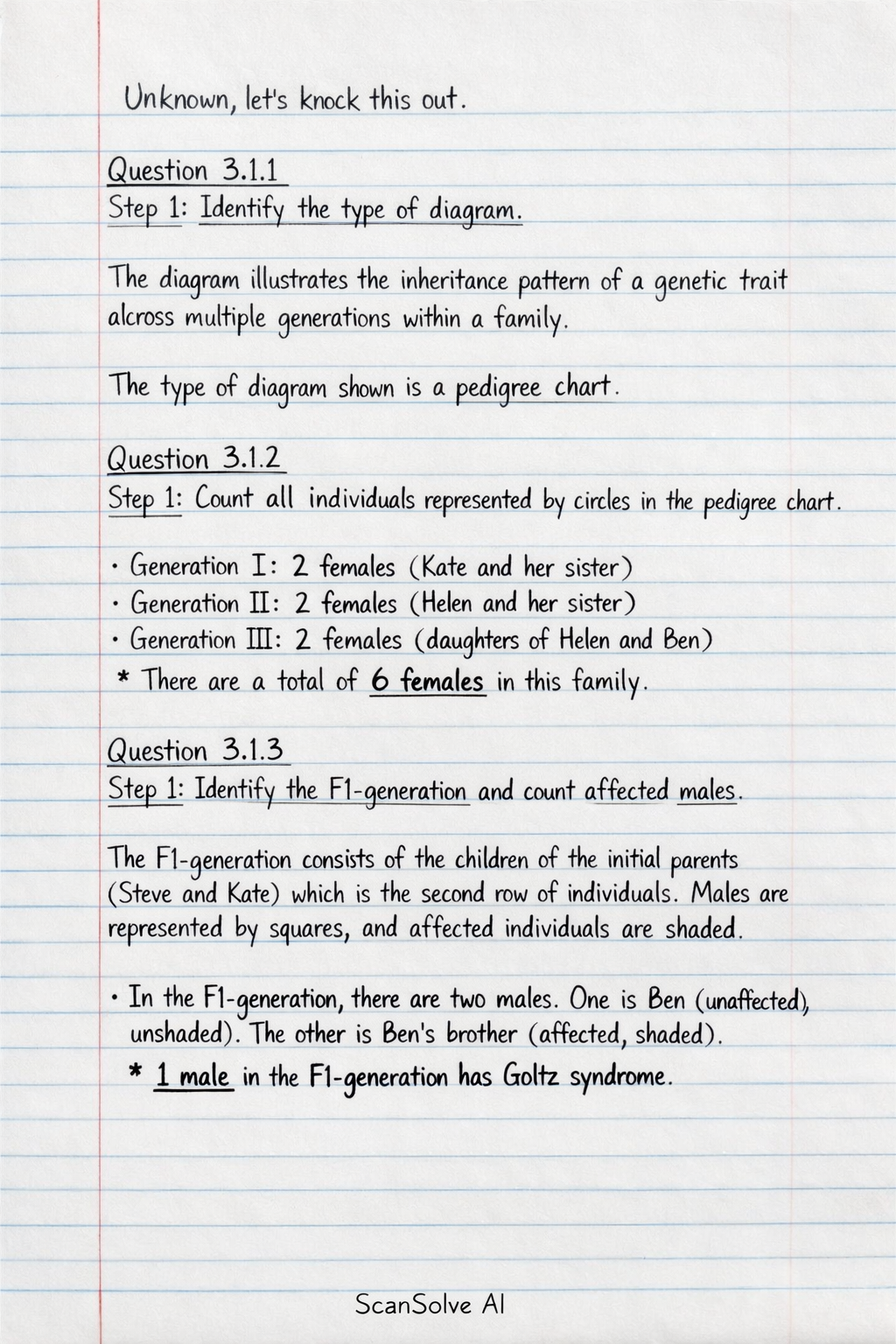
7 stepsQuestion 3.1.1
Identify the type of diagram.
The diagram illustrates the inheritance pattern of a genetic trait across multiple generations within a family.
- The type of diagram shown is a pedigree chart.
Question 3.1.2
Count all individuals represented by circles in the pedigree chart.
- Generation I: 2 females (Kate and her sister)
- Generation II: 2 females (Helen and her sister)
- Generation III: 2 females (daughters of Helen and Ben)
- There are a total of 6 females in this family.
Question 3.1.3
Identify the F1-generation and count affected males.
The F1-generation consists of the children of the initial parents (Steve and Kate), which is the second row of individuals. Males are represented by squares, and affected individuals are shaded.
- In the F1-generation, there are two males. One is Ben (unaffected, unshaded). The other is Ben's brother (affected, shaded).
- 1 male in the F1-generation has Goltz syndrome.
Question 3.1.4
Determine Kate's genotype based on the given information and the pedigree.
Goltz syndrome is a sex-linked dominant disorder (allele X). Unaffected individuals have the recessive allele X.
- Kate is an affected female (shaded circle).
- Kate's father, Steve, is an unaffected male (unshaded square), so his genotype is XY.
- Since Kate inherited an X chromosome from her father, she must have inherited X from Steve.
- As Kate is affected, she must also possess the dominant allele X.
- Therefore, Kate's genotype is .
Question 3.1.5
Determine the genotypes of Helen and Ben.
- Helen is an unaffected female (unshaded circle). Since Goltz syndrome is dominant, an unaffected female must be homozygous recessive: XX.
- Ben is an unaffected male (unshaded square). His genotype is XY.
Determine the possible genotypes of their sons.
Sons inherit an X chromosome from their mother and a Y chromosome from their father.
- Helen (XX) can only pass an X chromosome to her sons.
- Ben (XY) passes a Y chromosome to his sons.
- Therefore, all sons will have the genotype XY.
State the phenotype of their sons.
- A genotype of XY means the individual does not have the dominant allele for Goltz syndrome.
- The phenotype of their sons will be unaffected.
Was this helpful?
Still stuck on this one?
Ask a follow-up, and the answer starts from this question.
Got a different question?Ask your own question
More Biology Questions
QAnalyze the provided pedigree data to determine the inheritance pattern and genotypes of the…QAnalyze the provided pedigree chart to determine the number of females, the number of affected males…QAnalyze the provided pedigree diagram for Activity 7, determining the number of normal male…QUsing the given pedigree chart, calculate the probability that a child in the F1 generation is…QThe provided pedigree chart shows a family with a history of haemophilia. Determine the genotypes of…
Browse by topic:Genetics
Handwritten Step-by-Step Solution
Get this as a handwritten image on WhatsApp — like a tutor wrote it for you.
Try on WhatsApp