This biology question covers important biological concepts and processes. The step-by-step explanation below helps you understand the underlying mechanisms and reasoning.
ScanSolve AI Answer
b) (ii)
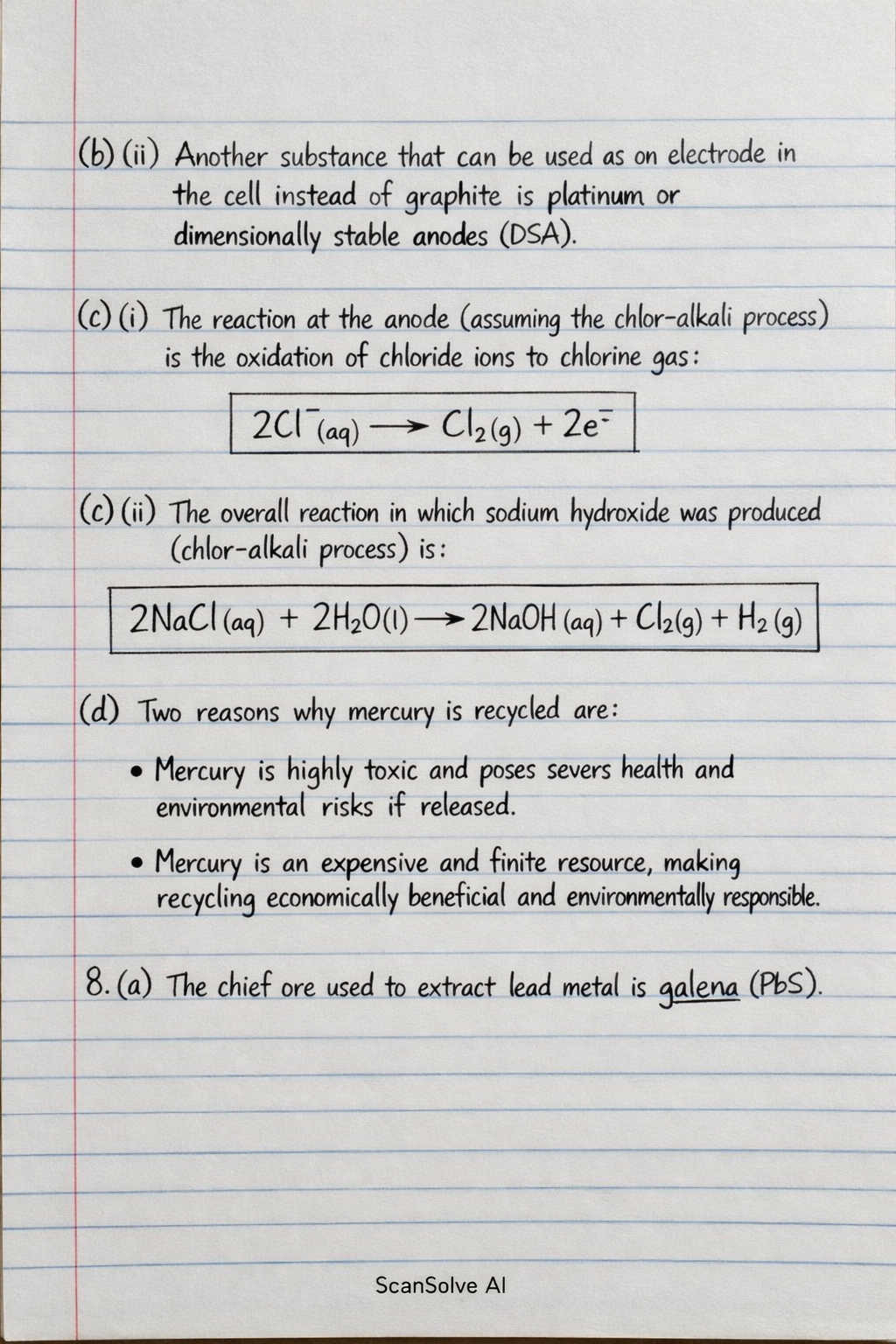
Another substance that can be used as an electrode in the cell instead of graphite is platinum or dimensionally stable anodes (DSA).
c) (i)
The reaction that occurred at the anode (assuming the chlor-alkali process) is the oxidation of chloride ions to chlorine gas:
$$\boxed{\text{2Cl}^-\text{(aq)} \rightarrow \text{Cl}_2\text{(g)} + 2\text{e}^-}$$
c) (ii)
The overall reaction in which sodium hydroxide was produced (chlor-alkali process) is the electrolysis of aqueous sodium chloride:
$$\boxed{\text{2NaCl(aq)} + \text{2H}_2\text{O(l)} \xrightarrow{\text{electrolysis}} \text{2NaOH(aq)} + \text{Cl}_2\text{(g)} + \text{H}_2\text{(g)}}$$
d)
Two reasons why mercury is recycled are:
• Mercury is highly toxic and poses severe health and environmental risks if released.
• Mercury is an expensive and finite resource, making recycling economically beneficial and environmentally responsible.
8. (a)
The chief ore used to extract lead metal is galena ($\text{PbS}$).
8. (b)
At the purification stage, the ore is concentrated, typically by froth flotation. This process separates the valuable lead sulfide from unwanted gangue (impurities) based on differences in their surface properties.
8. (c)
The equation for the reaction that takes place when lead sulfide ore is roasted in air is:
$$\boxed{\text{2PbS(s)} + 3\text{O}_2\text{(g)} \rightarrow 2\text{PbO(s)} + 2\text{SO}_2\text{(g)}}$$
Another substance that can be used as an electrode in the cell instead of graphite is platinum or dimensionally stable anodes (DSA).
|Biology
Another substance that can be used as an electrode in the cell instead of graphite is platinum or dimensionally stable anodes (DSA).
ScanSolve AI Answer
b) (ii)
Another substance that can be used as an electrode in the cell instead of graphite is platinum or dimensionally stable anodes (DSA).
c) (i)
The reaction that occurred at the anode (assuming the chlor-alkali process) is the oxidation of chloride ions to chlorine gas:
2Cl−(aq)→Cl2(g)+2e−
c) (ii)
The overall reaction in which sodium hydroxide was produced (chlor-alkali process) is the electrolysis of aqueous sodium chloride:
2NaCl(aq)+2H2O(l)electrolysis2NaOH(aq)+Cl2(g)+H2(g)
d)
Two reasons why mercury is recycled are:
• Mercury is highly toxic and poses severe health and environmental risks if released.
• Mercury is an expensive and finite resource, making recycling economically beneficial and environmentally responsible.
8. (a)
The chief ore used to extract lead metal is galena (PbS).
8. (b)
At the purification stage, the ore is concentrated, typically by froth flotation. This process separates the valuable lead sulfide from unwanted gangue (impurities) based on differences in their surface properties.
8. (c)
The equation for the reaction that takes place when lead sulfide ore is roasted in air is:
2PbS(s)+3O2(g)→2PbO(s)+2SO2(g)
Need help with your own homework?
Get instant step-by-step solutions to any question. Free to start.