
We read your photo as:
Answer questions on the ear and its function. Identify parts and explain their roles in hearing and balance, and consequences of damage.
ScanSolve AI Answer
-
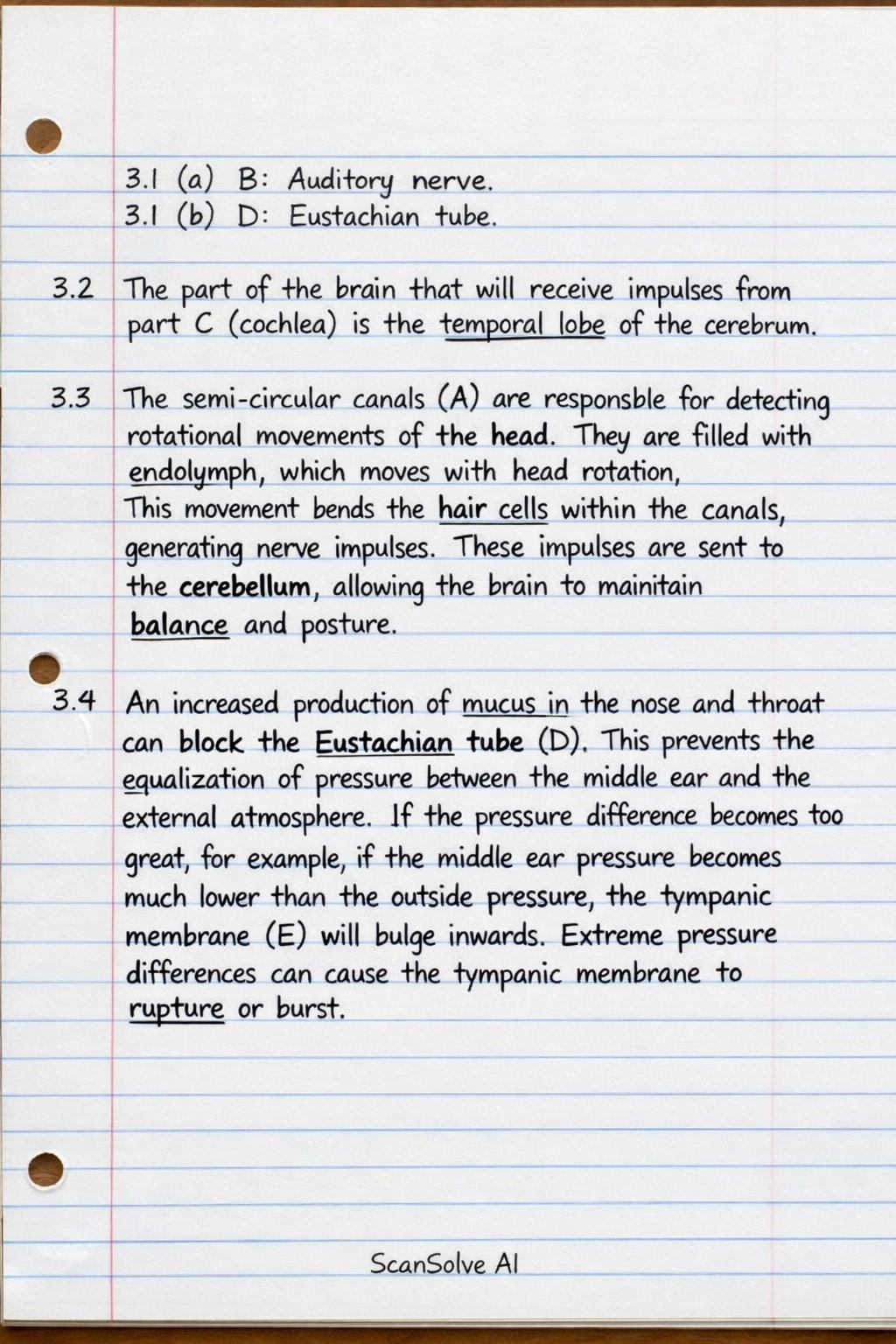
3.1 (a) B: Auditory nerve
-
3.1 (b) D: Eustachian tube
-
3.2 The part of the brain that will receive impulses from part C (cochlea) is the temporal lobe of the cerebrum.
-
3.3 The semi-circular canals (A) are responsible for detecting rotational movements of the head. They are filled with endolymph, which moves with head rotation. This movement bends the hair cells within the canals, generating nerve impulses. These impulses are sent to the cerebellum, allowing the brain to maintain balance and posture.
-
3.4 An increased production of mucus in the nose and throat can block the Eustachian tube (D). This prevents the equalization of pressure between the middle ear and the external atmosphere. If the pressure difference becomes too great, for example, if the middle ear pressure becomes much lower than the outside pressure, the tympanic membrane (E) will bulge inwards. Extreme pressure differences can cause the tympanic membrane to rupture or burst.
-
3.5 The structures at A are the ossicles (malleus, incus, stapes). These bones transmit sound vibrations from the eardrum to the inner ear. If the ossicles fuse, they become stiff and cannot vibrate freely. This prevents the efficient transmission of sound waves to the inner ear, leading to conductive hearing loss.
-
3.6 Region C is the cochlea, which contains hair cells that act as receptors for sound. If these receptors are damaged, they cannot convert sound vibrations into nerve impulses. This means that sound information cannot be sent to the brain, resulting in sensorineural hearing loss (nerve deafness), where the individual cannot perceive sounds or experiences distorted hearing.
-
3.7 The middle ear, including the tympanic membrane (E) and the ossicles (part of A), amplifies sounds through two main mechanisms:
- Area ratio: The tympanic membrane (eardrum) has a much larger surface area than the oval window (where the stapes pushes). Sound energy collected over the large eardrum is concentrated onto the smaller oval window, increasing the pressure.
- Lever action: The ossicles (malleus, incus, stapes) form a lever system. The malleus is longer than the incus, creating a mechanical advantage that increases the force exerted on the oval window by the stapes. These combined effects result in a significant amplification of sound pressure, allowing sound to be effectively transferred from the air to the fluid-filled inner ear.
Still stuck on this one?
Ask a follow-up, and the answer starts from this question.
More Biology Questions
Handwritten Step-by-Step Solution
Get this as a handwritten image on WhatsApp — like a tutor wrote it for you.
Try on WhatsApp