
We read your photo as:
Answer the following questions from Section B: 2. (a) Give two examples each of fungal, deficiency, and non-communicable diseases. (b) Explain homogeneous and heterogeneous mixtures. (c) Why is draggi
Biology
ScanSolve AI Answer
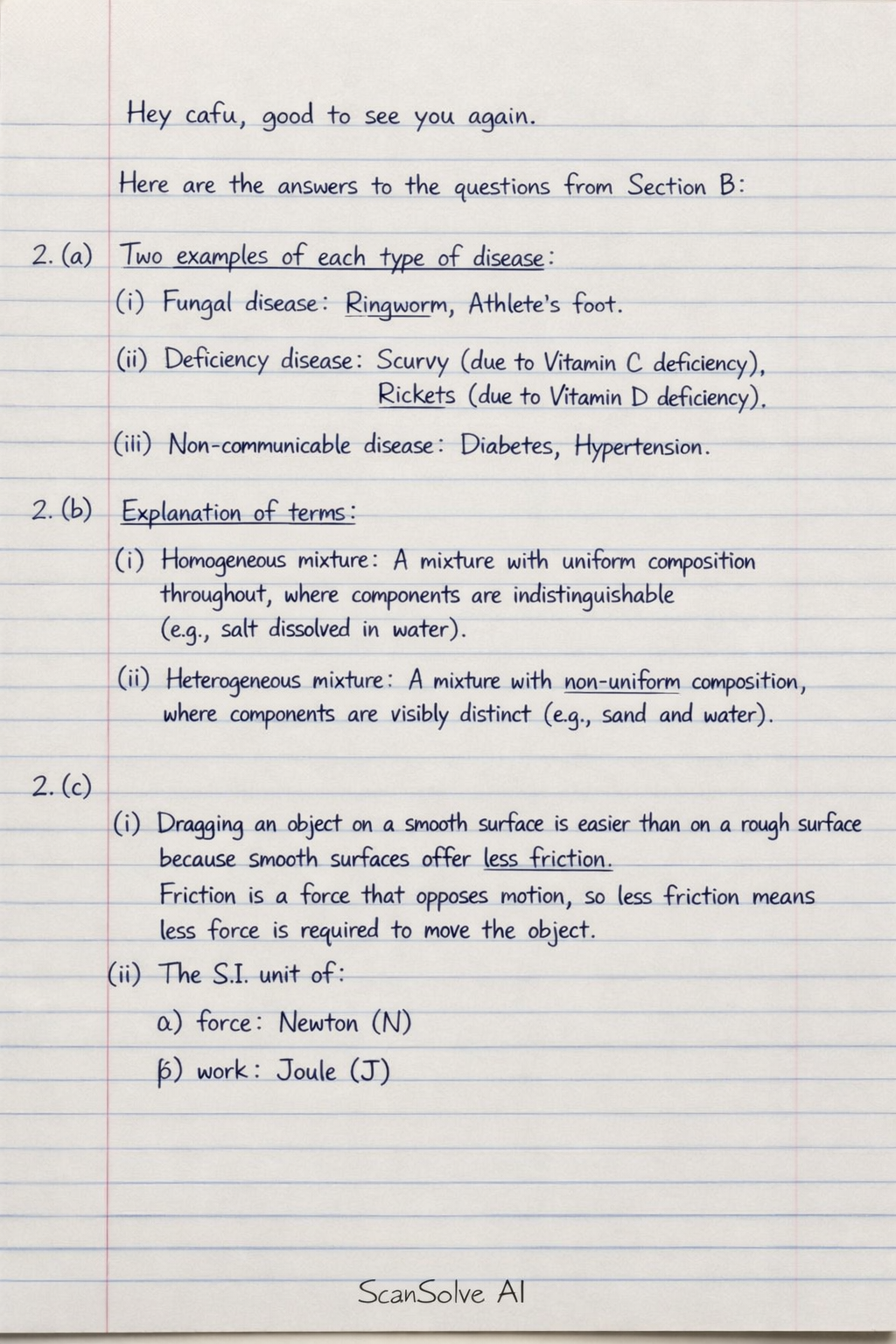
Here are the answers to the questions from Section B:
2. (a)
Two examples of each type of disease:
- (i) Fungal disease: Ringworm, Athlete's foot.
- (ii) Deficiency disease: Scurvy (due to Vitamin C deficiency), Rickets (due to Vitamin D deficiency).
- (iii) Non-communicable disease: Diabetes, Hypertension.
2. (b)
Explanation of terms:
- (i) Homogeneous mixture: A mixture with uniform composition throughout, where components are indistinguishable and appear as a single phase (e.g., salt dissolved in water).
- (ii) Heterogeneous mixture: A mixture with non-uniform composition, where components are visibly distinct and appear as separate phases (e.g., sand and water).
2. (c)
- (i) Dragging an object on a smooth surface is easier than on a rough surface because smooth surfaces offer less friction. Friction is a force that opposes motion, so less friction means less force is required to move the object.
- (ii) The S.I. unit of:
- (α) force: Newton (N)
- (β) work: Joule (J)
2. (d)
- (i) A balanced ration in poultry feed is a feed that provides all essential nutrients (carbohydrates, proteins, fats, vitamins, minerals, and water) in the correct proportions required for the optimal growth, production, and health of poultry.
- (ii) Three effects of malnutrition in poultry are:
- Stunted growth
- Reduced egg production
- Weakened immune system
3. (a)
- (i) Observations in a simple electric circuit with a cell, resistor, and bulb:
- (α) When the number of cells is doubled (in series): The bulb will shine brighter.
- (β) When the number of bulbs is doubled (in series): The bulbs will shine dimmer.
- (ii) Explanation of observations:
- (α) Doubling the number of cells (in series) increases the total voltage (potential difference) across the circuit. According to Ohm's Law (), with increased voltage and constant resistance, the current increases, making the bulb brighter.
- (β) Doubling the number of bulbs (in series) increases the total resistance of the circuit. With constant voltage and increased resistance, the current decreases, causing each bulb to shine dimmer.
3. (b)
How the following factors affect vegetable crop production:
- (i) Soil type: Different soil types affect water retention, nutrient availability, and aeration. Loamy soils are generally preferred for most vegetable crops due to their balanced properties.
- (ii) Nearness to source of water: Ensures consistent and adequate irrigation, which is crucial for the growth and yield of vegetable crops, especially
Was this helpful?
Still stuck on this one?
Ask a follow-up, and the answer starts from this question.
Got a different question?Ask your own question
More Biology Questions
QAnswer the following questions on Diseases: A. Give one word for the following. B. Fill in the…QDistinguish between fungal diseases and non-communicable diseases. List two examples each of fungal…QCan you provide answers to the following biology questions regarding nutrition, diseases, and blood…QWhat are the answers to the following Biology questions: 1. a) State any two disorders in a…QProvide answers for the following questions regarding diseases, mixtures, forces, and poultry…
Handwritten Step-by-Step Solution
Get this as a handwritten image on WhatsApp — like a tutor wrote it for you.
Try on WhatsApp