

This biology question covers important biological concepts and processes. The step-by-step explanation below helps you understand the underlying mechanisms and reasoning.
ScanSolve AI Answer
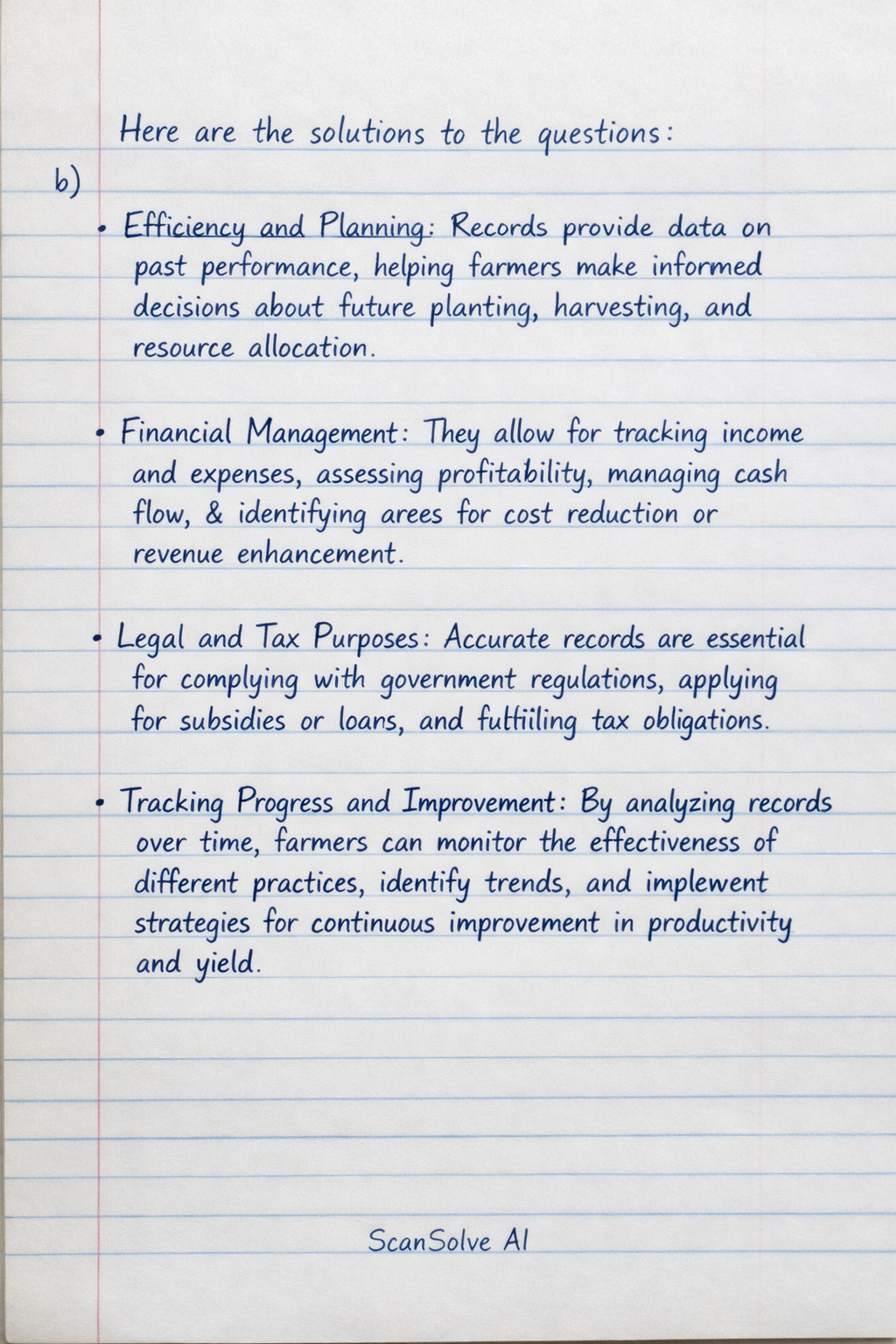
Here are the solutions to the questions: b) Different enterprises have different types of records, as an assistant record officer at Green Planet Flower and Dairy limited; you are supposed to keep all types of farm records. Explain FOUR reasons you think it is important to have farm records and accounts. • Efficiency and Planning: Records provide data on past performance, helping farmers make informed decisions about future planting, harvesting, and resource allocation. • Financial Management: They allow for tracking income and expenses, assessing profitability, managing cash flow, and identifying areas for cost reduction or revenue enhancement. • Legal and Tax Purposes: Accurate records are essential for complying with government regulations, applying for subsidies or loans, and fulfilling tax obligations. • Tracking Progress and Improvement: By analyzing records over time, farmers can monitor the effectiveness of different practices, identify trends, and implement strategies for continuous improvement in productivity and yield. a) Farm plan is a process of deciding in the present what to do in the future about the best combination of crops and livestock to be raised through rational use of resources. Describe FIVE characteristics of a good farm plan you will consider before starting a livestock enterprise. • Clear Objectives: A good farm plan clearly defines what the farmer aims to achieve, such as specific production targets, profitability goals, or sustainability objectives. • Resource Assessment: It includes a detailed inventory and analysis of all available resources, including land, labor, capital, water, and machinery, to ensure their optimal utilization. • Feasibility and Realism: The plan must be practical and achievable given the farmer's resources, skills, market conditions, and environmental factors. • Flexibility: A good farm plan is adaptable and can be adjusted to respond to unforeseen circumstances like changes in weather patterns, market prices, or disease outbreaks. • Profitability Analysis: It incorporates detailed financial projections, including estimated costs, revenues, and potential profits, to ensure the enterprise's economic viability. b) Break Even Analysis in business refers to the point in which total cost and total revenue are equal. Thus TR=TC and TR-TC =0. You have started a small business to sell bottled milk, and you are supposed to calculate the breakeven. The Total cost is Ksh 50,000 and cost of producing 1 bottle is Ksh 8, the sale of milk per bottle is Ksh 24. Calculate the total number of units you will sell to break even. Given: Total Fixed Cost (TFC) = Ksh 50,000 Variable Cost per unit (VC) = Ksh 8 Selling Price per unit (P) = Ksh 24 Step 1: Calculate the contribution margin per unit. Contribution Margin per unit = Selling Price per unit - Variable Cost per unit Contribution Margin per unit = Ksh 24 - Ksh 8 = Ksh 16 Step 2: Calculate the break-even point in units. Break-even Point (units) = Total Fixed CostContribution Margin per unit Break-even Point (units) = Ksh 50,000Ksh 16/unit = 3125 units The total number of units to sell to break even is 3125 units. c) Assuming you sell 3625 units of milk bottles, how much profits do you make Given: Units sold = 3625 Total Fixed Cost (TFC) = Ksh 50,000 Variable Cost per unit (VC) = Ksh 8 Selling Price per unit (P) = Ksh 24 Step 1: Calculate Total Revenue. Total Revenue = Units sold × Selling Price per unit Total Revenue = 3625 units × Ksh 24/unit = Ksh 87,000 Step 2: Calculate Total Variable Cost. Total Variable Cost = Units sold × Variable Cost per unit Total Variable Cost = 3625 units × Ksh 8/unit = Ksh 29,000 Step 3: Calculate Total Cost. Total Cost = Total Fixed Cost + Total Variable Cost Total Cost = Ksh 50,000 + Ksh 29,000 = Ksh 79,000 Step 4: Calculate Profit. Profit = Total Revenue - Total Cost Profit = Ksh 87,000 - Ksh 79,000 = Ksh 8,00