
We read your photo as:
Explain batch, continuous, and fed-batch cultures, and describe the roles of restriction enzymes and DNA ligase in genetic engineering.
ScanSolve AI Answer
Step-by-step solution
5 steps4. a)
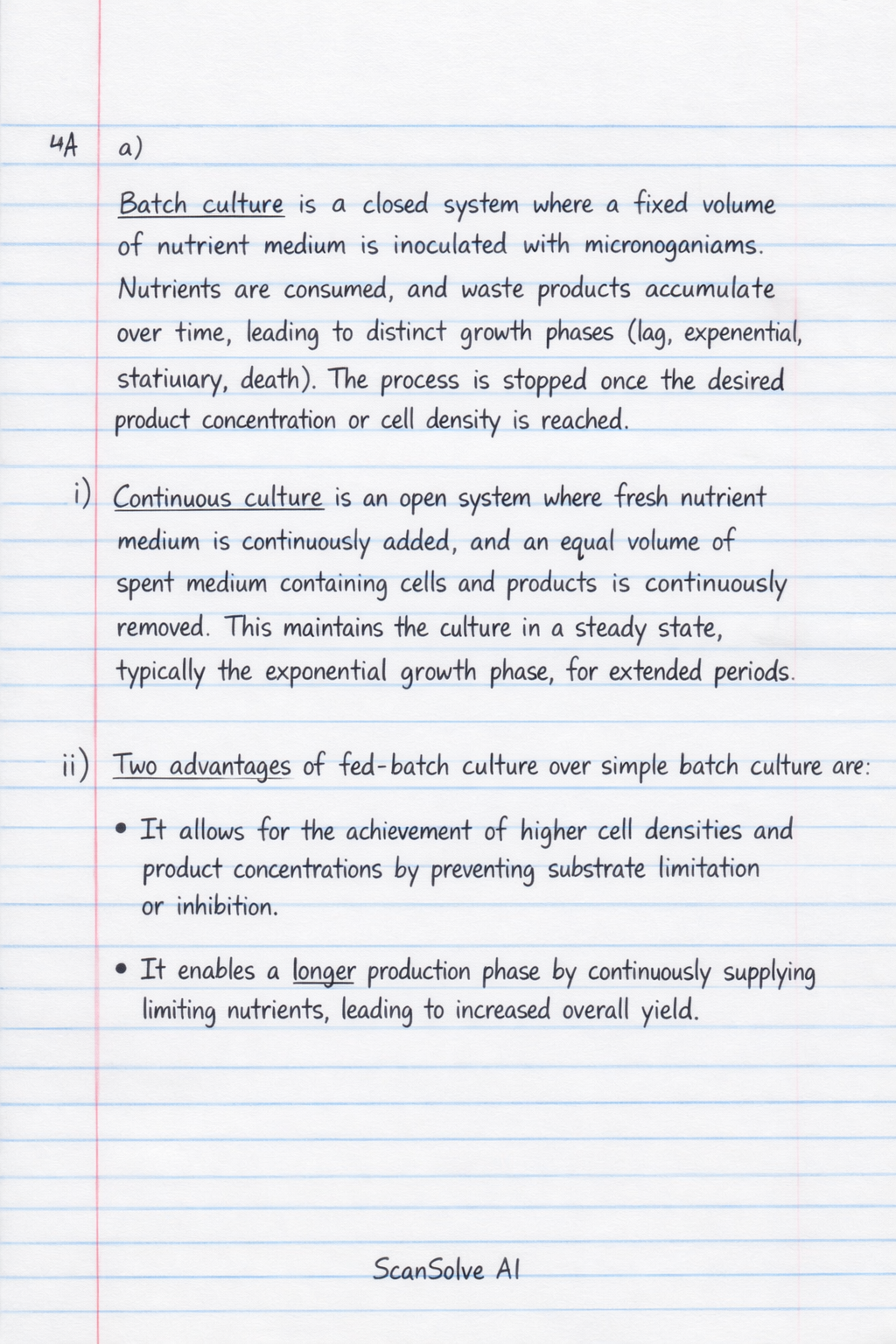
i) Batch culture is a closed system where a fixed volume of nutrient medium is inoculated with microorganisms. Nutrients are consumed, and waste products accumulate over time, leading to distinct growth phases (lag, exponential, stationary, death). The process is stopped once the desired product concentration or cell density is reached.
Continuous culture is an open system where fresh nutrient medium is continuously added, and an equal volume of spent medium containing cells and products is continuously removed. This maintains the culture in a steady state, typically the exponential growth phase, for extended periods.
ii) Two advantages of fed-batch culture over simple batch culture are:
- It allows for the achievement of higher cell densities and product concentrations by preventing substrate limitation or inhibition.
- It enables a longer production phase by continuously supplying limiting nutrients, leading to increased overall yield.
b)
i) Restriction enzymes (also called restriction endonucleases) recognize and cut DNA at specific nucleotide sequences, known as recognition sites. They are used to cut both the bacterial plasmid (vector) and the human insulin gene, often creating "sticky ends" (short single-stranded overhangs) that are complementary.
DNA ligase is an enzyme that catalyzes the formation of phosphodiester bonds between adjacent nucleotides. It is used to join the human insulin gene into the cut plasmid, forming a recombinant plasmid, by sealing the nicks in the DNA backbone.
ii)
Isolation of DNA.
The human insulin gene is isolated from human cells, and a plasmid (a small, circular DNA molecule) is isolated from a bacterium.
Cutting DNA.
Both the human insulin gene and the plasmid are cut with the same restriction enzyme. This enzyme recognizes a specific DNA sequence and cuts it, creating complementary sticky ends on both the insulin gene and the plasmid.
Ligation.
The cut human insulin gene and the cut plasmid are mixed together. The complementary sticky ends base-pair, and DNA ligase is added to form phosphodiester bonds, permanently joining the insulin gene into the plasmid to create a recombinant plasmid.
Transformation.
The recombinant plasmid is then introduced into E. coli bacteria. This process, called transformation, can be achieved by methods like heat shock or electroporation, making the bacterial cells temporarily permeable to DNA.
Selection.
The transformed E. coli cells are grown on a selective medium (e.g., containing an antibiotic if the plasmid carries an antibiotic resistance gene) to identify and isolate only those bacteria that have successfully taken up the recombinant plasmid. These bacteria will then multiply and express the human insulin gene.
c)
One ethical concern is the potential for unintended health effects if the genetically modified bacteria or their products were to escape or be consumed, especially in a developing country with potentially less stringent regulatory oversight. There are also concerns about the equitable access to such advanced medical treatments, as the cost of genetically engineered insulin might still be prohibitive for many in developing countries, despite local production.
One economic advantage is the reduction in production costs and the establishment of a local supply chain for insulin. This can decrease reliance on expensive imported insulin, making the vital medication more affordable and accessible to the local population, thereby improving public health outcomes and potentially creating local jobs.5. a)
i) Enzyme specificity refers to the ability of an enzyme to catalyze only one type of reaction or to act on only one specific substrate or a very limited range of substrates. This is due to the unique three-dimensional shape of the enzyme's active site, which is complementary to the shape of its specific substrate(s).
ii) According to the induced-fit model, the enzyme's active site is not a rigid structure but is flexible. When a substrate binds to the active site, the active site undergoes a slight conformational change to achieve a tighter fit around the substrate. This induced fit places strain on the substrate's bonds, weakening them and making them more susceptible to reaction. By distorting the substrate or bringing reacting groups into optimal proximity and orientation, the enzyme effectively stabilizes the transition state of the reaction. This stabilization lowers the activation energy required for the reaction to proceed, thereby increasing the reaction rate.
b)
i) The shape of the curve, showing an optimum at 37 °C and a sharp drop above 45 °C, can be explained by enzyme structure.
- At temperatures below 37 °C, as temperature increases, the kinetic energy of the enzyme and substrate molecules increases. This leads to more frequent and energetic collisions between them, increasing the rate of enzyme-substrate complex formation and thus the rate of oxygen production.
- At 37 °C, the enzyme catalase exhibits its optimum activity. This is the temperature at which the enzyme's structure is most stable and its catalytic efficiency is highest.
- Above 37 °C, further increases in temperature cause the enzyme molecules to vibrate more vigorously. Above 45 °C, this excessive kinetic energy begins to break the weak bonds (like hydrogen bonds and hydrophobic interactions) that maintain the enzyme's specific three-dimensional tertiary structure, including the active site. This process is called denaturation. As the active site changes shape, it can no longer bind effectively with the substrate, leading to a rapid and irreversible loss of enzyme activity and a sharp drop in oxygen production.
ii) Catalase from a thermophilic bacterium isolated from a hot spring would show a higher optimum temperature because thermophilic organisms are adapted to survive and thrive in extremely hot environments. Their enzymes, including catalase, have evolved to possess more stable structures that are resistant to denaturation at high temperatures. This increased stability is often due to a higher proportion of strong bonds (e.g., disulfide bridges), different amino acid compositions, or more extensive hydrophobic interactions within their protein structure, allowing their active sites to maintain their functional shape and catalytic activity at temperatures where enzymes from mesophilic organisms (like human liver catalase) would denature.
c) The importance of enzyme immobilisation in the food industry includes:
- Reusability and cost-effectiveness: Immobilized enzymes can be easily separated from the reaction mixture and reused multiple times, significantly reducing the cost of enzyme production and purification.
- Increased stability: Immobilization often enhances the enzyme's stability against changes in temperature, pH, and the presence of inhibitors, allowing for broader operating conditions and longer enzyme lifespan.
- Product purity: Since the enzymes are physically separated from the product, there is no enzyme contamination in the final food product, simplifying downstream processing and purification steps.
- Continuous processing: Immobilized enzymes facilitate continuous flow processes in bioreactors, which are more efficient and easier to control than batch processes, leading to higher productivity.
- Examples: Immobilized enzymes are used in the production of high-fructose corn syrup (using glucose isomerase), lactose-free milk (using lactase), and the clarification of fruit juices (using pectinase).
Still stuck on this one?
Ask a follow-up, and the answer starts from this question.
More Biology Questions
Handwritten Step-by-Step Solution
Get this as a handwritten image on WhatsApp — like a tutor wrote it for you.
Try on WhatsApp