
We read your photo as:
State the biological points of interest of specimen II. How is the alimentary canal of the bird adapted to its diet?
ScanSolve AI Answer
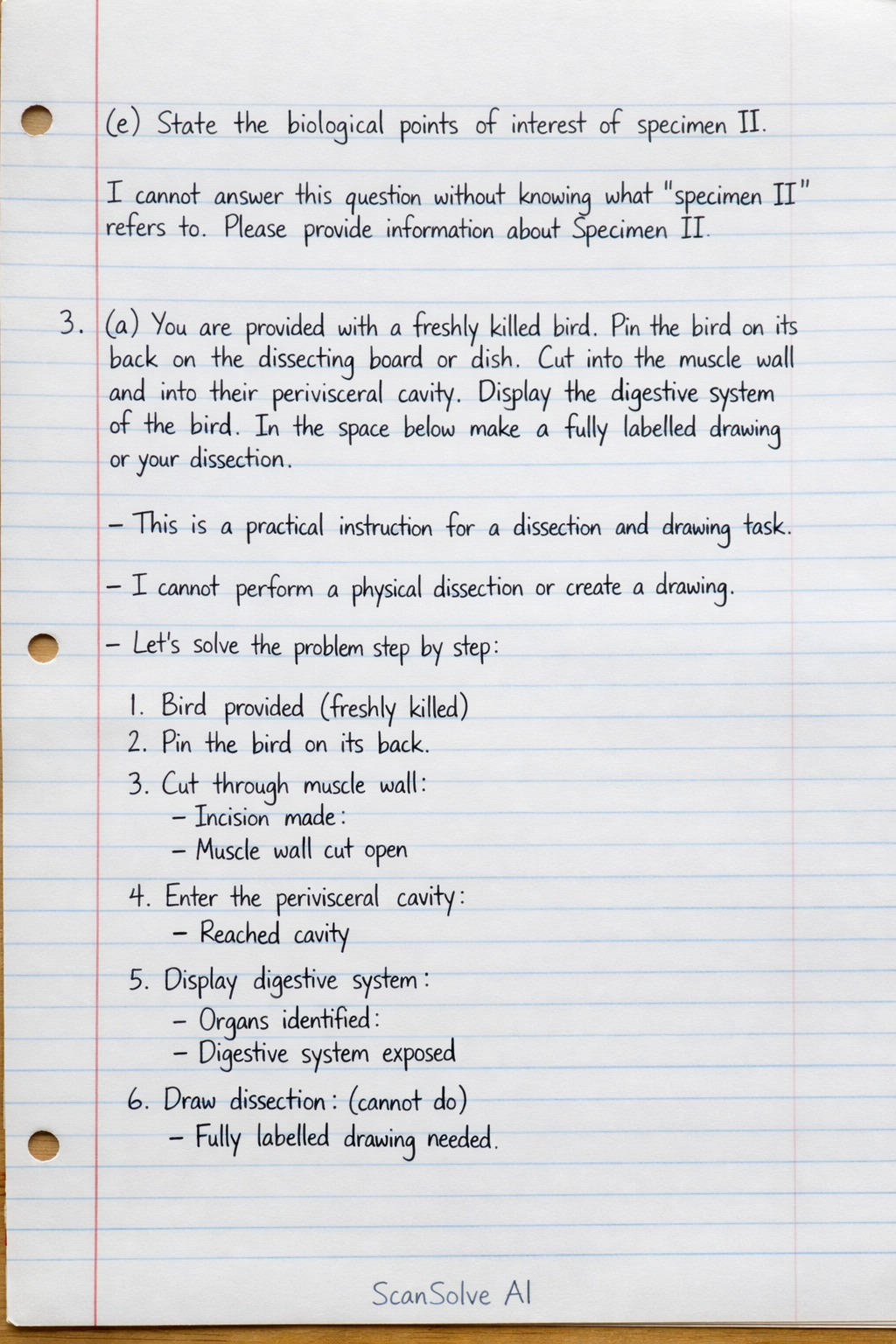
2. (e) State the biological points of interest of specimen II.
I cannot answer this question without knowing what "specimen II" refers to. Please provide information about Specimen II.
3. (a) You are provided with a freshly killed bird. Pin the bird on its back on the dissecting board or dish. Cut into the muscle wall and into their perivisceral cavity. Display the digestive system of the bird. In the space below make a fully labelled drawing of your dissection.
This is a practical instruction for a dissection and drawing task. I cannot perform a physical dissection or create a drawing.
3. (b) How is the alimentary canal of the bird adapted to its diet?
The alimentary canal of a bird shows several adaptations related to its diet:
- Beak/Bill: The shape and size of the beak are highly specialized for food acquisition, such as crushing seeds, tearing flesh, filtering water, or probing for insects.
- Crop: Many birds possess a crop, an enlargement of the esophagus, which serves for temporary storage and softening of food, allowing them to ingest large quantities quickly.
- Two-part stomach: Birds have a glandular stomach called the proventriculus for chemical digestion with enzymes and acids, followed by a muscular stomach called the gizzard (or ventriculus) which mechanically grinds food, often with the aid of ingested grit or stones, especially prominent in seed-eating birds.
- Rapid Digestion: Birds generally have a high metabolic rate, particularly for flight, requiring efficient and rapid digestion and absorption of nutrients.
- Ceca: Some birds, particularly herbivores, have paired ceca at the junction of the small and large intestines, which contain microorganisms that aid in the fermentation and digestion of plant material.
- Short Rectum/Large Intestine: The large intestine is typically short, primarily for water absorption, leading to rapid excretion of waste and reduced body weight for flight.
Still stuck on this one?
Ask a follow-up, and the answer starts from this question.
More Biology Questions
Handwritten Step-by-Step Solution
Get this as a handwritten image on WhatsApp — like a tutor wrote it for you.
Try on WhatsApp