
We read your photo as:
Explain the biological reasons behind: i) Red blood cells bursting in hypotonic solution, ii) Plant cells shrinking in hypertonic solution, iii) Left ventricle wall thicker than right, iv) Ventricle w
ScanSolve AI Answer
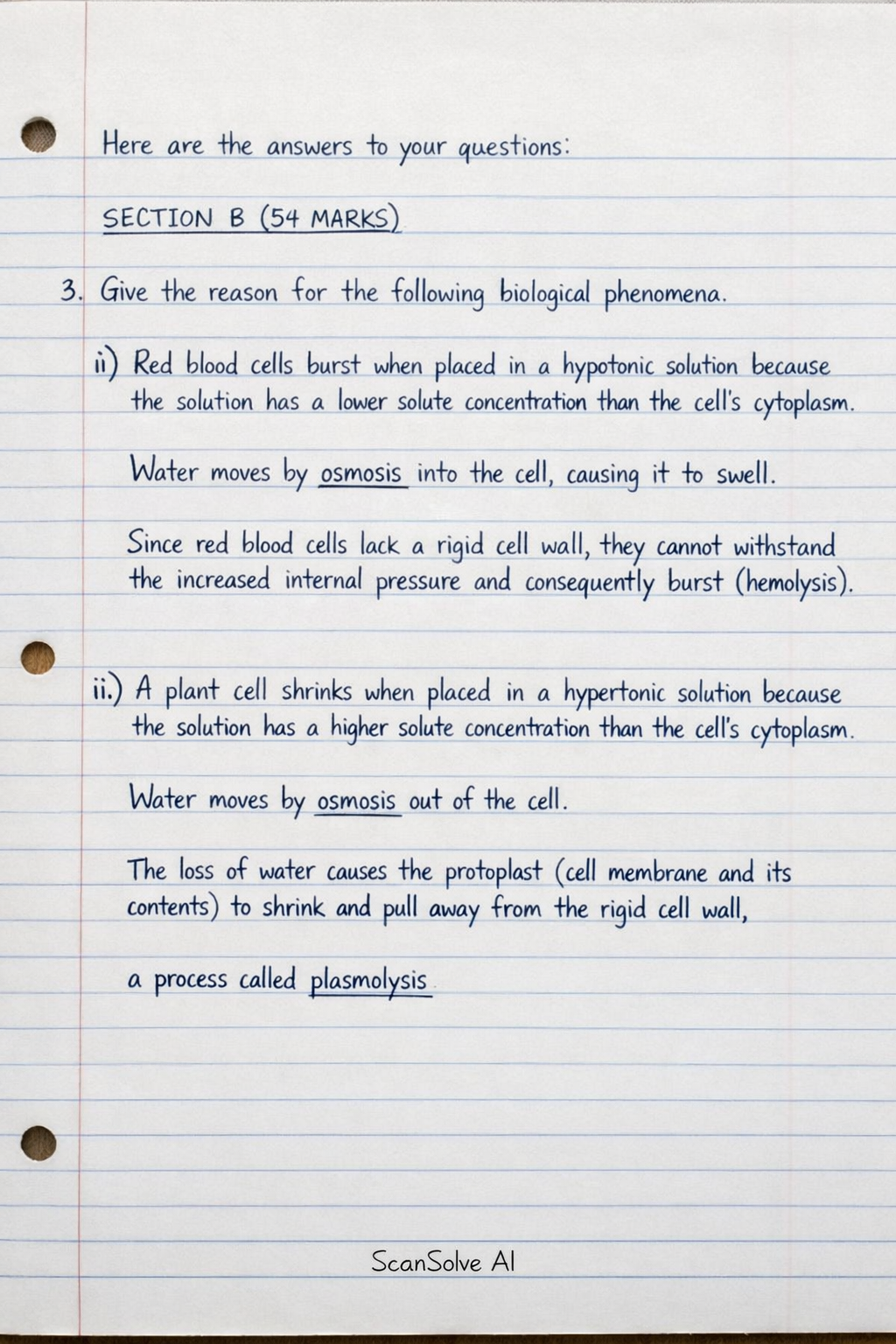
Here are the answers to your questions:
SECTION B (54 MARKS)
3. Give the reason for the following biological phenomena
i) Red blood cells burst when placed in a hypotonic solution because the solution has a lower solute concentration than the cell's cytoplasm. Water moves by osmosis into the cell, causing it to swell. Since red blood cells lack a rigid cell wall, they cannot withstand the increased internal pressure and consequently burst (hemolysis).
ii) A plant cell shrinks when placed in a hypertonic solution because the solution has a higher solute concentration than the cell's cytoplasm. Water moves by osmosis out of the cell. The loss of water causes the protoplast (cell membrane and its contents) to shrink and pull away from the rigid cell wall, a process called plasmolysis.
iii) The walls of the left ventricle are thicker than the wall of the right ventricle because the left ventricle pumps oxygenated blood to the entire body (systemic circulation), which requires significantly higher pressure and force to overcome resistance and reach distant tissues. The right ventricle only pumps deoxygenated blood to the lungs (pulmonary circulation), a shorter circuit requiring less pressure.
iv) The walls of the ventricles are thicker than those of the auricles (atria) because ventricles are the main pumping chambers that eject blood into the arteries to circulate it to the lungs and the rest of the body, requiring strong muscular contractions. Auricles (atria) are receiving chambers that only pump blood a short distance into the ventricles, thus requiring less muscular force.
v) It is healthier to breathe through the nose than through the mouth because the nasal cavity is adapted to filter, warm, and humidify inhaled air. Hairs and mucus trap dust and pathogens, and the rich blood supply warms the air, while moisture humidifies it. Breathing through the mouth bypasses these protective mechanisms, allowing unfiltered, unwarmed, and unhumidified air to enter the lungs, which can cause irritation and increase the risk of infection.
vi) Freshwater fish die when introduced into marine (salt) water because freshwater fish are adapted to a hypotonic environment and constantly gain water while losing salts. Marine water is hypertonic (higher salt concentration). In marine water, freshwater fish would rapidly lose water from their bodies by osmosis and gain excessive salts, leading to severe dehydration and failure of their osmoregulatory systems.
4.a) Explain the following biological terms
i) Gaseous exchange: This is the process by which gases, primarily oxygen and carbon dioxide, are exchanged between an organism and its external environment. It occurs across specialized respiratory surfaces (e.g., alveoli in lungs, gills) via diffusion, driven by differences in partial pressures of the gases.
ii) Respiration: This is a biochemical process in living organisms where organic substances, typically glucose, are broken down to release chemical energy. This energy is then captured and stored in ATP (adenosine triphosphate) molecules for cellular activities. Respiration can be aerobic (with oxygen) or anaerobic (without oxygen).
4.b) State four differences between aerobic and anaerobic respiration
- Oxygen Requirement: Aerobic respiration requires oxygen, while anaerobic respiration does not.
- Energy Yield: Aerobic respiration produces a large amount of ATP (e.g., 30-32 ATP molecules per glucose), whereas anaerobic respiration produces a small amount of ATP (e.g., 2 ATP molecules per glucose).
- Glucose Breakdown: Aerobic respiration involves the complete breakdown of glucose, while anaerobic respiration involves the partial breakdown of glucose.
- End Products: Aerobic respiration produces carbon dioxide and water. Anaerobic respiration produces lactic acid (in animals) or ethanol and carbon dioxide (in yeast).
4.c) State three features of respiratory surface
- Large surface area: To maximize the rate of gas diffusion.
- Thin walls: To minimize the diffusion distance for gases.
- Moist surface: To allow gases to dissolve before diffusing across the membrane.
- Rich blood supply (vascularization): To maintain a steep concentration gradient for gases by continuously transporting them away.
Still stuck on this one?
Ask a follow-up, and the answer starts from this question.
More Biology Questions
Handwritten Step-by-Step Solution
Get this as a handwritten image on WhatsApp — like a tutor wrote it for you.
Try on WhatsApp