

This biology question covers important biological concepts and processes. The step-by-step explanation below helps you understand the underlying mechanisms and reasoning.
ScanSolve AI Answer
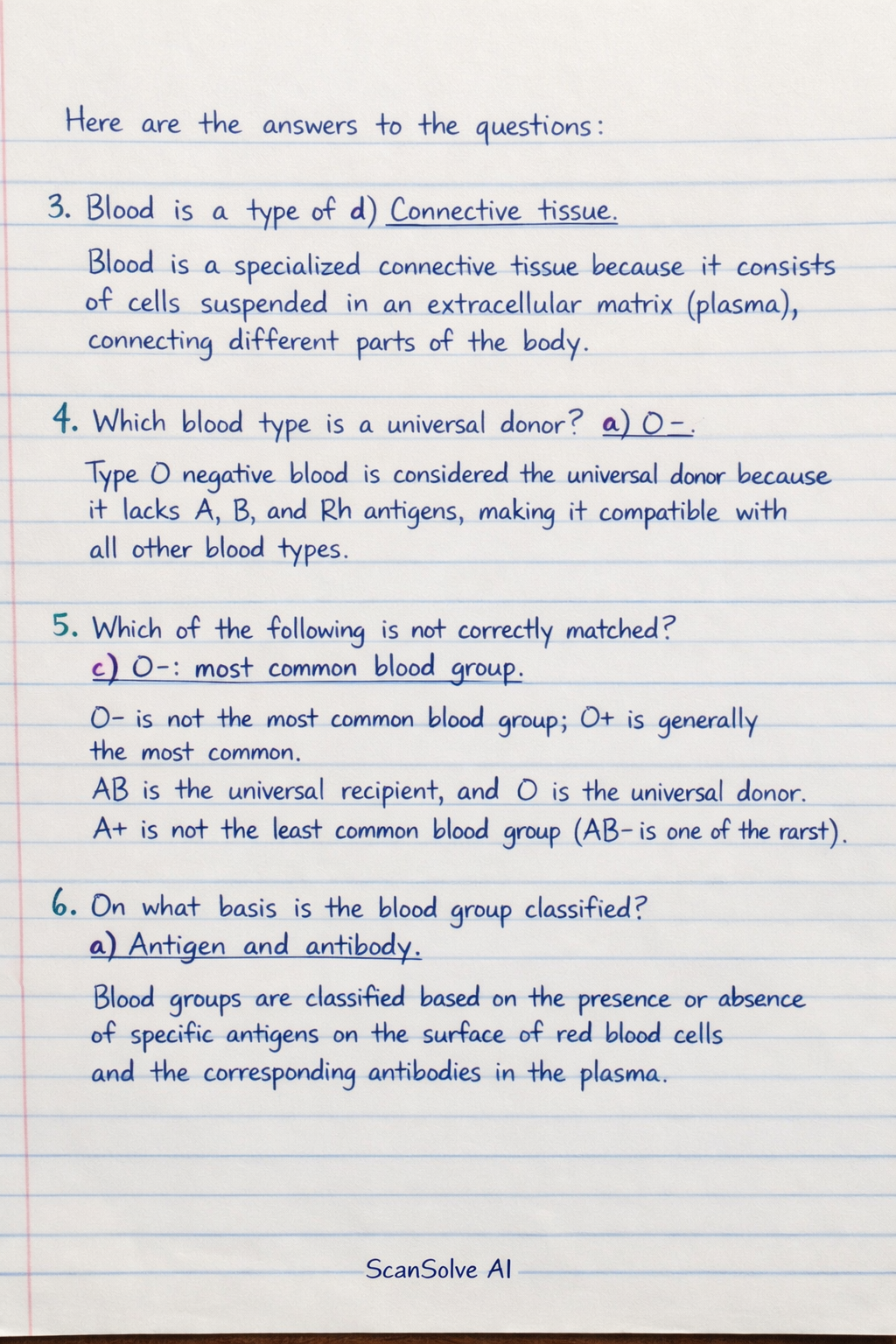
Here are the answers to the questions: 3. Blood is a type of d) Connective tissue. Blood is a specialized connective tissue because it consists of cells suspended in an extracellular matrix (plasma), connecting different parts of the body. 4. Which blood type is a universal donor? a) O -. Type O negative blood is considered the universal donor because it lacks A, B, and Rh antigens, making it compatible with all other blood types. 5. Which of the following is not correctly matched? c) O-: most common blood group. O- is not the most common blood group; O+ is generally the most common. AB is the universal recipient, and O is the universal donor. A+ is not the least common blood group (AB- is one of the rarest). 6. On what basis is the blood group classified? a) Antigen and antibody. Blood groups are classified based on the presence or absence of specific antigens on the surface of red blood cells and the corresponding antibodies in the plasma. 7. Process of formation of blood corpuscles is called c) Haemopoiesis. Haemopoiesis (or hematopoiesis) is the process by which all blood cellular components are formed. That's 2 down. 3 left today — send the next one.