
We read your photo as:
Briefly explain the roles of lipids, proteins, and enzymes in the human body. Describe the functions of bile juice in digestion.
ScanSolve AI Answer
Step-by-step solution
9 stepsAnswer question 13 b).
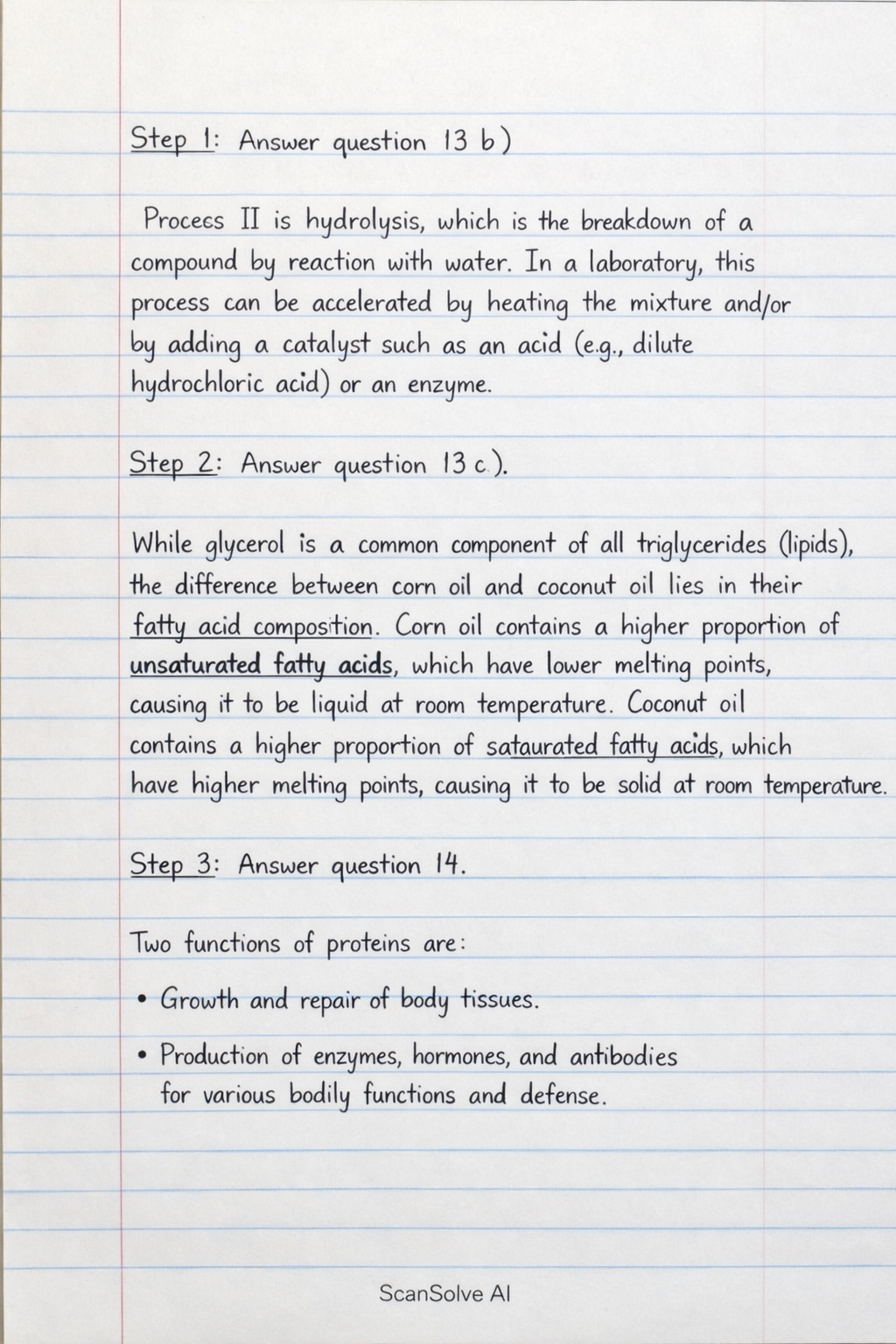
Process II is hydrolysis, which is the breakdown of a compound by reaction with water. In a laboratory, this process can be accelerated by heating the mixture and/or by adding a catalyst such as an acid (e.g., dilute hydrochloric acid) or an enzyme.
Answer question 13 c).
While glycerol is a common component of all triglycerides (lipids), the difference between corn oil and coconut oil lies in their fatty acid composition. Corn oil contains a higher proportion of unsaturated fatty acids, which have lower melting points, causing it to be liquid at room temperature. Coconut oil contains a higher proportion of saturated fatty acids, which have higher melting points, causing it to be solid at room temperature.
Answer question 14.
Two functions of proteins are:
- Growth and repair of body tissues.
- Production of enzymes, hormones, and antibodies for various bodily functions and defense.
Answer question 15 a).
Two functions of bile juice in digestion are:
- Emulsification of fats: It breaks down large fat globules into smaller ones, increasing the surface area for lipase action.
- Neutralization of acidic chyme: It neutralizes the acidic chyme from the stomach, providing an optimal alkaline pH for the action of pancreatic enzymes in the small intestine.
Answer question 15 b).
Pepsin is secreted in its inactive form, pepsinogen, to prevent it from digesting the proteins of the stomach wall itself (autodigestion). It is only activated into pepsin by hydrochloric acid in the stomach lumen.
Answer question 15 c).
Another enzyme that is also secreted in an inactive form is trypsin (secreted as trypsinogen).
Answer question 16.
Two roles of hydrochloric acid produced by the wall of the human stomach are:
- It provides an acidic medium (optimal pH) for the action of pepsin, which digests proteins.
- It kills most bacteria ingested with food, preventing infections.
Answer question 17.
Two functions of the large intestine in humans are:
- Absorption of water and mineral salts from undigested food material.
- Storage and elimination of undigested waste material (feces) from the body.
Answer question 18.
The diagram mentioned in question 18 is not visible in the provided image, so this question cannot be answered.
Still stuck on this one?
Ask a follow-up, and the answer starts from this question.
More Biology Questions
Handwritten Step-by-Step Solution
Get this as a handwritten image on WhatsApp — like a tutor wrote it for you.
Try on WhatsApp