
We read your photo as:
Describe the cardiac cycle, including the roles of the different chambers and valves.
ScanSolve AI Answer
Step-by-step solution
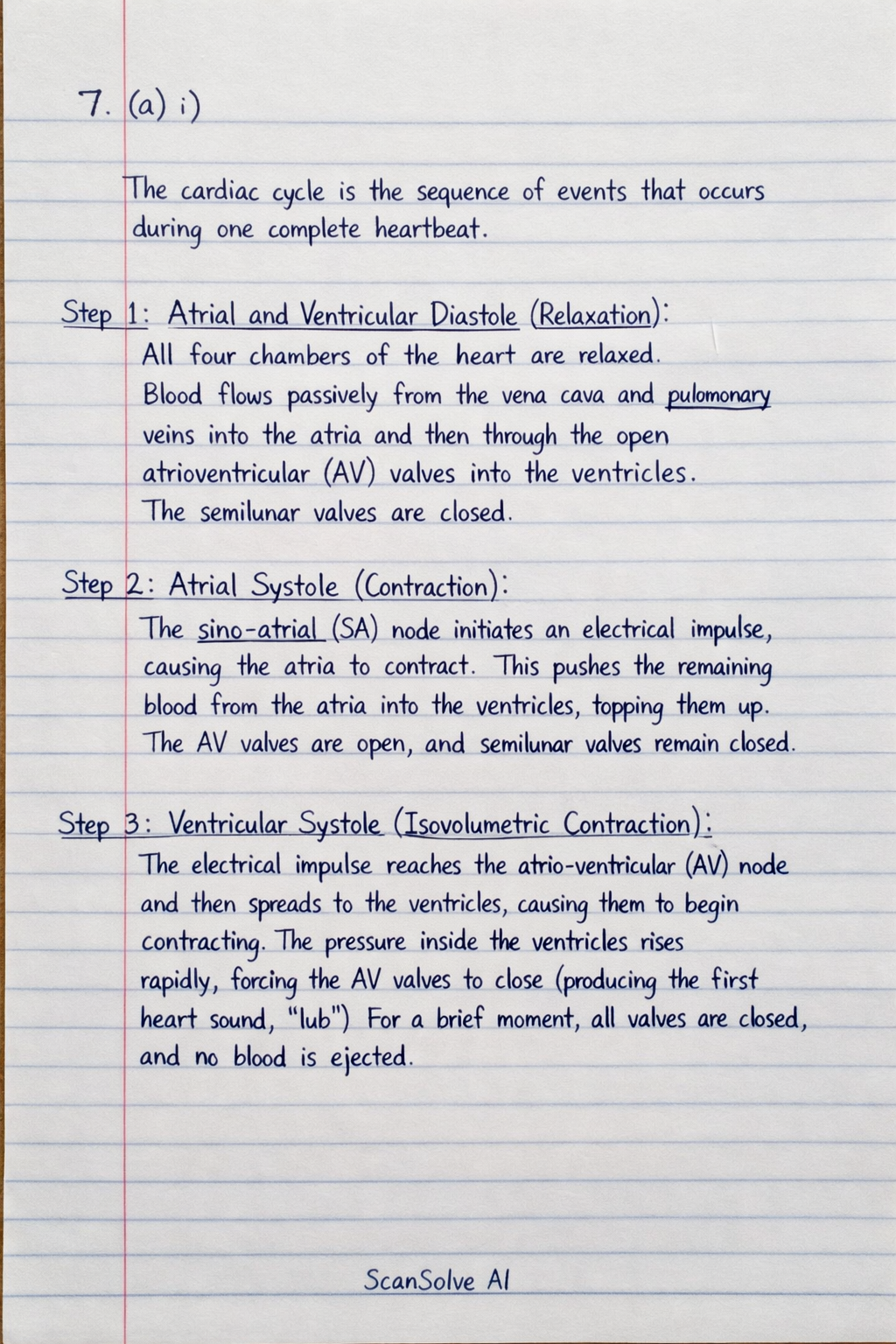
11 steps7. (a) i)
The cardiac cycle is the sequence of events that occurs during one complete heartbeat.
Atrial and Ventricular Diastole (Relaxation)**
All four chambers of the heart are relaxed. Blood flows passively from the vena cava and pulmonary veins into the atria and then through the open atrioventricular (AV) valves into the ventricles. The semilunar valves are closed.
Atrial Systole (Contraction)**
The sino-atrial (SA) node initiates an electrical impulse, causing the atria to contract. This pushes the remaining blood from the atria into the ventricles, topping them up. The AV valves are open, and semilunar valves remain closed.
Ventricular Systole (Isovolumetric Contraction)**
The electrical impulse reaches the atrio-ventricular (AV) node and then spreads to the ventricles, causing them to begin contracting. The pressure inside the ventricles rises rapidly, forcing the AV valves to close (producing the first heart sound, "lub"). For a brief moment, all valves are closed, and no blood is ejected.
Ventricular Systole (Ejection Phase)**
As ventricular pressure continues to rise and exceeds the pressure in the aorta and pulmonary artery, the semilunar valves open. Blood is rapidly ejected from the left ventricle into the aorta and from the right ventricle into the pulmonary artery.
Ventricular Diastole (Isovolumetric Relaxation)**
The ventricles relax, and the pressure inside them drops. As ventricular pressure falls below the pressure in the aorta and pulmonary artery, the semilunar valves close (producing the second heart sound, "dub") to prevent backflow. For a brief moment, all valves are closed.
Return to Atrial and Ventricular Diastole**
As ventricular pressure continues to drop and falls below atrial pressure, the AV valves open, and the cycle returns to Step 1, with blood flowing passively into the ventricles.
7. (a) ii)
A diagram of the heart would show:- The sino-atrial (SA) node located in the wall of the right atrium, near the opening of the superior vena cava.
- The atrio-ventricular (AV) node located in the interatrial septum, near the junction of the atria and ventricles, just above the tricuspid valve.
7. (b)
During exercise, the nervous and hormonal systems coordinate to increase heart rate:Nervous System (Sympathetic)**
Increased physical activity leads to higher metabolic demand, resulting in increased levels and decreased pH in the blood. These changes are detected by chemoreceptors in the carotid arteries and aorta. Proprioceptors in muscles and joints also detect movement.
These signals are sent to the cardiac control center in the medulla oblongata of the brain.
The medulla increases the activity of the sympathetic nervous system and decreases the activity of the parasympathetic nervous system.
Sympathetic nerves release the neurotransmitter norepinephrine (noradrenaline) directly onto the SA node.
Norepinephrine binds to receptors on the SA node cells, increasing the rate at which they depolarize and generate electrical impulses, thus increasing heart rate.
Hormonal System**
In response to stress or anticipation of exercise, the adrenal medulla (part of the adrenal gland) releases the hormones epinephrine (adrenaline) and some norepinephrine into the bloodstream.
These hormones travel through the blood and bind to the same receptors on the SA node cells as norepinephrine from the sympathetic nerves.
This further enhances the rate of SA node depolarization, leading to an additional increase in heart rate and force of contraction.
Both systems work synergistically to ensure that the heart pumps more blood per minute, delivering sufficient oxygen and nutrients to the working muscles and removing waste products.7. (c)
Two factors linked to the rising cases of hypertension in urban areas of Cameroon and their effect on the cardiac cycle are:-
High Sodium Intake:
- Factor: Urban diets often include a higher consumption of processed foods, fast foods, and restaurant meals, which are typically high in sodium (salt).
- Effect on Cardiac Cycle: High sodium intake leads to increased water retention in the body, which in turn increases the total blood volume. This increased blood volume means the heart has to pump a larger amount of blood with each beat, increasing the preload on the ventricles. To overcome this increased volume and maintain adequate blood flow, the heart must work harder, leading to higher pressure during ventricular systole. Over time, this sustained increased workload can lead to the thickening of the heart muscle (ventricular hypertrophy) and reduced efficiency of the cardiac cycle, contributing to hypertension.
-
Sedentary Lifestyle:
- Factor: Urbanization often brings about more sedentary occupations (desk jobs), increased reliance on motorized transport, and fewer opportunities for regular physical activity compared to rural lifestyles.
- Effect on Cardiac Cycle: A sedentary lifestyle contributes to obesity, poor cardiovascular fitness, and can lead to the development of atherosclerosis (hardening and narrowing of arteries due to plaque buildup). This narrowing of blood vessels increases peripheral resistance (afterload) that the heart must pump against. The heart has to generate significantly higher pressure during ventricular systole to eject blood into these stiff, narrowed arteries. This chronic increase in workload can lead to ventricular hypertrophy and eventually impair the heart's ability to pump efficiently, disrupting the normal cardiac cycle and resulting in elevated blood pressure.
-
Still stuck on this one?
Ask a follow-up, and the answer starts from this question.
More Biology Questions
Handwritten Step-by-Step Solution
Get this as a handwritten image on WhatsApp — like a tutor wrote it for you.
Try on WhatsApp