
We read your photo as:
Describe the characteristics of circulatory systems, differentiate between open and closed systems, and explain the process of blood clotting.
ScanSolve AI Answer
Step-by-step solution
4 stepsPart a
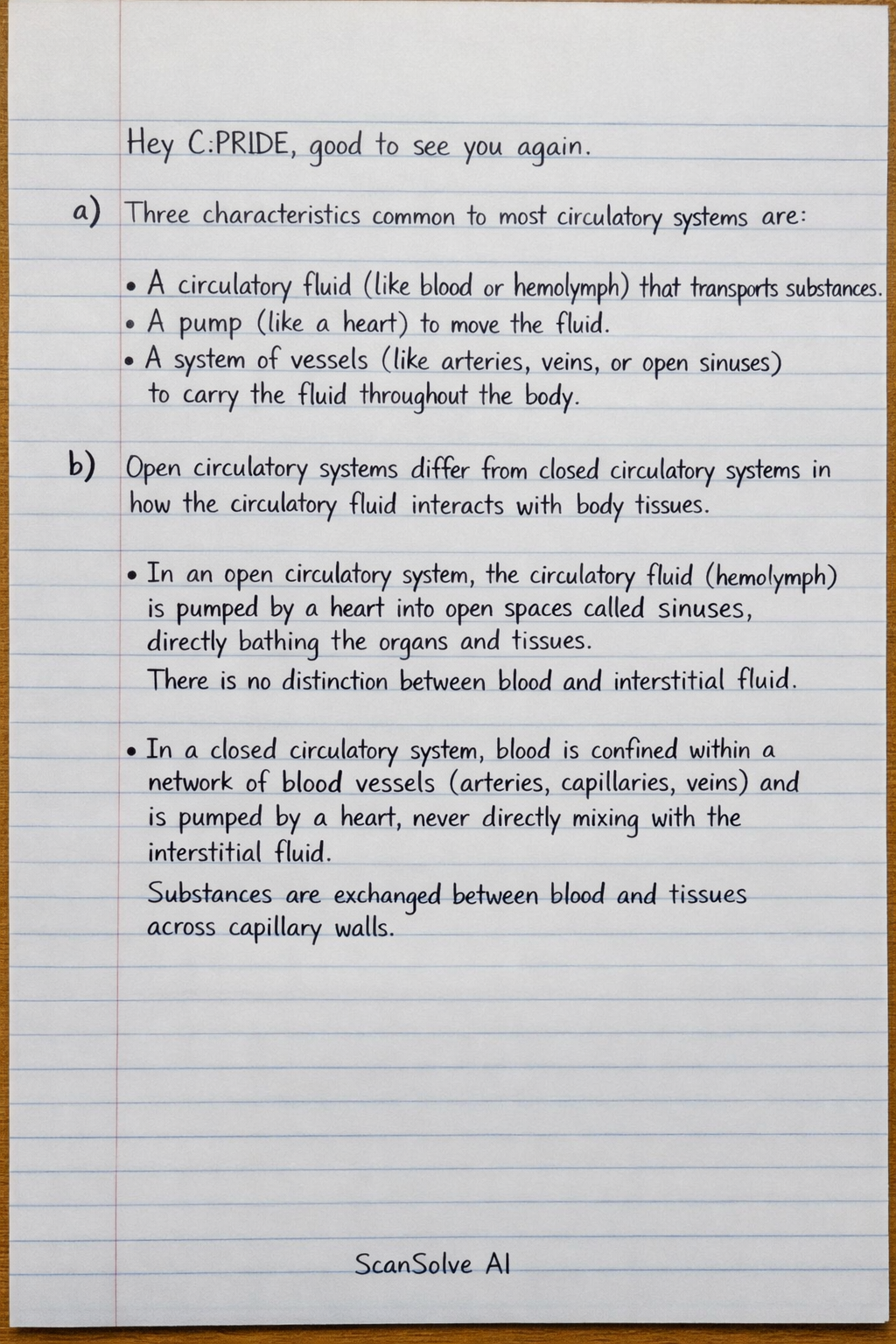
Three characteristics common to most circulatory systems are
- A circulatory fluid (like blood or hemolymph) that transports substances.
- A pump (like a heart) to move the fluid.
- A system of vessels (like arteries, veins, or open sinuses) to carry the fluid throughout the body.
Part b
Open circulatory systems differ from closed circulatory systems in how the circulatory fluid interacts with body tissues.
- In an open circulatory system, the circulatory fluid (hemolymph) is pumped by a heart into open spaces called sinuses, directly bathing the organs and tissues. There is no distinction between blood and interstitial fluid.
- In a closed circulatory system, blood is confined within a network of blood vessels (arteries, capillaries, veins) and is pumped by a heart, never directly mixing with the interstitial fluid. Substances are exchanged between blood and tissues across capillary walls.
Part c· 4 steps
The series of events that occur during blood clotting (hemostasis) are
Vascular Spasm*
When a blood vessel is injured, the smooth muscle in its wall contracts, reducing blood flow to the damaged area.
Platelet Plug Formation*
Platelets adhere to the exposed collagen fibers at the injury site and become activated. They release chemicals that attract more platelets, forming a temporary platelet plug.
Coagulation (Blood Clotting)*
A complex cascade of enzymatic reactions involving clotting factors (proteins) in the blood plasma is initiated. This cascade ultimately converts inactive prothrombin into active thrombin. Thrombin then converts soluble fibrinogen into insoluble fibrin threads.
Clot Retraction and Repair*
Fibrin threads form a mesh that traps red blood cells and platelets, creating a stable blood clot. The clot then retracts, pulling the edges of the damaged vessel together, and tissue repair begins.
Part d
Oxygen is transported by blood primarily in two ways
- Bound to Hemoglobin: The vast majority of oxygen (about 98.5%) is transported by binding to hemoglobin, a protein found in red blood cells. Each hemoglobin molecule can bind up to four oxygen molecules, forming oxyhemoglobin. This allows blood to carry a large amount of oxygen efficiently.
- Dissolved in Plasma: A small amount of oxygen (about 1.5%) is transported directly dissolved in the blood plasma. This dissolved oxygen contributes to the partial pressure of oxygen in the blood, which drives the loading and unloading of oxygen from hemoglobin.
Still stuck on this one?
Ask a follow-up, and the answer starts from this question.
More Biology Questions
Handwritten Step-by-Step Solution
Get this as a handwritten image on WhatsApp — like a tutor wrote it for you.
Try on WhatsApp