
We read your photo as:
Classification of living things 2. Cell (Draw a well labelled diagram) 3. Plant and animal cells.
ScanSolve AI Answer
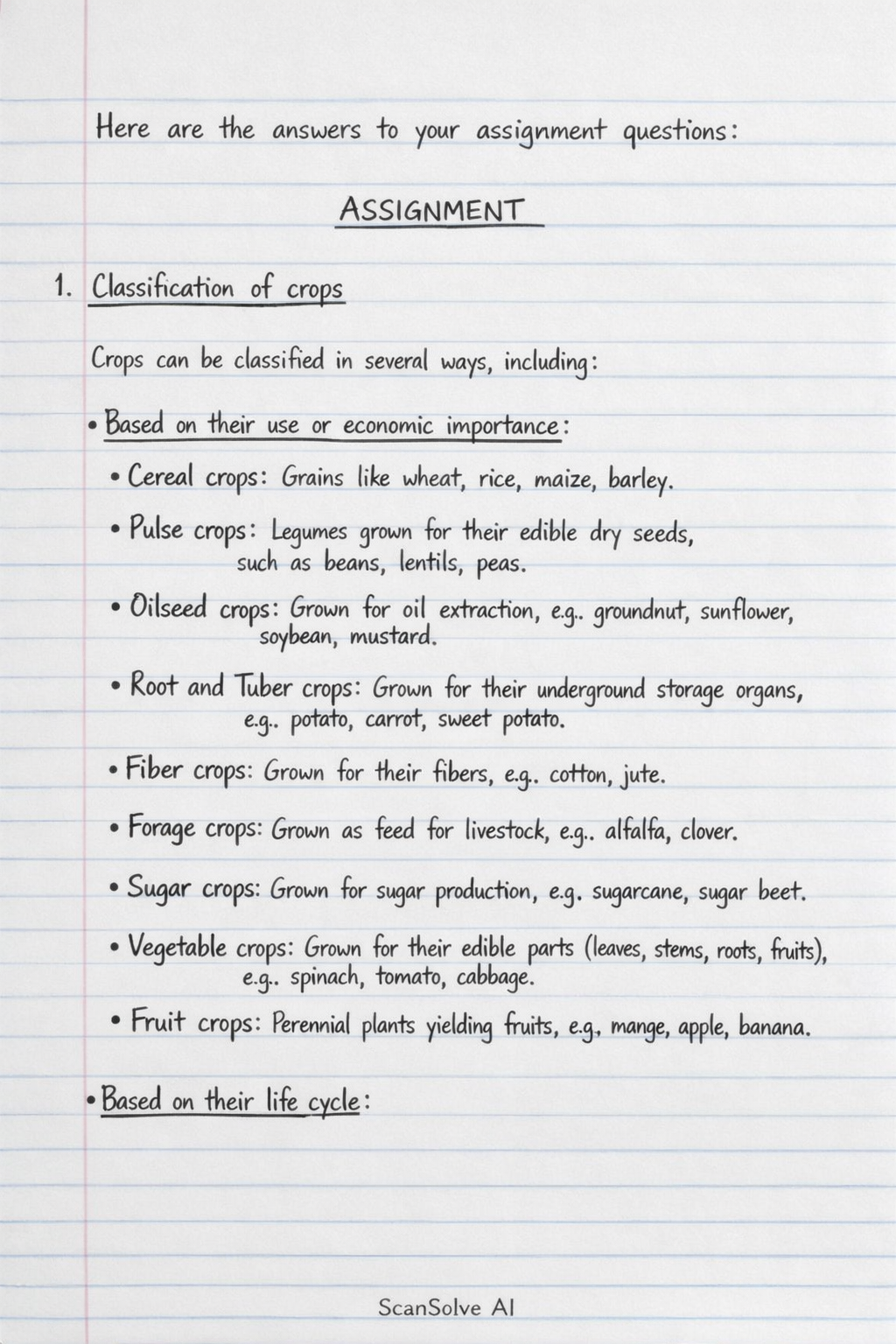
Here are the answers to your assignment questions:
ASSIGNMENT
1. Classification of crops
Crops can be classified in several ways, including:
- Based on their use or economic importance:
- Cereal crops: Grains like wheat, rice, maize, barley.
- Pulse crops: Legumes grown for their edible dry seeds, such as beans, lentils, peas.
- Oilseed crops: Grown for oil extraction, e.g., groundnut, sunflower, soybean, mustard.
- Root and Tuber crops: Grown for their underground storage organs, e.g., potato, carrot, sweet potato.
- Fiber crops: Grown for their fibers, e.g., cotton, jute.
- Forage crops: Grown as feed for livestock, e.g., alfalfa, clover.
- Sugar crops: Grown for sugar production, e.g., sugarcane, sugar beet.
- Vegetable crops: Grown for their edible parts (leaves, stems, roots, fruits), e.g., spinach, tomato, cabbage.
- Fruit crops: Perennial plants yielding fruits, e.g., mango, apple, banana.
- Based on their life cycle:
- Annual crops: Complete their life cycle in one growing season (e.g., wheat, rice).
- Biennial crops: Complete their life cycle in two growing seasons (e.g., carrot, onion).
- Perennial crops: Live for more than two years (e.g., fruit trees, alfalfa).
- Based on climatic conditions:
- Tropical crops: Grow in warm climates (e.g., rice, sugarcane).
- Temperate crops: Grow in cooler climates (e.g., wheat, apple).
- Based on growing season (in some regions like India):
- Kharif crops (Monsoon crops): Sown in June-July, harvested in September-October (e.g., rice, maize, cotton).
- Rabi crops (Winter crops): Sown in October-November, harvested in March-April (e.g., wheat, barley, mustard).
- Zaid crops (Summer crops): Sown in March-June (e.g., cucumber, watermelon).
2. Cell (Draw a well labelled diagram of plant and animal cells.)
Since I cannot draw, I will describe the key features and differences between plant and animal cells that should be included in a well-labeled diagram.
-
Common Organelles (present in both plant and animal cells):
- Cell membrane: Outer boundary, controls passage of substances.
- Cytoplasm: Jelly-like substance filling the cell, where organelles are suspended.
- Nucleus: Contains genetic material (DNA), controls cell activities.
- Nuclear envelope: Double membrane surrounding the nucleus.
- Nucleolus: Involved in ribosome synthesis.
- Chromatin: DNA and proteins.
- Mitochondria: Powerhouses of the cell, produce ATP through cellular respiration.
- Endoplasmic Reticulum (ER): Network of membranes involved in protein and lipid synthesis.
- Rough ER: Has ribosomes, involved in protein synthesis and modification.
- Smooth ER: Lacks ribosomes, involved in lipid synthesis and detoxification.
- Ribosomes: Sites of protein synthesis.
- Golgi apparatus (or Golgi complex/body): Modifies, sorts, and packages proteins and lipids.
- Lysosomes: Contain digestive enzymes (more common in animal cells, rare in plant cells).
- Peroxisomes: Involved in metabolic processes, breaking down fatty acids.
-
Key Differences to highlight in diagrams:
-
Plant Cell Specific Features:
- Cell wall: Rigid outer layer outside the cell membrane, provides structural support and protection.
- Chloroplasts: Sites of photosynthesis, contain chlorophyll.
- Large central vacuole: Stores water, nutrients, and waste products; maintains turgor pressure.
- Plasmodesmata: Channels through the cell wall connecting adjacent plant cells.
- Absence of centrioles (except in some lower plants).
-
Animal Cell Specific Features:
- No cell wall.
- No chloroplasts.
- Small, temporary, or no vacuoles.
- Centrioles: Involved in cell division, found in the centrosome.
- Lysosomes: More prominent and numerous.
- Cilia or flagella: May be present for movement.
-
A well-labeled diagram should clearly point out each of these structures for both a plant cell and an animal cell.
Still stuck on this one?
Ask a follow-up, and the answer starts from this question.
More Biology Questions
Handwritten Step-by-Step Solution
Get this as a handwritten image on WhatsApp — like a tutor wrote it for you.
Try on WhatsApp