
We read your photo as:
Explain the clinical correlations for the latissimus dorsi muscle, focusing on its use in musculocutaneous flaps and as a cardiac muscle substitute.
ScanSolve AI Answer
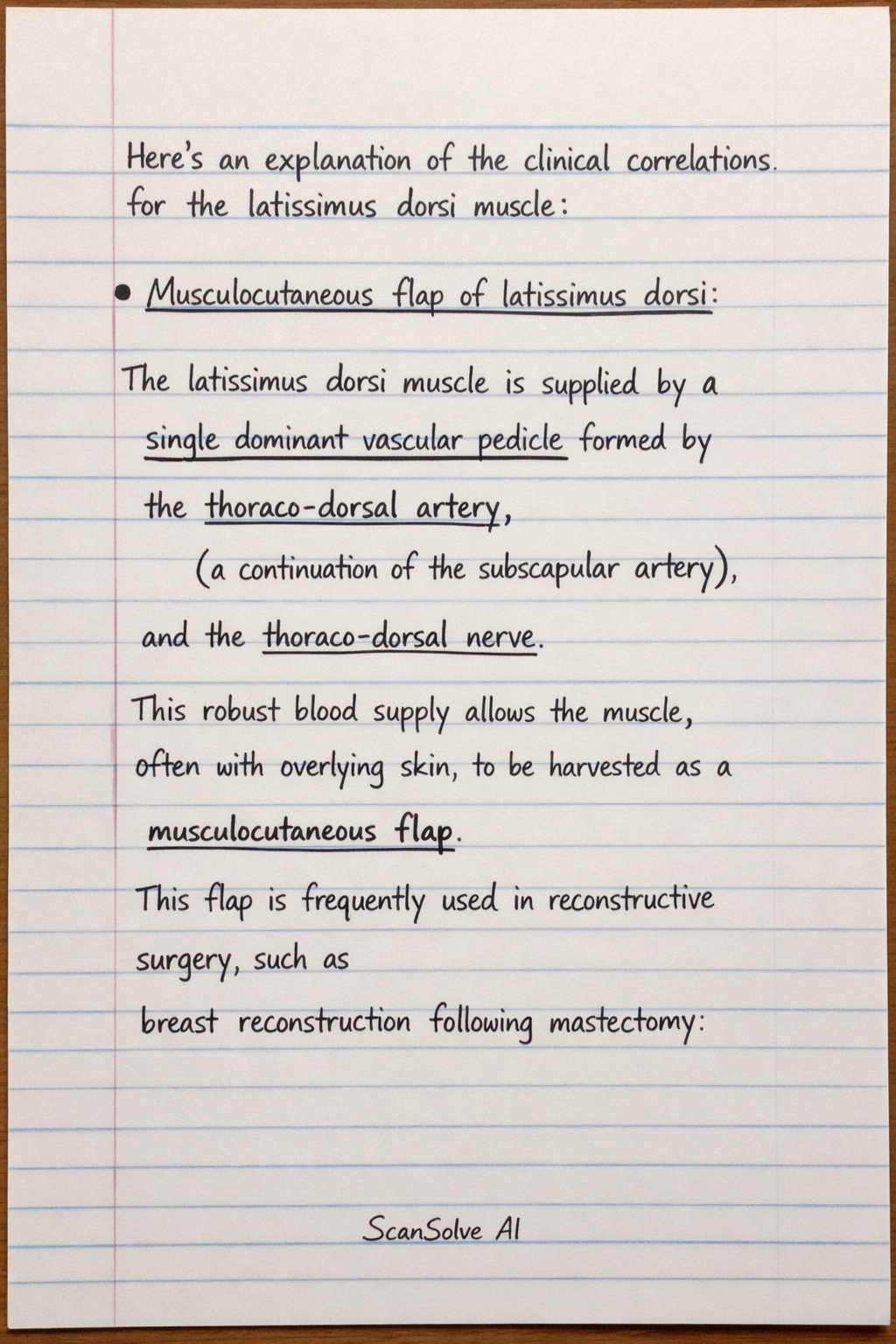
Here's an explanation of the clinical correlations for the latissimus dorsi muscle:
-
Musculocutaneous flap of latissimus dorsi: The latissimus dorsi muscle is supplied by a single dominant vascular pedicle formed by the thoraco-dorsal artery (a continuation of the subscapular artery) and the thoraco-dorsal nerve. This robust blood supply allows the muscle, often with overlying skin, to be harvested as a musculocutaneous flap. This flap is frequently used in reconstructive surgery, such as breast reconstruction following mastectomy.
-
Conditioning of latissimus dorsi to act as a cardiac muscle: The latissimus dorsi muscle can be conditioned with pulsed electrical impulses to transform its function. After conditioning, it behaves like cardiac muscle, becoming non-fatigable and using oxygen at a steady rate. This conditioned muscle can then be used as an autotransplant to repair surgically removed portions of the heart. The procedure involves detaching the muscle from its origin, keeping its neurovascular pedicle intact, and wrapping it around the heart in the pericardial cavity. A pacemaker is necessary to ensure continuous rhythmic contractions.
Still stuck on this one?
Ask a follow-up, and the answer starts from this question.
More Biology Questions
Handwritten Step-by-Step Solution
Get this as a handwritten image on WhatsApp — like a tutor wrote it for you.
Try on WhatsApp