
We read your photo as:
Explain close breeding, line breeding, cross breeding, and out crossing in livestock breeding, and list ten factors for selecting breeding stock.
ScanSolve AI Answer
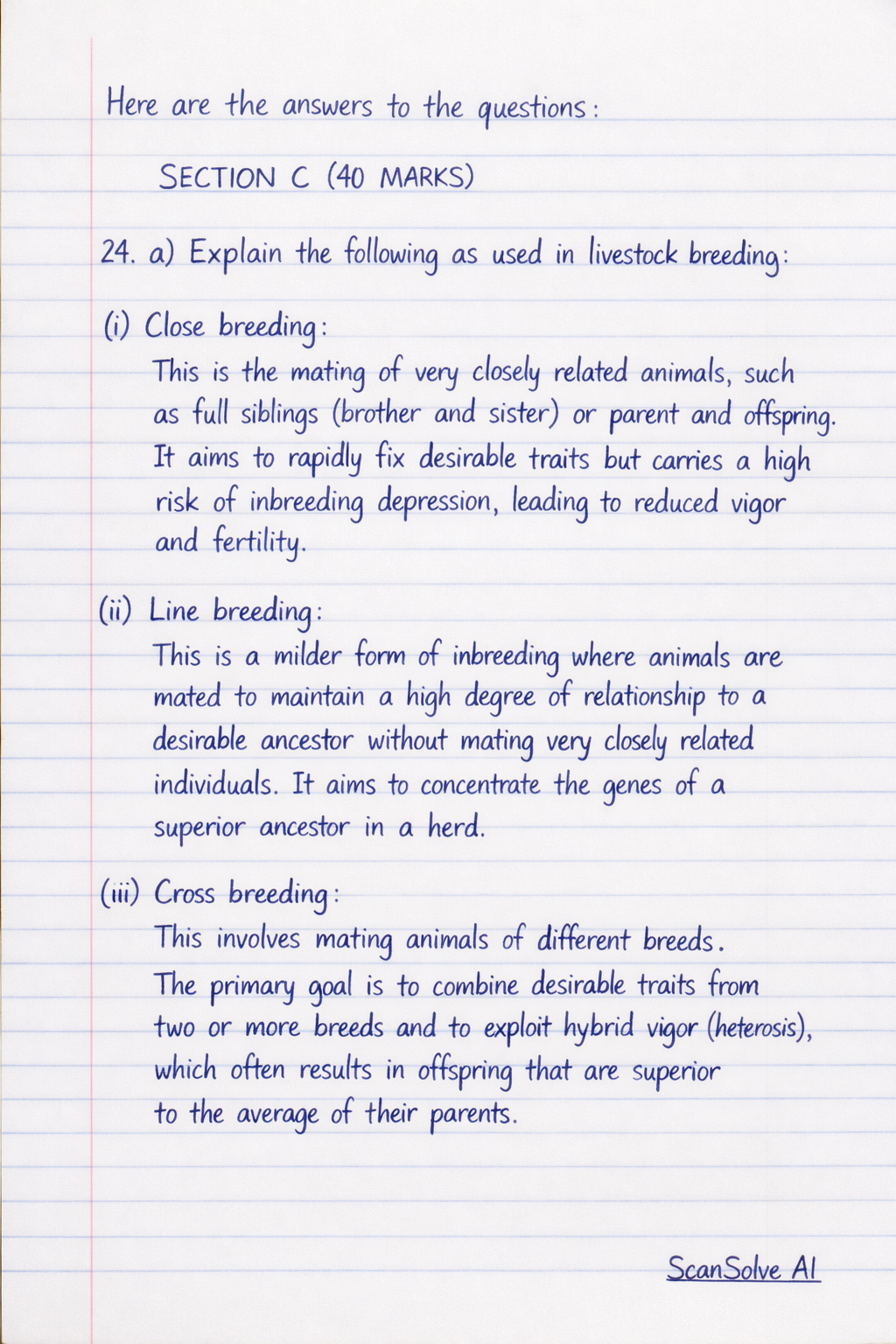
Here are the answers to the questions:
SECTION C (40 MARKS)
24. a) Explain the following as used in livestock breeding:
- (i) Close breeding: This is the mating of very closely related animals, such as full siblings (brother and sister) or parent and offspring. It aims to rapidly fix desirable traits but carries a high risk of inbreeding depression, leading to reduced vigor and fertility.
- (ii) Line breeding: This is a milder form of inbreeding where animals are mated to maintain a high degree of relationship to a desirable ancestor without mating very closely related individuals. It aims to concentrate the genes of a superior ancestor in a herd.
- (iii) Cross breeding: This involves mating animals of different breeds. The primary goal is to combine desirable traits from two or more breeds and to exploit hybrid vigor (heterosis), which often results in offspring that are superior to the average of their parents.
- (iv) Out crossing: This is the mating of unrelated animals within the same breed. It is used to introduce new genetic material into a line, increase genetic diversity, and reduce the effects of inbreeding, thereby improving vigor and productivity.
b) Explain ten factors to be considered when selecting a breeding stock.
- Age: Select animals that are mature enough for breeding but not too old, ensuring good reproductive performance and longevity.
- Health and Vigor: Choose healthy, disease-free animals that show good vitality and resistance to common diseases.
- Conformation/Physical Appearance: Select animals with desirable physical traits specific to the breed and purpose (e.g., strong legs, good udder attachment for dairy cattle).
- Temperament: Animals should have a calm and manageable temperament to ensure ease of handling and reduce stress.
- Fertility/Reproductive Performance: Select animals with a proven record of high fertility, regular breeding cycles, and successful offspring production.
- Production Records: Consider records such as milk yield, growth rate, egg production, or litter size, depending on the animal and production goal.
- Mothering Ability: For females, good maternal instincts, including caring for offspring and milk production, are crucial.
- Pedigree/Ancestry: Examine the lineage to ensure desirable traits are present in ancestors and to avoid genetic defects.
- Adaptability: Choose animals that are well-adapted to the local environmental conditions, including climate and feed availability.
- Economic Value/Market Demand: Select breeds or individuals whose products (meat, milk, eggs) are in high demand and fetch good market prices.
25. a) What are disease predisposing factors?
Disease predisposing factors are conditions or circumstances that make an animal more susceptible or vulnerable to developing a particular disease, even if the direct cause (e.g., pathogen) is present.
b) State five predisposing factors of mastitis in dairy cattle.
- Poor milking hygiene: Inadequate cleaning of udders and teats before milking, or dirty milking equipment.
- Faulty milking machines: Incorrect vacuum pressure or pulsation rate can injure teats, making them prone to infection.
- Injury to teats or udder: Cuts, bruises, or chaps on the teats can provide entry points for bacteria.
- Poor housing and bedding conditions: Dirty, wet, or poorly drained bedding can harbor mastitis-causing bacteria.
- Stress: Factors like nutritional deficiencies, heat stress, or overcrowding can weaken the cow's immune system.
c) Describe the characteristics of eggs selected for incubation.
- Size: Eggs should be of medium, uniform size, as very small or very large eggs often have poor hatchability.
- Shape: They should have a normal, oval shape. Abnormally shaped eggs (too round, too long, or misshapen) hatch poorly.
- Shell Quality: Shells should be smooth, strong, and free from cracks, thin spots, or ridges. Good shell quality protects the embryo and prevents moisture loss.
- Cleanliness: Eggs must be clean and free from dirt, feces, or blood. Washing is generally discouraged as it can remove the protective cuticle and introduce bacteria.
- Age: Eggs should be fresh, ideally 1-7 days old. Hatchability decreases significantly with older eggs.
- Source: Eggs should come from healthy, well-fed breeding stock that are free from diseases.
d) Explain any four general methods of disease control in livestock.
- Prevention: This involves measures taken to stop diseases from occurring in the first place. Examples include vaccination to build immunity, maintaining strict biosecurity (e.g., controlling access to the farm, disinfecting equipment), and providing proper nutrition to boost the animals' immune systems.
- Treatment: This involves administering medication to sick animals to cure them or alleviate symptoms. This includes using antibiotics for bacterial infections, anthelmintics for internal parasites, and antivirals for some viral diseases.
- Control of Vectors and Intermediate Hosts: Many diseases are transmitted by vectors (e.g., ticks, tsetse flies) or require an intermediate host (e.g., snails for liver flukes). Controlling these organisms through methods like dipping, spraying, or habitat modification can break the disease cycle.
- Culling/Slaughter: In cases of highly contagious or incurable diseases, infected animals may be culled (removed from the herd) or slaughtered to prevent further spread of the disease and protect the rest of the herd. This is often a last resort but can be crucial for disease eradication.
26. Discuss the management of layers from day old up to point of lay in a deep litter system.
The management of layers from day old up to the point of lay (pullet stage) in a deep litter system is crucial for developing healthy, productive hens.
-
Brooding Stage (Day 1 to 6-8 weeks):
- Housing Preparation: The deep litter house must be thoroughly cleaned, disinfected, and dried. A fresh layer of absorbent litter material (e.g., wood shavings, rice hulls) 10-15 cm deep is spread. Brooders (heat sources), feeders, and waterers are set up.
- Temperature Management: Chicks require high temperatures initially (around 32-35°C at chick level) for the first week, gradually reducing by about 3°C each week until ambient temperature is reached. This is achieved using brooders, and a brooder guard is used to confine chicks to the heated area.
- Feeding: Chicks are provided with a high-protein chick starter mash ad libitum (freely available) in shallow feeders to encourage early feeding.
- Water: Fresh, clean water must be available at all times in chick founts, which are gradually replaced with larger drinkers.
- Lighting: Continuous light (23-24 hours) is provided for the first few days to help chicks find feed and water, then gradually reduced to a consistent day length (e.g., 8-10 hours) during the grower stage.
- Vaccination: A strict vaccination schedule is followed to protect against common poultry diseases like Marek's, Newcastle, and Gumboro.
- Ventilation: Good ventilation is maintained to provide fresh air and remove ammonia, but drafts must be avoided.
- Litter Management: The litter is regularly stirred to keep it dry and prevent caking, which helps control ammonia and pathogen buildup.
-
Grower Stage (6-8 weeks to 18-20 weeks/Point of Lay):
- Space: As pullets grow, adequate floor space, feeder space, and drinker space are provided to prevent overcrowding and stress.
- Feeding: Pullets are switched to a grower mash, which has a lower protein and energy content than starter feed. Feed restriction may be practiced to control body weight and ensure uniform growth, preventing early maturity and prolapse.
- Water: Continuous access to fresh, clean water is essential.
- Lighting: A consistent day length (e.g., 8-10 hours) is maintained. Light stimulation (increasing day length) is avoided until the point of lay to prevent premature laying.
- Vaccination and Parasite Control: Booster vaccinations are administered as per schedule, and deworming is carried out to control internal parasites.
- Beak Trimming: If necessary, beak trimming may be performed to prevent feather pecking and cannibalism, especially in large flocks.
- Litter Management: Continued management of the deep litter is vital, ensuring it remains dry, friable, and well-aerated.
- Monitoring: Regular monitoring for health, growth rate, and flock uniformity is crucial. Any sick or stunted birds are identified and managed appropriately.
-
Transition to Lay (around 18-20 weeks):
- Feed Change: Pullets are gradually transitioned from grower mash to layer mash as they approach the point of lay (around 18-20 weeks), providing the necessary calcium and nutrients for egg production.
- Light Stimulation: The day length is gradually increased (e.g., by 30 minutes per week) to stimulate the onset of egg production and maximize peak lay.
- Nesting Boxes: Clean nesting boxes are introduced into the house to encourage hens to lay eggs in designated areas, reducing floor eggs and improving egg hygiene.
Still stuck on this one?
Ask a follow-up, and the answer starts from this question.
More Biology Questions
Handwritten Step-by-Step Solution
Get this as a handwritten image on WhatsApp — like a tutor wrote it for you.
Try on WhatsApp