

This biology question covers important biological concepts and processes. The step-by-step explanation below helps you understand the underlying mechanisms and reasoning.
ScanSolve AI Answer
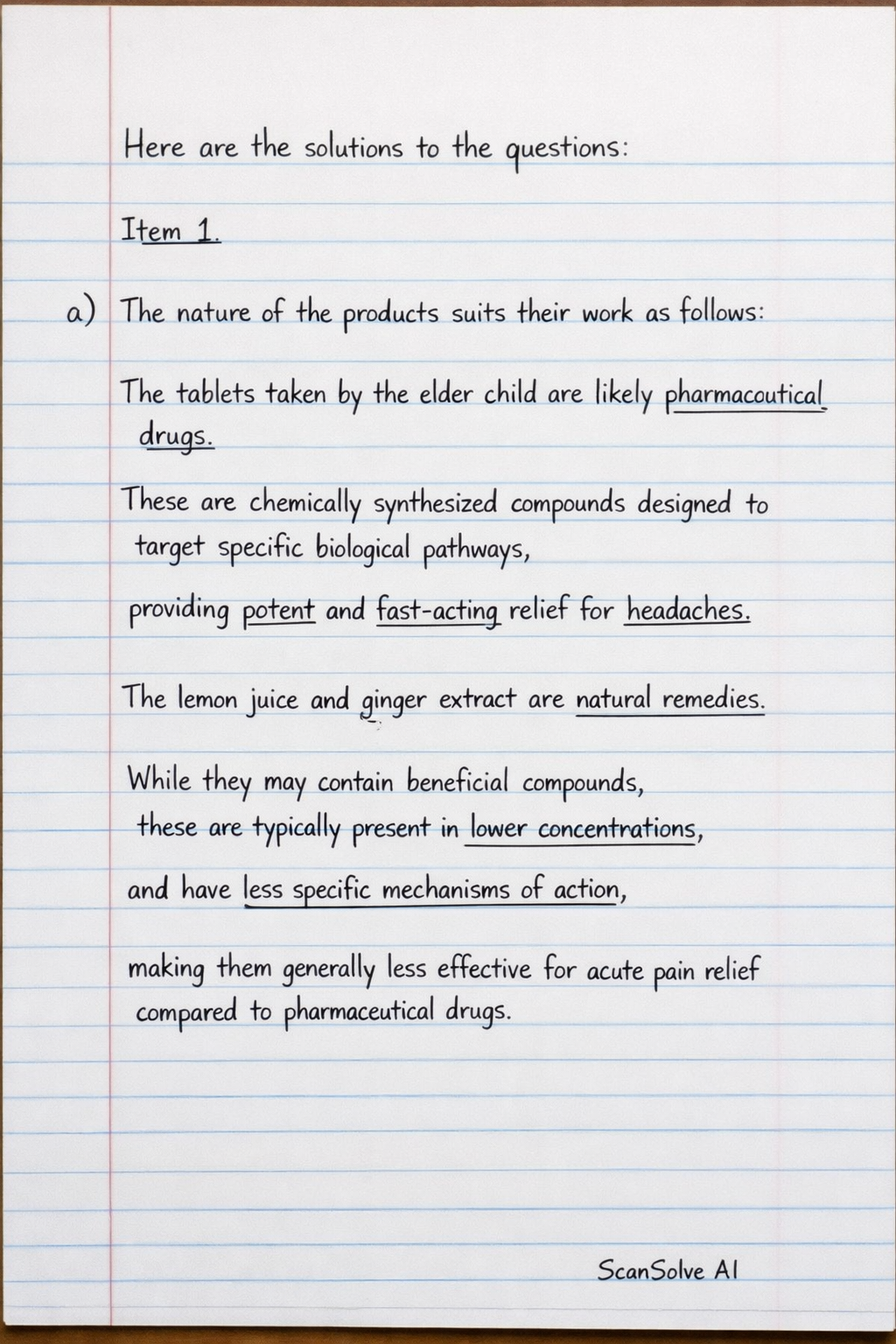
Here are the solutions to the questions: Item 1 a) The nature of the products suits their work as follows: The tablets taken by the elder child are likely pharmaceutical drugs. These are chemically synthesized compounds designed to target specific biological pathways, providing potent and fast-acting relief for symptoms like headaches. The lemon juice and ginger extract are natural remedies. While they may contain beneficial compounds, these are typically present in lower concentrations and have less specific mechanisms of action, making them generally less effective for acute pain relief compared to pharmaceutical drugs. b) After using the tablets for a long period of time, the elder child could experience several issues. Depending on the type of pain reliever, long-term use can lead to side effects such as gastrointestinal problems (e.g., ulcers from NSAIDs), liver or kidney damage, or even rebound headaches where the medication itself causes more frequent or severe headaches. There is also a risk of developing tolerance or dependence on the medication. c) The process of healing (relief from headache) was not the same because the efficacy of the treatments differed significantly. The elder child's tablets contained active pharmaceutical ingredients specifically formulated to alleviate headache pain, leading to effective and likely faster relief. In contrast, the younger child's natural remedies (lemon juice and ginger) contain compounds that are generally less potent and less concentrated for pain relief, resulting in little or no improvement for the headache. Item 2 a) Step 1: Determine the percentage of oxygen. The total percentage of calcium and carbon is 40\% + 12\% = 52\%. The percentage of oxygen is 100\% - 52\% = 48\%. Step 2: Calculate the moles of each element in 100 g of the compound. Molar mass of Ca ≈ 40.08 g/mol Molar mass of C ≈ 12.01 g/mol Molar mass of O ≈ 16.00 g/mol Moles of Ca = 40 g40.08 g/mol ≈ 1.00 mol Moles of C = 12 g12.01 g/mol ≈ 1.00 mol Moles of O = 48 g16.00 g/mol = 3.00 mol Step 3: Determine the empirical formula. The simplest mole ratio of Ca:C:O is 1:1:3. The empirical formula is CaCO_3. Step 4: Calculate the empirical formula mass. Empirical formula mass of CaCO_3 = 40.08 + 12.01 + (3 × 16.00) = 40.08 + 12.01 + 48.00 = 100.09 g/mol. Step 5: Determine the molecular formula. The given molecular mass is 99.98. The ratio n = Molecular MassEmpirical Formula Mass = (99.98)/(100.09) ≈ 1. Since n ≈ 1, the molecular formula is the same as the empirical formula. The compound Q is Calcium Carbonate (CaCO_3). It belongs to the category of ionic compounds or salts, specifically a carbonate. What's next?