
We read your photo as:
Explain the components and function of a reflex arc, including the role of neurons and the synapse, and calculate the time taken for a reflex action given distance and speed.
ScanSolve AI Answer
Answer
Step-by-step solution
3 steps-
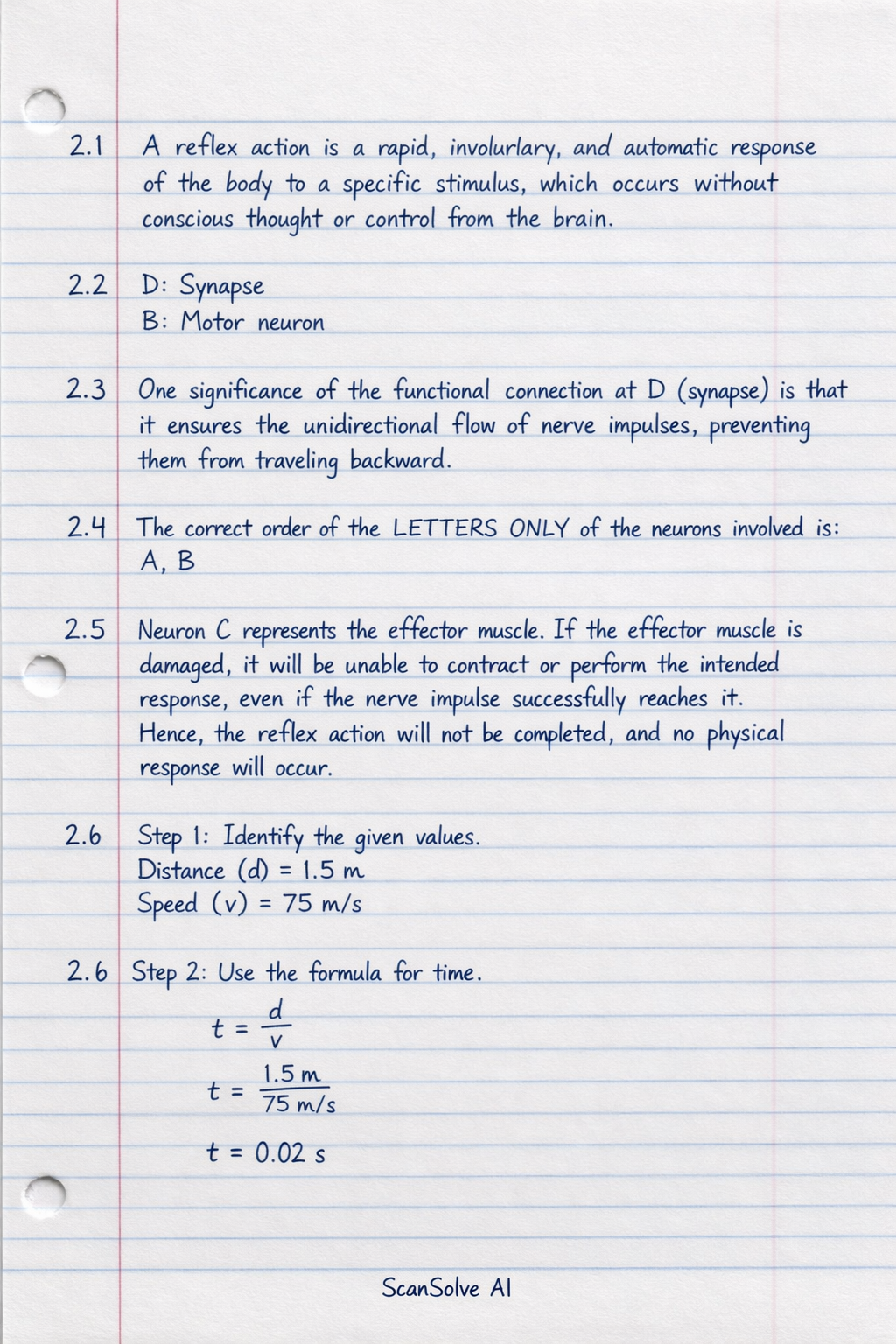
2.1 A reflex action is a rapid, involuntary, and automatic response of the body to a specific stimulus, which occurs without conscious thought or control from the brain.
-
2.2
- D: Synapse
- B: Motor neuron (or Efferent neuron)
-
2.3 One significance of the functional connection at D (synapse) is that it ensures the unidirectional flow of nerve impulses, preventing them from traveling backward.
-
2.4 The correct order of the LETTERS ONLY of the neurons involved is: A, B
-
2.5 Neuron C represents the effector muscle. If the effector muscle is damaged, it will be unable to contract or perform the intended response, even if the nerve impulse successfully reaches it. This means the reflex action will not be completed, and no physical response will occur.
-
2.6
Identify the given values.
Distance () =
Speed () =Use the formula for time, which is distance divided by speed.
Substitute the values into the formula and calculate.
The time taken for this reflex action to occur is .
- 2.7 Neuron A is a sensory neuron (specifically, a pseudounipolar neuron).
A labelled diagram of neuron A would show:
- A cell body (soma) containing a nucleus.
- A single process extending from the cell body that then branches into two:
- One branch acting as a dendrite (or peripheral axon) with receptor endings to detect stimuli.
- The other branch acting as an axon (central axon) extending towards the spinal cord.
- The axon would be covered by a myelin sheath (formed by Schwann cells) with gaps called Nodes of Ranvier.
- The end of the axon would have axon terminals (synaptic knobs).
- 2.7 Neuron A is a sensory neuron (specifically, a pseudounipolar neuron).
A labelled diagram of neuron A would show:
Try one yourself
A new problem that tests the same skill.
Still stuck on this one?
Ask a follow-up, and the answer starts from this question.
More Biology Questions
Handwritten Step-by-Step Solution
Get this as a handwritten image on WhatsApp — like a tutor wrote it for you.
Try on WhatsApp