
We read your photo as:
Explain the concepts of agroforestry, differentiate between indigenous and exotic forests, and name two indigenous softwood trees in Kenya.
ScanSolve AI Answer
Here are the answers to the questions from the image:
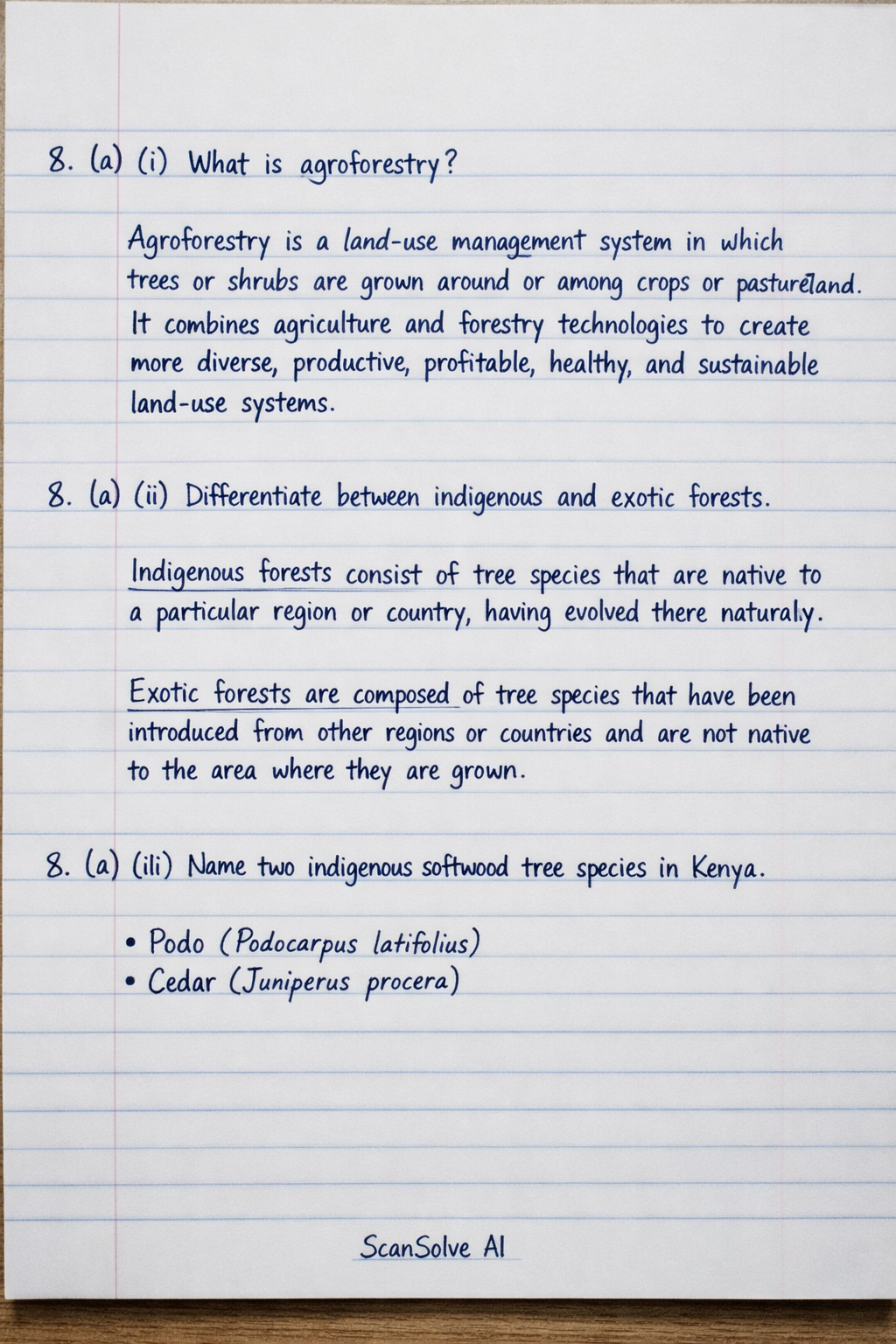
8. (a) (i) What is agroforestry?
Agroforestry is a land-use management system in which trees or shrubs are grown around or among crops or pastureland. It combines agriculture and forestry technologies to create more diverse, productive, profitable, healthy, and sustainable land-use systems.
8. (a) (ii) Differentiate between indigenous and exotic forests.
Indigenous forests consist of tree species that are native to a particular region or country, having evolved there naturally. Exotic forests are composed of tree species that have been introduced from other regions or countries and are not native to the area where they are grown.
8. (a) (iii) Name two indigenous softwood trees species in Kenya.
- Podo (Podocarpus latifolius)
- Cedar (Juniperus procera)
8. (b) (i) Explain three factors that favour the growth of natural forests on the slopes of Mt. Kenya.
- High altitude and varied relief: The mountain's slopes provide a range of altitudes, leading to different climatic zones suitable for various forest types, from montane to alpine.
- High rainfall: The mountain receives significant orographic rainfall due to moist air masses rising and cooling, providing ample moisture for tree growth.
- Moderate temperatures: Temperatures decrease with altitude, creating cool conditions favorable for the growth of specific montane forest species without extreme heat or cold.
- Deep, well-drained volcanic soils: The fertile volcanic soils on the slopes provide essential nutrients and good drainage, supporting dense forest vegetation.
8. (b) (ii) State four factors that have led to the reduction of the area under forest on the slope of Mt. Kenya.
- Illegal logging: Unauthorized felling of trees for timber and charcoal production.
- Expansion of agriculture: Clearing forest land for farming due to increasing population pressure.
- Human settlement: Encroachment into forest areas for housing and infrastructure development.
- Forest fires: Both natural and human-induced fires destroy large tracts of forest.
- Overgrazing: Livestock grazing in forest areas hinders regeneration and damages young trees.
8. (c) Give the differences in the exploitation of softwood forests in Kenya and Canada under the following headings:
8. (c) (i) Tree species
- Kenya: Primarily exploits indigenous softwoods like Cedar and Podo, and exotic softwoods like Cypress and Pine (e.g., Pinus patula).
- Canada: Exploits vast natural stands of indigenous softwoods such as Spruce (Picea species), Fir (Abies species), and Pine (Pinus species).
8. (c) (ii) Problems facing forestry.
- Kenya: Faces challenges like illegal logging, deforestation due to agricultural expansion, limited capital for sustainable management, and inadequate technology for processing.
- Canada: Deals with issues such as large-scale clear-cutting leading to habitat loss, environmental concerns from pulp and paper industries, market fluctuations for timber products, and managing vast, remote forest areas.
8. (d) Form four students in a school carried out a field study on the forestry within their county.
8. (d) (i) Give three reasons why reconnaissance was necessary for field study.
- To identify suitable routes and access points to the study area.
- To assess potential risks and safety concerns in the field.
- To familiarize the students and teachers with the physical environment and features of the forest.
- To determine the availability of resources and equipment needed for the study.
- To formulate or refine research questions and objectives based on initial observations.
8. (d) (ii) State two advantages of using the content analysis in the study of forests.
- It allows for the systematic and objective analysis of existing textual or visual data (e.g., forest reports, maps, photographs) without direct field presence.
- It can be used to identify patterns, themes, and trends in forest management practices or environmental changes over time.
- It is a cost-effective method as it utilizes readily available information, reducing the need for extensive fieldwork.
9. (a) (i) Differentiate between land reclamation and land rehabilitation.
Land reclamation involves creating new usable land from areas that were previously unusable, such as draining swamps or filling in coastal areas. Land rehabilitation focuses on restoring degraded or damaged land to a productive or healthy state, often through measures like afforestation, soil conservation, or erosion control.
9. (a) (ii) Give three ways in which land has been reclaimed in Kenya.
- Draining swamps: Converting marshy areas into agricultural land or settlement areas.
- Irrigation schemes: Developing arid or semi-arid lands for agriculture by providing water.
- Afforestation/Reforestation: Planting trees on barren or degraded land to restore its productivity and ecological value.
- Terracing: Constructing terraces on steep slopes to create arable land and control soil erosion.
9. (b) Explain four physical factors that influenced the location of Mwea irrigation scheme.
- Extensive flat land: The Mwea plains provide a large, gently sloping area suitable for gravity-fed irrigation and mechanized farming.
- Availability of water: The scheme is located near permanent rivers like the Thiba and Nyamindi, which provide a reliable source of water for irrigation.
- Fertile soils: The area has deep, well-drained, and fertile volcanic soils (e.g., black cotton soils) suitable for rice cultivation.
- Moderate temperatures: The warm temperatures in the region are ideal for the growth and maturation of rice crops.
- Low rainfall: The area experiences relatively low and unreliable rainfall, making irrigation essential and thus influencing the scheme's location.
9. (c) Study the map of Mwea Tabere below and use it to answer question c(i)
9. (c) (i) Name the sections marked B and C
- Section B: Thiba
- Section C: Wang'uru
9. (c) (ii) Identify River marked Z and X
- River Z: Thiba River
- River X: Nyamindi River
9. (d) Describe the stages followed in creation of polders in Netherlands.
- Construction of dikes: An area of shallow sea or lake is enclosed by building a ring of dikes (embankments) to separate it from the main body of water.
- Pumping out water: Powerful pumps are used to drain the water from the enclosed area, lowering the water level until the land is exposed.
- Draining and desalinization: A network of drainage ditches and canals is dug to further remove water and allow rainwater to leach out salts from the newly exposed soil, making it suitable for agriculture.
- Soil improvement: The reclaimed land is often left for several years to allow the soil to settle, dry, and improve in fertility, sometimes with the addition of sand or clay.
- Cultivation and settlement: Once the soil is suitable, the land is brought under cultivation, and infrastructure like roads, farms, and settlements are developed.
Still stuck on this one?
Ask a follow-up, and the answer starts from this question.
More Biology Questions
Handwritten Step-by-Step Solution
Get this as a handwritten image on WhatsApp — like a tutor wrote it for you.
Try on WhatsApp