
We read your photo as:
Consider the statements A, B and C and select the correct option.
ScanSolve AI Answer
Answer
115. Consider the statements A, B and C and select the correct option.
-
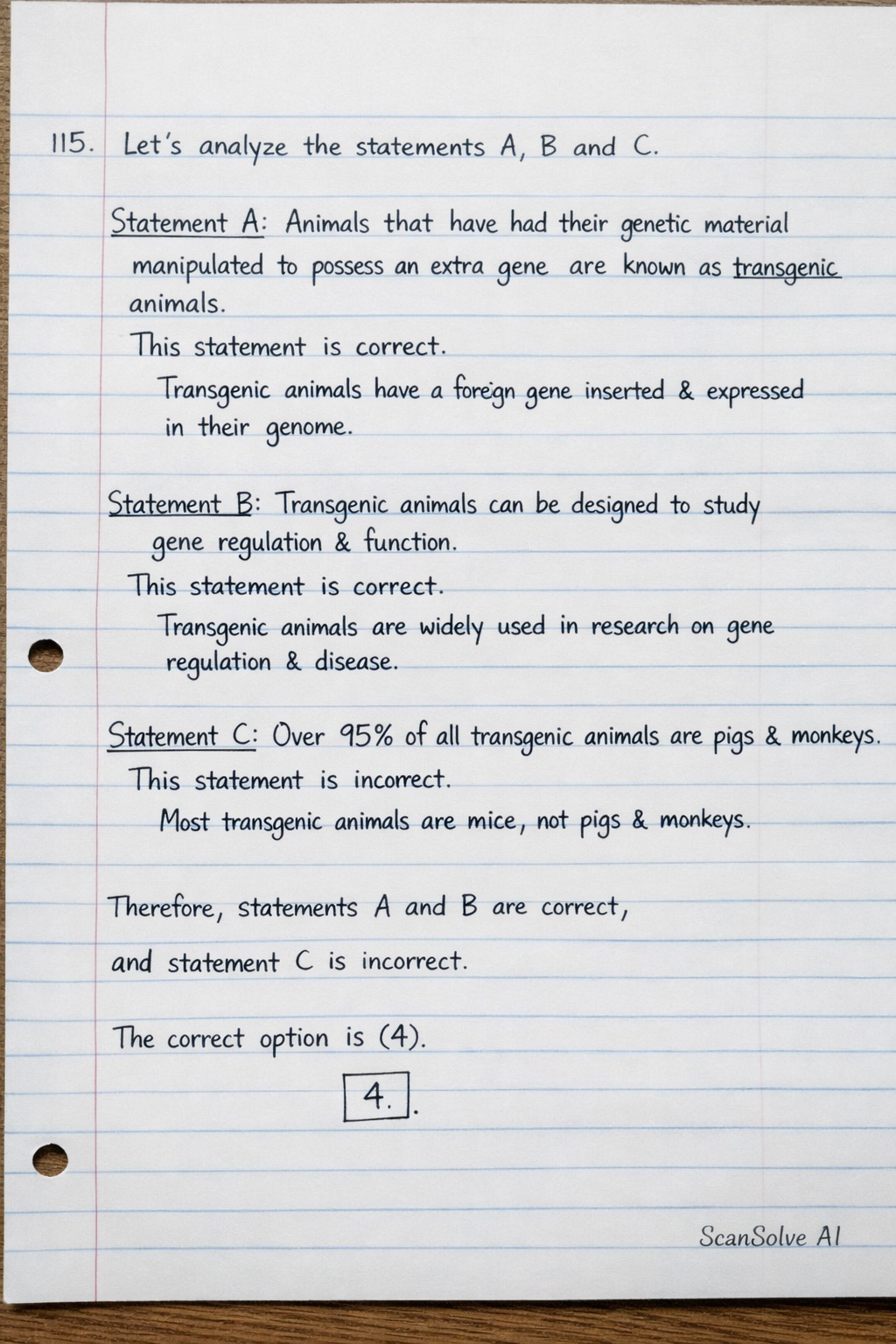
Statement A: Animals that have had their genetic material manipulated to possess and express an extra (foreign) gene are known as transgenic animals.
- This statement is correct. The definition of a transgenic animal involves the introduction and expression of a foreign gene (transgene) in its genome.
-
Statement B: Transgenic animals can be specifically designed to allow the study of how genes are regulated and how they affect the normal functions of the body.
- This statement is correct. Transgenic animals are widely used in research to understand gene function, regulation, and their roles in development and disease.
-
Statement C: Over 95% of all existing transgenic animals are pigs and monkeys.
- This statement is incorrect. The vast majority of transgenic animals used in research are mice, not pigs and monkeys.
Based on the evaluation, statements A and B are correct, while statement C is incorrect.
The correct option is (4).
116. All of the following lead to decrease in maternal and infant mortality rates, except
- (1) Better awareness about sex related matters: Increased awareness promotes family planning, safe practices, and timely medical care, leading to a decrease in mortality rates.
- (2) Better post-natal care: Comprehensive care for mothers and newborns after delivery significantly reduces complications and improves survival rates, leading to a decrease in mortality rates.
- (3) Decreased numbers of medically assisted deliveries: Medically assisted deliveries (e.g., in hospitals with skilled professionals) are crucial for managing high-risk pregnancies and complications during childbirth. A decrease in such deliveries would likely lead to an increase in maternal and infant mortality rates, not a decrease.
- (4) Better detection and cure of STDs: Early detection and treatment of sexually transmitted diseases prevent adverse outcomes for both mother and child, thus decreasing mortality rates.
The factor that does not lead to a decrease in maternal and infant mortality rates is (3).
Try one yourself
A new problem that tests the same skill.
Still stuck on this one?
Ask a follow-up, and the answer starts from this question.
More Biology Questions
Handwritten Step-by-Step Solution
Get this as a handwritten image on WhatsApp — like a tutor wrote it for you.
Try on WhatsApp