
How to calculate coordination number and number of atoms per unit cell in types of crystals
ScanSolve AI Answer
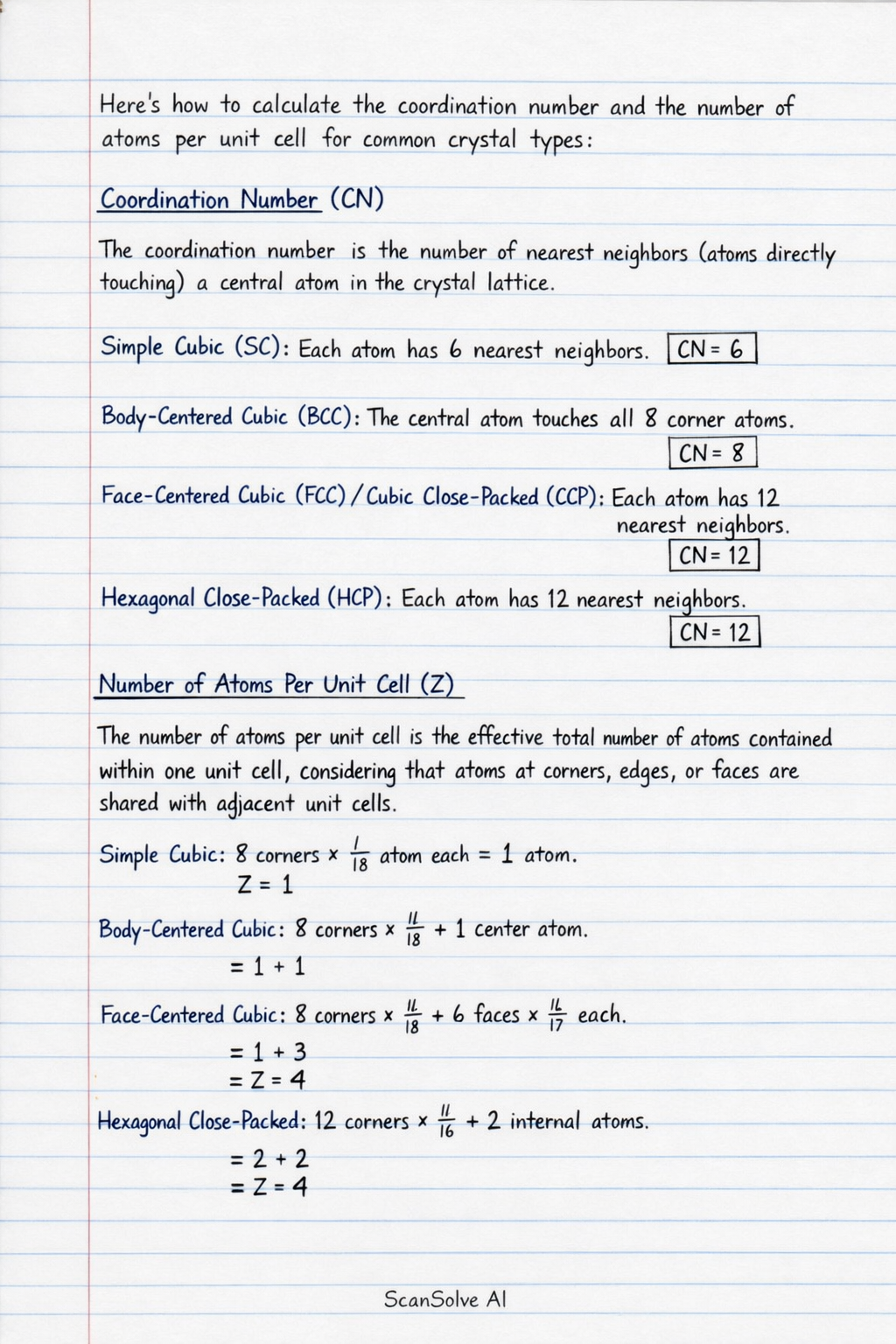
Here's how to calculate the coordination number and the number of atoms per unit cell for common crystal types:
Coordination Number (CN)
The coordination number is the number of nearest neighbors (atoms directly touching) a central atom in the crystal lattice.
- Simple Cubic (SC): Each atom has 6 nearest neighbors.
- CN =
- Body-Centered Cubic (BCC): The central atom touches all 8 corner atoms.
- CN =
- Face-Centered Cubic (FCC) / Cubic Close-Packed (CCP): Each atom has 12 nearest neighbors.
- CN =
- Hexagonal Close-Packed (HCP): Each atom has 12 nearest neighbors.
- CN =
Number of Atoms Per Unit Cell (Z)
The number of atoms per unit cell is the effective total number of atoms contained within one unit cell, considering that atoms at corners, edges, or faces are shared with adjacent unit cells.
- Contribution of atoms based on their position:
- Corner atom: Contributes to the unit cell.
- Face-centered atom: Contributes to the unit cell.
- Edge-centered atom: Contributes to the unit cell.
- Body-centered atom: Contributes 1 (entirely within the unit cell).
Let's calculate Z for common cubic structures:
1. Simple Cubic (SC)
- Atoms at corners: 8 corners atom/corner = 1 atom
- Total atoms per unit cell:
2. Body-Centered Cubic (BCC)
- Atoms at corners: 8 corners atom/corner = 1 atom
- Atom at body center: 1 body-centered atom atom/body = 1 atom
- Total atoms per unit cell:
3. Face-Centered Cubic (FCC)
- Atoms at corners: 8 corners atom/corner = 1 atom
- Atoms at face centers: 6 faces atom/face = 3 atoms
- Total atoms per unit cell:
4. Hexagonal Close-Packed (HCP)
For a standard hexagonal unit cell (a prism containing three layers of atoms):
- Atoms at corners: 12 corners atom/corner = 2 atoms
- Atoms at top/bottom face centers: 2 faces atom/face = 1 atom
- Atoms entirely within the cell (middle layer): 3 atoms atom/atom = 3 atoms
- Total atoms per unit cell:
Still stuck on this one?
Ask a follow-up, and the answer starts from this question.
More Biology Questions
Handwritten Step-by-Step Solution
Get this as a handwritten image on WhatsApp — like a tutor wrote it for you.
Try on WhatsApp