
We read your photo as:
Create a lesson plan on personal hygiene.
Biology
ScanSolve AI Answer
Step-by-step solution
3 stepsHere is a new topic and a lesson plan structure based on the format provided in your image.
New Topic: Personal Hygiene
Lesson Plan Structure:
Introduction to Personal Hygiene
- Time (mins): 10
- Content Development: Definition of personal hygiene; importance of personal hygiene for health and well-being.
- Instructional Strategies: Brainstorming, asking open-ended questions.
- Teacher's Performance (T.P.A.): Teacher initiates discussion by asking "What is hygiene?" and "Why is it important to be clean?". Guides students to define personal hygiene and discuss its benefits.
- Pupils' Performance/Activity: Pupils share their initial ideas and definitions, actively participate in the discussion, and contribute reasons for maintaining hygiene.
- Learning (L.A.): Pupils are able to define personal hygiene and explain its importance for health.
Types of Personal Hygiene
- Time (mins): 20
- Content Development: Exploration of different aspects of personal hygiene: body hygiene (bathing), dental hygiene (brushing teeth), hand hygiene (washing hands), hair hygiene (washing hair), clothing hygiene (wearing clean clothes).
- Instructional Strategies: Examples and illustrations, group discussion, concept mapping.
- Teacher's Performance (T.P.A.): Teacher presents various types of hygiene using visual aids (pictures/charts). Divides students into groups to discuss specific practices for each type. Facilitates the creation of a concept map summarizing the types.
- Pupils' Performance/Activity: Pupils identify and categorize different types of hygiene. In groups, they discuss and list specific practices. They collaboratively create a concept map.
- Learning (L.A.): Pupils can identify and categorize the main types of personal hygiene.
Practices for Good Personal Hygiene
- Time (mins): 15
- Content Development: Practical steps and routines for maintaining good personal hygiene, such as daily bathing, brushing teeth twice a day, washing hands before meals and after using the toilet, regular hair washing, and wearing clean clothes.
- Instructional Strategies: Think-pair-share, demonstration (if feasible), questioning skills to check understanding.
- Teacher's Performance (T.P.A.): Teacher explains and, if possible, demonstrates proper techniques (e.g., handwashing steps). Asks questions to ensure understanding of routines and addresses common misconceptions.
- Pupils' Performance/Activity: Pupils discuss and share their daily hygiene routines with a partner. They answer questions, communicate the importance of consistent practices, and identify areas for improvement.
- Learning (L.A.): Pupils can explain and outline practical steps for maintaining good personal hygiene.
Was this helpful?
Still stuck on this one?
Ask a follow-up, and the answer starts from this question.
Got a different question?Ask your own question
More Biology Questions
QWhat is personal hygieneQWhat are the answers to the following questions regarding personal hygiene?QCreate 12 lesson plans for Sub-Strand 3.1 Water, focusing on knowledge, skills, and attitudes.QA Grade 7 class is involved in a project to improve hygiene in their school.QCreate a lesson plan focusing on the use of dashes, parentheses, and personal journal writing for…
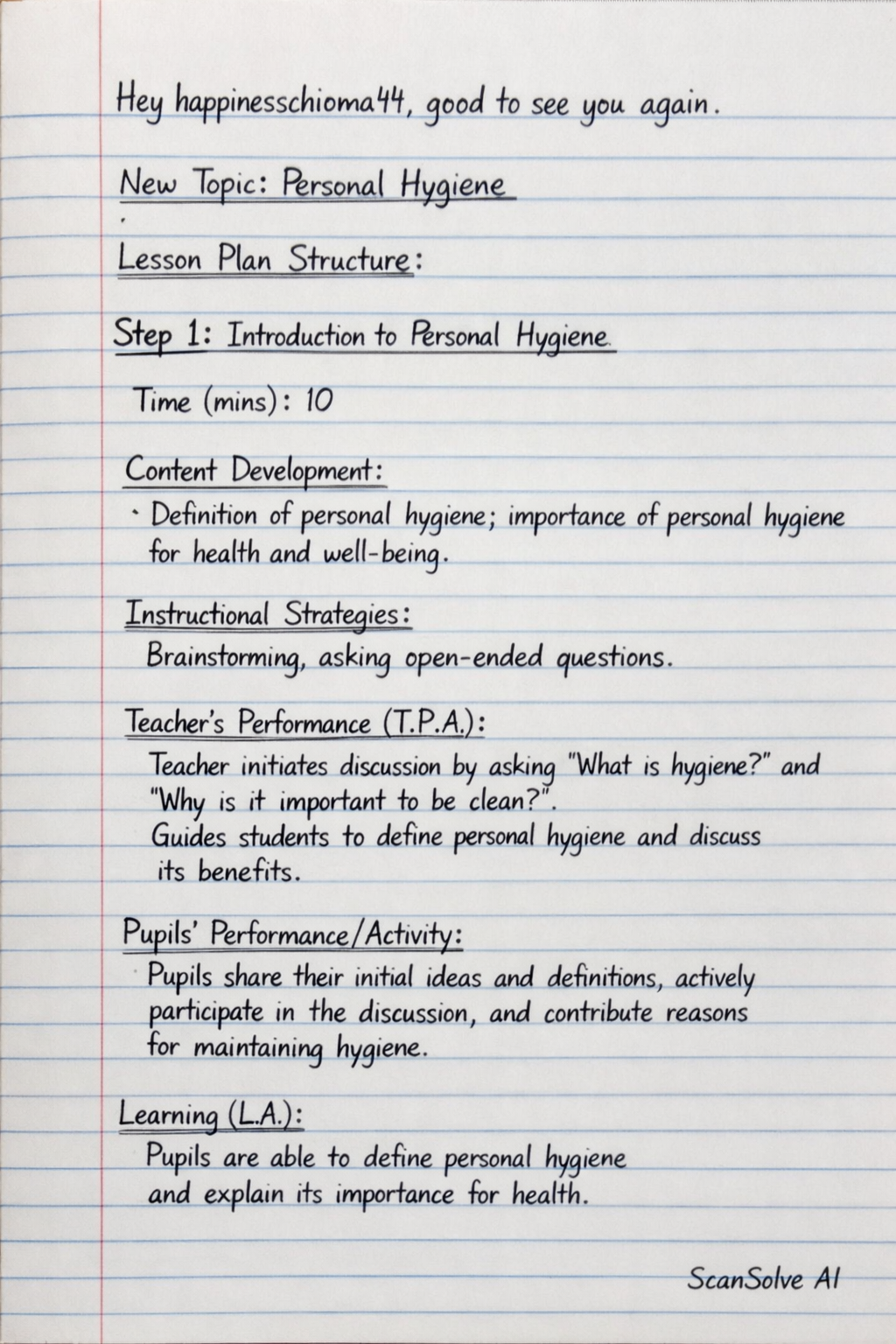
Handwritten Step-by-Step Solution
Get this as a handwritten image on WhatsApp — like a tutor wrote it for you.
Try on WhatsApp