
We read your photo as:
Explain active transport, fertilization, implantation, and the path of sperm. Identify the corpus luteum and acrosome, and describe continental drift.
ScanSolve AI Answer
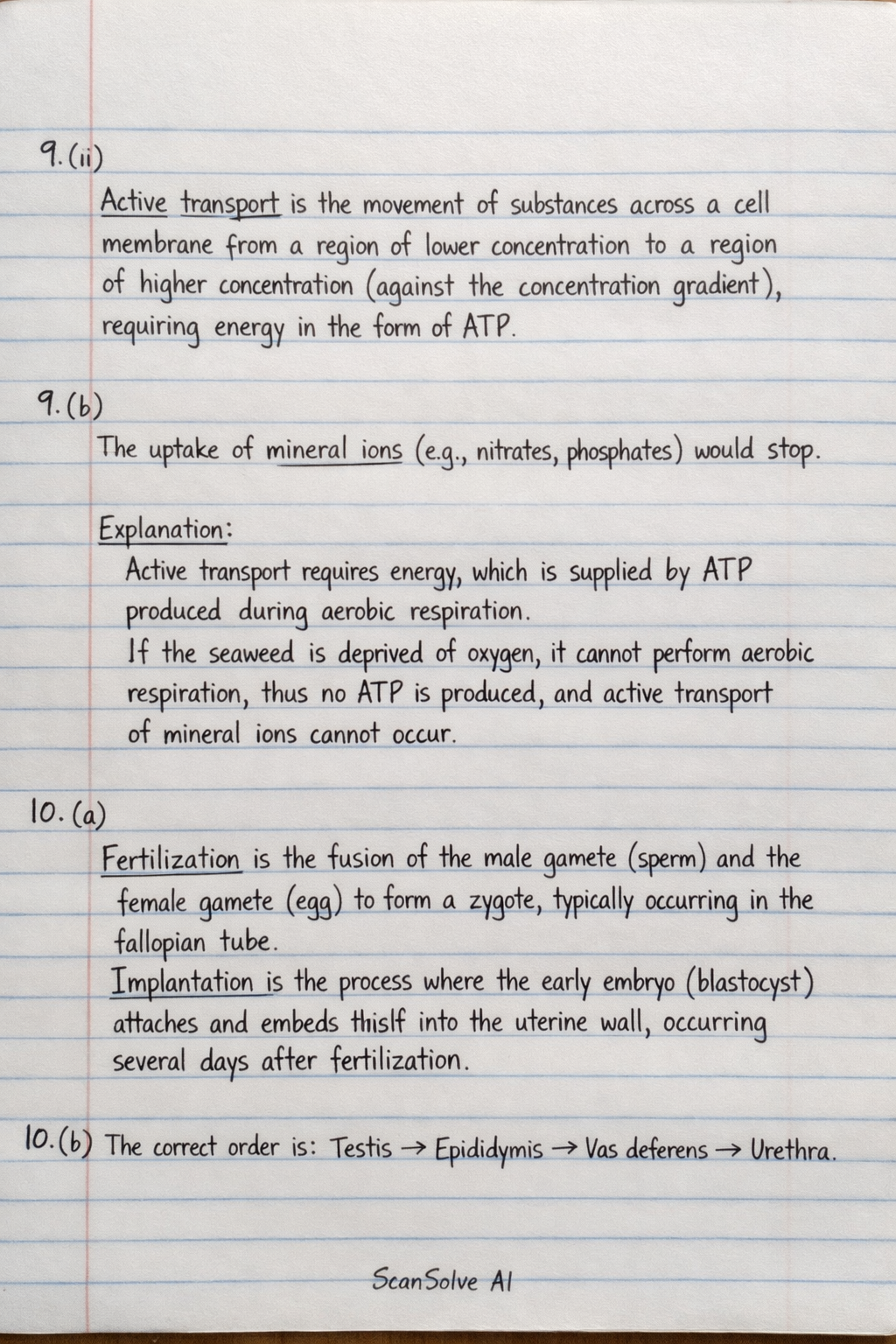
9. (ii)
Active transport is the movement of substances across a cell membrane from a region of lower concentration to a region of higher concentration (against the concentration gradient), requiring energy in the form of ATP.
9. (b)
The uptake of mineral ions (e.g., nitrates, phosphates) would stop.
Explanation: Active transport requires energy, which is supplied by ATP produced during aerobic respiration. If the seaweed is deprived of oxygen, it cannot perform aerobic respiration, thus no ATP is produced, and active transport of mineral ions cannot occur.
10. (a)
Fertilization is the fusion of the male gamete (sperm) and the female gamete (egg) to form a zygote, typically occurring in the fallopian tube. Implantation is the process where the early embryo (blastocyst) attaches and embeds itself into the uterine wall, occurring several days after fertilization.
10. (b)
The correct order is: Testis → Epididymis → Vas deferens → Urethra.
10. (c)
(i) The structure that develops from the remains of the Graafian follicle after ovulation is the corpus luteum.
(ii) The part of the head of a spermatozoon containing enzymes is the acrosome.
15. (a)
The evolutionary theory that includes the idea that all continents were originally one big supercontinent called Pangaea is Plate Tectonics (or Continental Drift).
15. (b)
Darwin's theory of natural selection would explain the long necks of modern giraffes as follows:
- Within the ancestral giraffe population, there was natural variation in neck length; some giraffes had slightly longer necks than others.
- During periods of food scarcity, giraffes with longer necks had an advantage because they could reach leaves higher up on trees, accessing more food.
- These longer-necked giraffes were more likely to survive, reproduce, and pass on their genes for longer necks to their offspring.
- Over many generations, this differential survival and reproduction led to an increase in the average neck length within the giraffe population, resulting in the long-necked giraffes observed today.
Still stuck on this one?
Ask a follow-up, and the answer starts from this question.
More Biology Questions
Handwritten Step-by-Step Solution
Get this as a handwritten image on WhatsApp — like a tutor wrote it for you.
Try on WhatsApp