
We read your photo as:
Diagram of the human eye, label the parts and explain pupillary dilation and how to treat common vision problems.
Biology
ScanSolve AI Answer
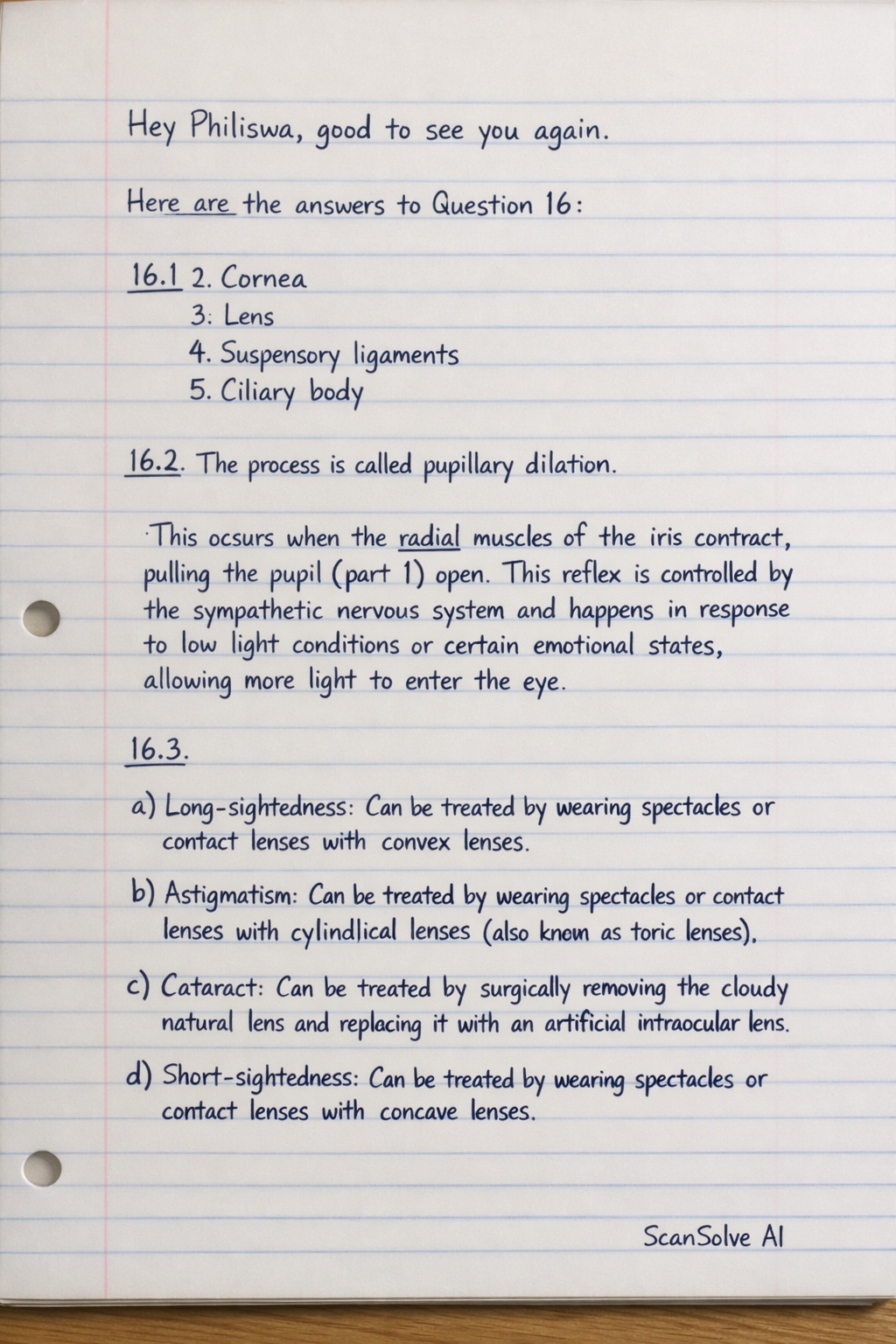
Here are the answers to Question 16:
16.1
- 2: Cornea
- 3: Lens
- 4: Suspensory ligaments
- 5: Ciliary body
16.2
The process is called pupillary dilation.
This occurs when the radial muscles of the iris contract, pulling the pupil (part 1) open. This reflex is controlled by the sympathetic nervous system and happens in response to low light conditions or certain emotional states, allowing more light to enter the eye.
16.3
- a) Long-sightedness: Can be treated by wearing spectacles or contact lenses with convex lenses.
- b) Astigmatism: Can be treated by wearing spectacles or contact lenses with cylindrical lenses (also known as toric lenses).
- c) Cataract: Can be treated by surgically removing the cloudy natural lens and replacing it with an artificial intraocular lens.
- d) Short-sightedness: Can be treated by wearing spectacles or contact lenses with concave lenses.
Was this helpful?
Still stuck on this one?
Ask a follow-up, and the answer starts from this question.
Got a different question?Ask your own question
More Biology Questions
QIdentify the labeled parts (A, B, C) in Diagram 1 and describe the processes of pupillary reflex and…QFigure 3 shows a diagram of the human eye. Answer the following questions based on the diagram…QIdentify and explain the functions of parts of the eye and correct myopia.QIdentify the parts of the human eye labeled A, B, and C, and give the letter and name of the parts…QExplain the changes in pupil size and light intensity as a lamp moves away from the eye, and the…
Handwritten Step-by-Step Solution
Get this as a handwritten image on WhatsApp — like a tutor wrote it for you.
Try on WhatsApp