
Diagram of the ultrafine structure of the cell
Biology
ScanSolve AI Answer
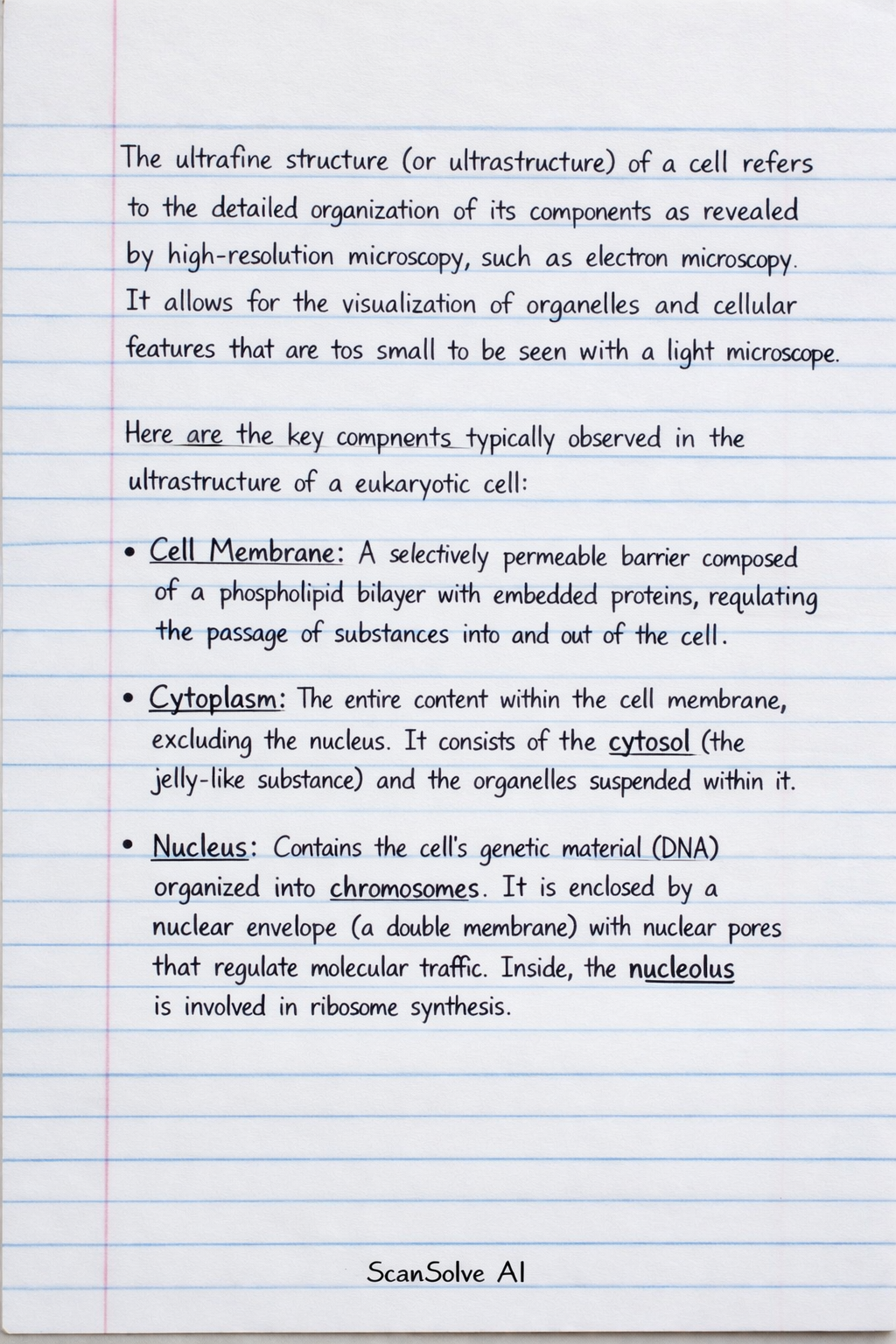
The ultrafine structure (or ultrastructure) of a cell refers to the detailed organization of its components as revealed by high-resolution microscopy, such as electron microscopy. It allows for the visualization of organelles and cellular features that are too small to be seen with a light microscope.
Here are the key components typically observed in the ultrastructure of a eukaryotic cell:
- Cell Membrane: A selectively permeable barrier composed of a phospholipid bilayer with embedded proteins, regulating the passage of substances into and out of the cell.
- Cytoplasm: The entire content within the cell membrane, excluding the nucleus. It consists of the cytosol (the jelly-like substance) and the organelles suspended within it.
- Nucleus: Contains the cell's genetic material (DNA) organized into chromosomes. It is enclosed by a nuclear envelope (a double membrane) with nuclear pores that regulate molecular traffic. Inside, the nucleolus is involved in ribosome synthesis.
- Mitochondria: Often called the "powerhouses" of the cell, they are responsible for cellular respiration, generating ATP. They have a double membrane, with the inner membrane folded into cristae.
- Endoplasmic Reticulum (ER): A network of interconnected membranes forming sacs and tubules.
- Rough ER (RER): Studded with ribosomes, involved in the synthesis, folding, modification, and transport of proteins destined for secretion or insertion into membranes.
- Smooth ER (SER): Lacks ribosomes, involved in lipid synthesis, detoxification of drugs and poisons, and storage of calcium ions.
- Ribosomes: Small particles made of ribosomal RNA and protein, responsible for protein synthesis (translation). They can be free in the cytoplasm or attached to the RER.
- Golgi Apparatus (or Golgi Complex/Body): A stack of flattened membrane-bound sacs called cisternae. It modifies, sorts, and packages proteins and lipids from the ER for secretion or delivery to other organelles.
- Lysosomes: Membrane-bound sacs containing hydrolytic enzymes that digest waste materials, cellular debris, and foreign invaders.
- Peroxisomes: Small, membrane-bound organelles containing enzymes involved in various metabolic reactions, including the breakdown of fatty acids and detoxification, producing hydrogen peroxide as a byproduct.
- Cytoskeleton: A network of protein filaments and tubules that extends throughout the cytoplasm, providing structural support, maintaining cell shape, and facilitating cell movement and transport of organelles. It includes microtubules, microfilaments (actin filaments), and intermediate filaments.
- Centrosomes (in animal cells): A region near the nucleus that is the main microtubule-organizing center. It contains a pair of centrioles involved in cell division.
- Vacuoles (prominent in plant cells): Large, membrane-bound sacs that store water, nutrients, and waste products, and help maintain turgor pressure.
- Cell Wall (in plant, fungal, and bacterial cells): A rigid outer layer that provides structural support and protection to the cell.
- Chloroplasts (in plant and algal cells): Organelles responsible for photosynthesis, converting light energy into chemical energy. They contain chlorophyll and have a double membrane, with internal stacks of thylakoids called grana.
Was this helpful?
Still stuck on this one?
Ask a follow-up, and the answer starts from this question.
Got a different question?Ask your own question
More Biology Questions
Handwritten Step-by-Step Solution
Get this as a handwritten image on WhatsApp — like a tutor wrote it for you.
Try on WhatsApp