
We read your photo as:
Define Medical Laboratory Science (MLS) and list its major disciplines and their relevance in healthcare.
ScanSolve AI Answer
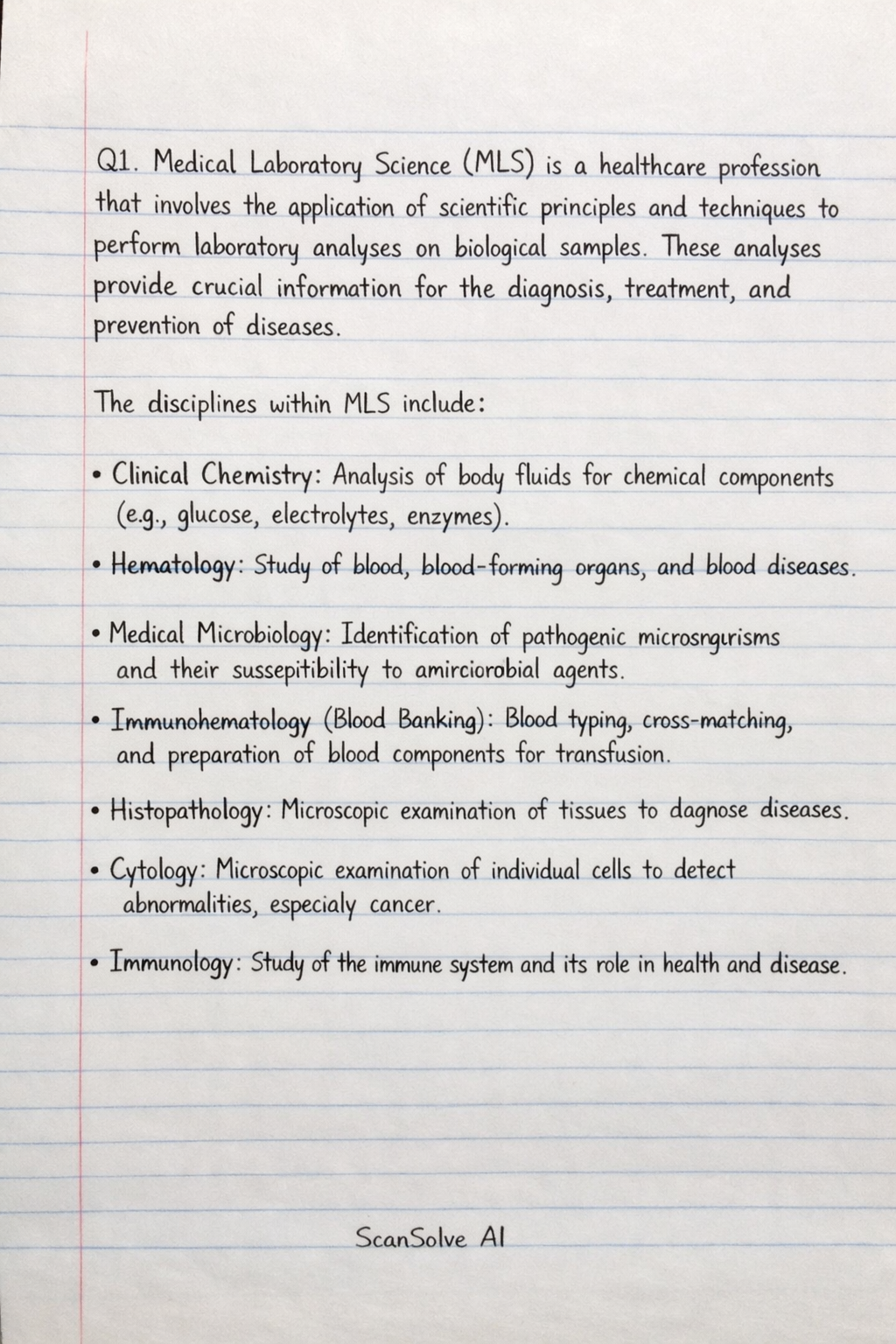
Q1. Medical Laboratory Science (MLS) is a healthcare profession that involves the application of scientific principles and techniques to perform laboratory analyses on biological samples. These analyses provide crucial information for the diagnosis, treatment, and prevention of diseases.
The disciplines within MLS include:
- Clinical Chemistry: Analysis of body fluids for chemical components (e.g., glucose, electrolytes, enzymes).
- Hematology: Study of blood, blood-forming organs, and blood diseases.
- Medical Microbiology: Identification of pathogenic microorganisms and their susceptibility to antimicrobial agents.
- Immunohematology (Blood Banking): Blood typing, cross-matching, and preparation of blood components for transfusion.
- Histopathology: Microscopic examination of tissues to diagnose diseases.
- Cytology: Microscopic examination of individual cells to detect abnormalities, especially cancer.
- Immunology: Study of the immune system and its role in health and disease.
- Molecular Diagnostics: Detection and analysis of DNA and RNA for diagnostic purposes.
MLS is highly relevant in healthcare provision by:
- Providing objective data for accurate disease diagnosis.
- Monitoring the effectiveness of treatment and patient response to therapy.
- Screening for diseases in asymptomatic individuals.
- Contributing to public health surveillance and epidemiological studies.
- Supporting research and development of new diagnostic tests and treatments.
Q2. Hematology is the branch of medical science concerned with the study of blood, blood-forming organs (bone marrow, spleen, lymph nodes), and blood-related diseases. It involves the analysis of blood components and their functions.
Branches of hematology include:
- General Hematology: Focuses on routine blood tests like complete blood count (CBC), erythrocyte sedimentation rate (ESR), and peripheral blood smear examination to diagnose common blood disorders.
- Coagulation Studies: Investigates the blood clotting process, including tests for bleeding disorders (e.g., hemophilia) and thrombotic conditions (e.g., deep vein thrombosis).
- Transfusion Medicine (Immunohematology): Deals with blood typing, cross-matching, antibody screening, and the safe administration of blood and blood products.
- Hematological Malignancies: Specializes in the diagnosis, classification, and monitoring of blood cancers such as leukemias, lymphomas, and multiple myeloma.
- Hemoglobinopathies: Focuses on inherited disorders affecting hemoglobin, such as sickle cell anemia and thalassemias.
Q3.
Q4. Laboratory animals are used extensively in medical research, drug development, vaccine testing, and education. They serve as models to understand human diseases, test the safety and efficacy of new treatments, and train future scientists and healthcare professionals. Their use is critical when non-animal alternatives are not yet available or sufficient.
Principles for the proper management of laboratory animals:
- Replacement: Whenever possible, use non-animal methods (e.g., cell cultures, computer models) instead of live animals.
- Reduction: Use the minimum number of animals necessary to obtain statistically valid and scientifically sound results.
- Refinement: Implement methods that minimize pain, suffering, distress, and improve the welfare of animals throughout their lives. This includes appropriate housing, nutrition, environmental enrichment, and pain management.
- Responsibility: Ensure that all personnel involved in animal care and use are adequately trained, competent, and adhere to ethical guidelines and regulations.
- Record Keeping: Maintain accurate and detailed records of animal acquisition, housing, care, experimental procedures, and health status. This ensures accountability and traceability.
Q5.
i. Types of glasswares in chemical pathology and their uses:
- Beakers: Used for holding, mixing, and heating liquids; provide approximate volume measurements.
- Conical Flasks (Erlenmeyer Flasks): Used for mixing, heating, and titrations; their narrow neck reduces evaporation.
- Measuring Cylinders: Used for approximate measurement of liquid volumes; not for precise work.
- Volumetric Flasks: Used for precise preparation of solutions to a specific, accurate volume.
- Pipettes (Volumetric and Graduated): Used for accurate transfer of specific volumes of liquid. Volumetric pipettes are for a single, fixed volume, while graduated pipettes allow for variable volumes.
- Burettes: Used for accurate dispensing of variable volumes of liquid, primarily in titrations.
- Test Tubes: Small, cylindrical glass tubes used for holding small samples, mixing reagents, and performing reactions.
- Reagent Bottles: Used for storing prepared reagents and solutions.
ii. SOP in respect of specimen collection/processing in Chemical Pathology Laboratory:
A Standard Operating Procedure (SOP) is a set of written instructions detailing how to perform a routine task to ensure consistency, quality, and safety. For specimen collection and processing in chemical pathology, SOPs cover:
- Patient Identification: Verifying patient identity before collection.
- Specimen Type and Container: Ensuring the correct type of specimen (e.g., serum, plasma, urine) is collected in the appropriate container with the correct anticoagulant or preservative.
- Labeling: Accurate and complete labeling of all specimens with patient details, date, and time of collection.
- Collection Technique: Detailed steps for venipuncture, urine collection, etc., to minimize contamination and hemolysis.
- Transport: Guidelines for timely and appropriate transport of specimens to the laboratory, maintaining stability (e.g., on ice, protected from light).
- Processing: Instructions for centrifugation, aliquotting, and storage conditions (temperature, duration) to preserve analyte integrity before analysis. Adherence to SOPs minimizes pre-analytical errors, which are a major source of laboratory errors, ensuring reliable test results.
iii. Anticoagulants/Preservatives in chemical pathology laboratory:
- Anticoagulants are substances that prevent blood from clotting, allowing for the separation of plasma or whole blood analysis.
- EDTA (Ethylenediaminetetraacetic acid): Chelates calcium ions, preventing coagulation. Primarily used for hematology tests (e.g., CBC) but not for calcium or enzyme assays.
- Heparin (Sodium, Lithium, Ammonium): Activates antithrombin III, inhibiting thrombin formation. Used for plasma chemistry, blood gas analysis, and some molecular tests.
- Sodium Citrate: Binds calcium ions reversibly. Used for coagulation studies (e.g., PT, PTT) and erythrocyte sedimentation rate (ESR).
- Potassium Oxalate: Precipitates calcium ions. Often combined with sodium fluoride.
- Preservatives are substances added to a specimen to maintain the stability of specific analytes or prevent microbial growth.
- Sodium Fluoride: Inhibits glycolysis, preserving glucose levels in blood samples for up to 24 hours. Often combined with potassium oxalate.
- Acids (e.g., Hydrochloric Acid): Used in 24-hour urine collections to maintain pH and preserve certain analytes like catecholamines or calcium.
iv. Biomedical wastes segregation and disposal methods:
Biomedical waste refers to any waste generated during the diagnosis, treatment, or immunization of human beings or animals, or in research activities. Proper segregation and disposal are crucial to prevent infection and environmental contamination.
- Segregation: Waste is separated at the point of generation into color-coded containers based on its type:
- Yellow: Pathological waste (human/animal tissues, organs), chemical waste, soiled waste.
- Red: Contaminated recyclable waste (tubing, bottles, catheters, IV sets).
- Blue/White Translucent: Glassware, metallic body implants.
- Black: Non-infectious general waste.
- Puncture-proof containers: For sharps (needles, scalpels, broken glass).
- Disposal Methods:
- Incineration: High-temperature burning for pathological, pharmaceutical, and some chemical wastes.
- Autoclaving/Steam Sterilization: For infectious waste, rendering it non-infectious before landfilling.
- Chemical Disinfection: For liquid infectious waste.
- Encapsulation/Inertization: For sharps and pharmaceutical waste, solidifying them in a matrix before landfilling.
- Landfilling: For treated and general non-hazardous waste.
v. Safety in chemical pathology laboratory:
Ensuring safety in a chemical pathology laboratory is paramount due to the presence of biological hazards, chemicals, and specialized equipment. Key safety measures
Still stuck on this one?
Ask a follow-up, and the answer starts from this question.
More Biology Questions
Handwritten Step-by-Step Solution
Get this as a handwritten image on WhatsApp — like a tutor wrote it for you.
Try on WhatsApp