
We read your photo as:
Differentiate the diagnostic stage of Schistosoma mansoni and Schistosoma haematobium.
ScanSolve AI Answer
1. Differentiate the diagnostic stage of:
a) Schistosoma mansoni and Schistosoma haematobium*
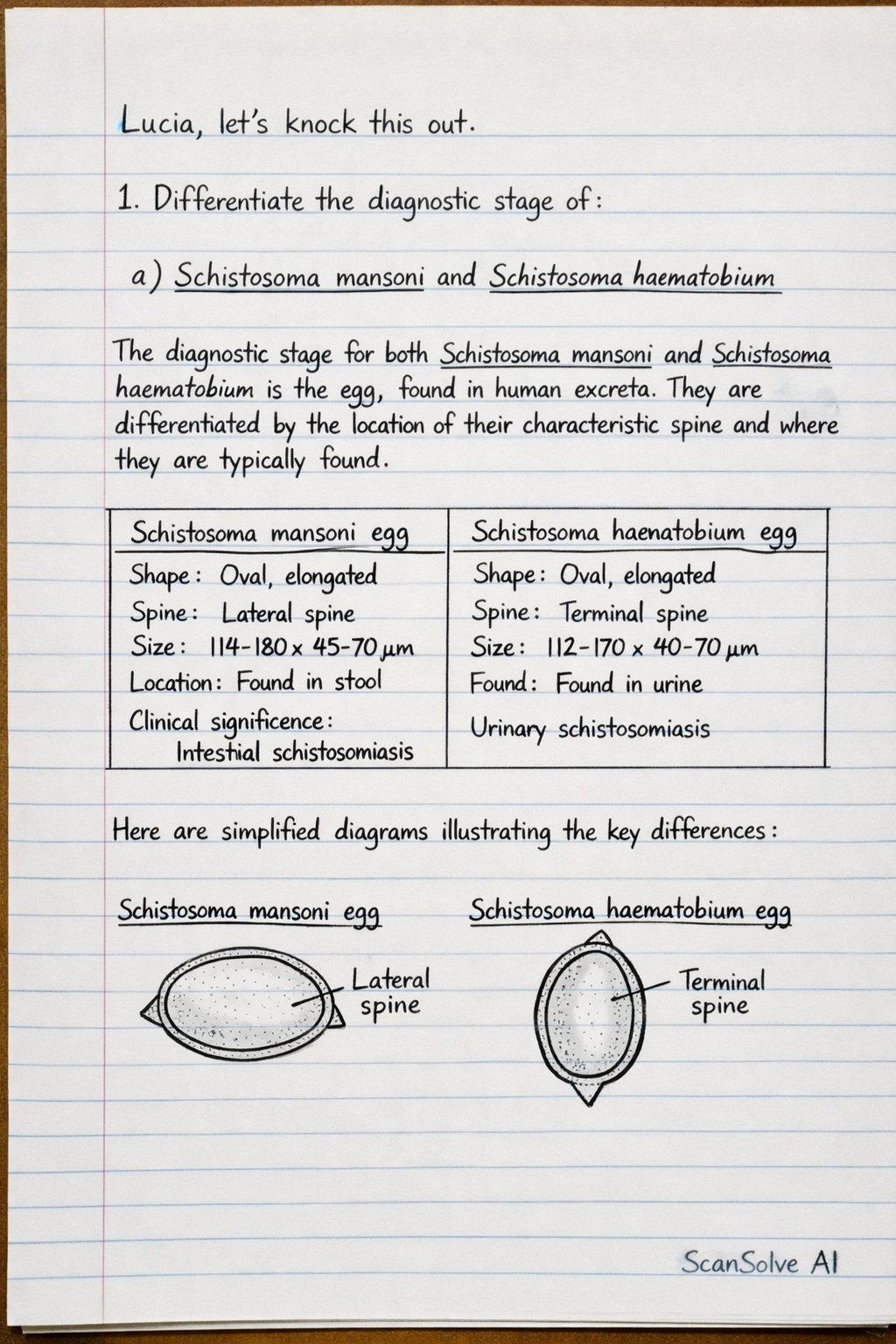
The diagnostic stage for both Schistosoma mansoni and Schistosoma haematobium is the egg, found in human excreta. They are differentiated by the location of their characteristic spine and where they are typically found.
Here are simplified diagrams illustrating the key differences:
\begin{array}{cc}
\text{Schistosoma mansoni egg} & \text{Schistosoma haematobium egg} \\
\includegraphics[width=0.2\textwidth]{schistosoma_mansoni_egg.png} & \includegraphics[width=0.2\textwidth]{schistosoma_haematobium_egg.png} \\
\text{• Lateral spine} & \text{• Terminal spine} \\
\text{• Found in stool} & \text{• Found in urine} \\
\end{array}
(Note: The images above are placeholders for actual hand-drawn diagrams that would show the lateral and terminal spines respectively, similar to your provided drawings.)
b) Plasmodium falciparum and Plasmodium malariae*
The diagnostic stages for Plasmodium species are observed in blood smears, primarily as ring forms, trophozoites, schizonts, and gametocytes within red blood cells.
Still stuck on this one?
Ask a follow-up, and the answer starts from this question.
More Biology Questions
Handwritten Step-by-Step Solution
Get this as a handwritten image on WhatsApp — like a tutor wrote it for you.
Try on WhatsApp