
We read your photo as:
Describe the digestive and respiratory systems, listing their organs and functions. Include the main organs of the digestive system.
ScanSolve AI Answer
Step-by-step solution
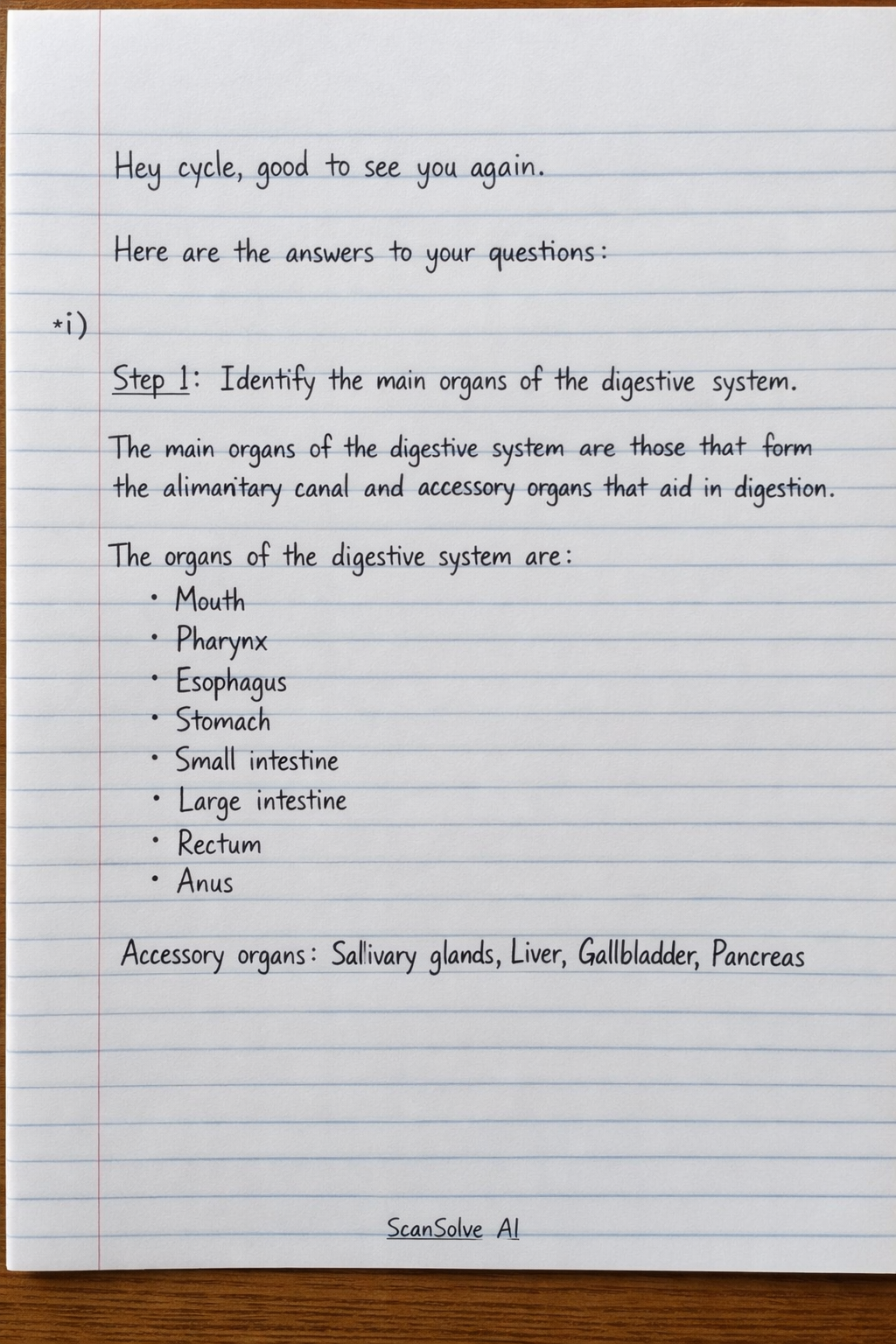
7 stepsHere are the answers to your questions:
Part i· 1 step
Identify the main organs of the digestive system.
The main organs of the digestive system are those that form the alimentary canal and accessory organs that aid in digestion.
The organs of the digestive system are:- Mouth
- Pharynx
- Esophagus
- Stomach
- Small intestine
- Large intestine
- Rectum
- Anus
- Accessory organs: Salivary glands, Liver, Gallbladder, Pancreas
Part ii· 2 steps
Define the respiratory system.
The respiratory system is the biological system responsible for gas exchange in the body, primarily taking in oxygen and expelling carbon dioxide.
List four functions of the respiratory system.
Four functions of the respiratory system are:
- Gas exchange: Facilitates the intake of oxygen and removal of carbon dioxide.
- Regulation of blood pH: Helps maintain the acid-base balance of the blood by controlling carbon dioxide levels.
- Voice production: Air passing through the vocal cords in the larynx produces sound.
- Olfaction (sense of smell): Contains olfactory receptors in the nasal cavity.
Part iii· 1 step
List the organs participating in the respiratory system.
The organs participating in the respiratory system are:
- Nose/Nasal Cavity: Filters, warms, and moistens incoming air.
- Pharynx (Throat): Passageway for both air and food.
- Larynx (Voice Box): Contains vocal cords for sound production and prevents food from entering the trachea.
- Trachea (Windpipe): A tube that carries air to the lungs.
- Bronchi: Two main tubes branching from the trachea, leading to the lungs.
- Bronchioles: Smaller branches within the lungs that lead to the alveoli.
- Alveoli: Tiny air sacs in the lungs where gas exchange occurs.
- Lungs: The primary organs of respiration, containing bronchi, bronchioles, and alveoli.
- Diaphragm: A muscle below the lungs that contracts and relaxes to facilitate breathing.
Part iv· 2 steps
Define the circulatory system.
The circulatory system, also known as the cardiovascular system, is a network of blood vessels, blood, and the heart that transports blood throughout the body.
List the functions of the circulatory system.
The functions of the circulatory system include:
- Transport of oxygen and nutrients: Delivers oxygen from the lungs and nutrients from the digestive system to all body cells.
- Transport of waste products: Carries metabolic waste products (like carbon dioxide and urea) from cells to organs for excretion.
- Regulation of body temperature: Helps distribute heat throughout the body.
- Immunity: Transports white blood cells and antibodies to fight infections.
- Hormone transport: Carries hormones from endocrine glands to target organs.
Part v· 1 step
Complete the sentence based on the visible text.
The veins and arteries are the blood vessels involved in respiration. (They are part of the circulatory system.)
Still stuck on this one?
Ask a follow-up, and the answer starts from this question.
More Biology Questions
Handwritten Step-by-Step Solution
Get this as a handwritten image on WhatsApp — like a tutor wrote it for you.
Try on WhatsApp