
We read your photo as:
Discuss genetic variability in reproduction, and the functions of the placenta.
ScanSolve AI Answer
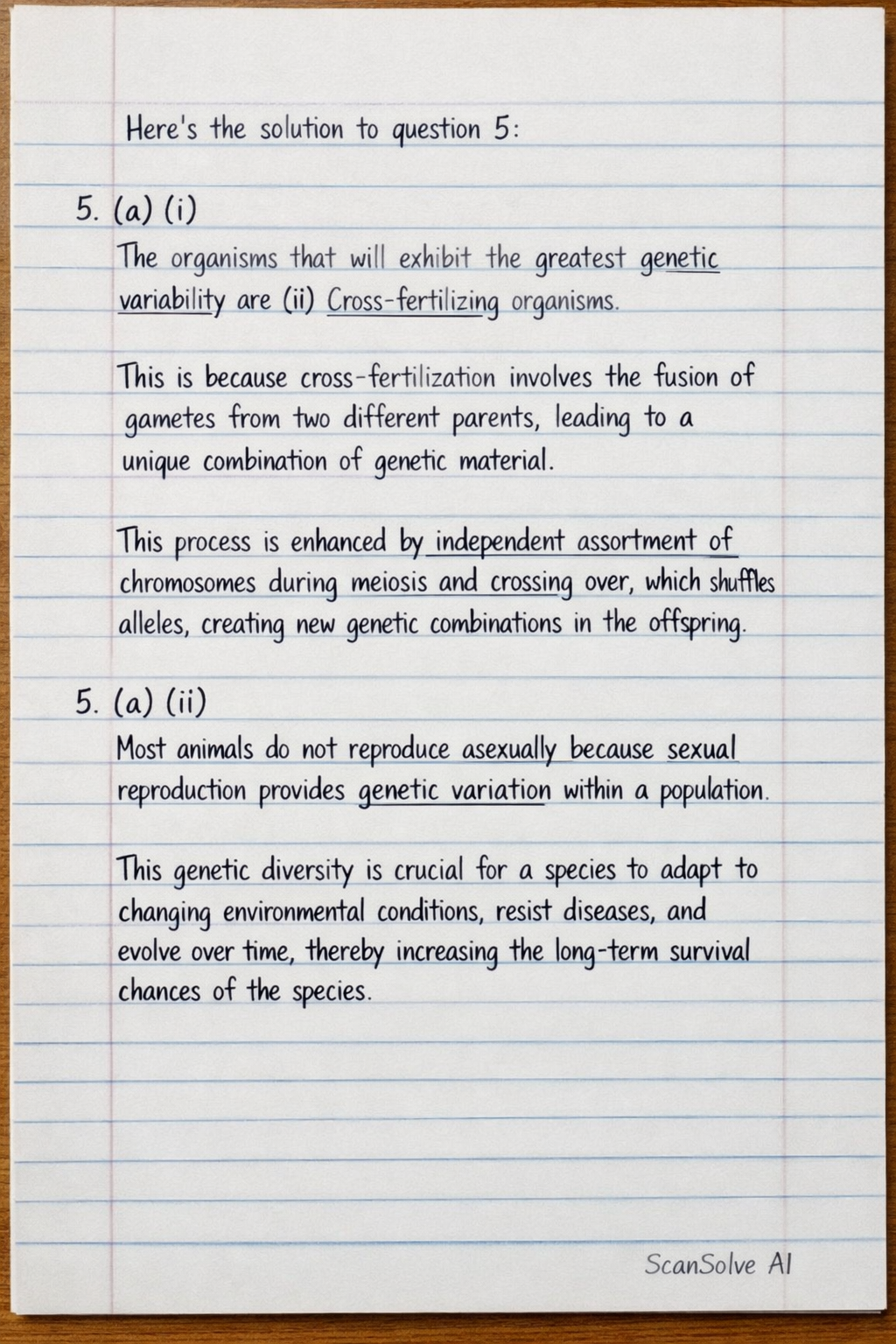
Here's the solution to question 5:
5. (a) (i) You are provided with the following organisms: (i) Self-fertilizing (ii) Cross-fertilizing and (iii) Asexually reproducing. Which of these three sets of organisms will exhibit the greatest genetic variability and why?
The organisms that will exhibit the greatest genetic variability are (ii) Cross-fertilizing organisms.
This is because cross-fertilization involves the fusion of gametes from two different parents, leading to a unique combination of genetic material. This process is enhanced by independent assortment of chromosomes during meiosis and crossing over, which shuffles alleles, creating new genetic combinations in the offspring.
5. (a) (ii) Why do most animals not reproduce asexually?
Most animals do not reproduce asexually because sexual reproduction provides genetic variation within a population. This genetic diversity is crucial for a species to adapt to changing environmental conditions, resist diseases, and evolve over time, thereby increasing the long-term survival chances of the species.
5. (b) What are the functions of the placenta?
The functions of the placenta include:
- Exchange of gases: Facilitates the transfer of oxygen from the mother's blood to the foetus and carbon dioxide from the foetus to the mother.
- Nutrient supply: Transports essential nutrients (e.g., glucose, amino acids, vitamins, minerals) from the mother to the developing foetus.
- Waste removal: Removes metabolic waste products, such as urea and creatinine, from the foetal blood and transfers them to the mother's blood for excretion.
- Hormone production: Produces vital hormones like progesterone and estrogen, which are essential for maintaining the pregnancy and supporting foetal development.
- Immune protection: Transfers maternal antibodies to the foetus, providing passive immunity against certain diseases.
5. (c) Describe:
5. (c) (i) Pollen development
Pollen development occurs within the anthers of a flower. Inside the anther, diploid microspore mother cells undergo meiosis to produce four haploid microspores. Each microspore then undergoes mitosis to form a two-celled pollen grain, which consists of a larger vegetative cell (or tube cell) and a smaller generative cell. The generative cell later divides by mitosis to form two sperm cells (male gametes).
5. (c) (ii) Embryo or ovule development in flowering plants.
Ovule development (formation of the embryo sac): Within the ovary, an ovule develops. Inside the ovule, a diploid megaspore mother cell undergoes meiosis to produce four haploid megaspores. Typically, three degenerate, and one functional megaspore remains. This functional megaspore then undergoes three rounds of mitosis without cytokinesis, resulting in an eight-nucleate, seven-celled structure called the embryo sac (female gametophyte), which contains the egg cell.
Embryo development (after fertilization): After fertilization, the zygote (formed from the fusion of the egg cell and one sperm cell) undergoes repeated mitotic divisions. It first forms a proembryo, which then differentiates into a mature embryo consisting of a radicle (embryonic root), a plumule (embryonic shoot), and one or two cotyledons (seed leaves). Simultaneously, the primary endosperm nucleus (formed from the fusion of the central cell and the second sperm cell) develops into the endosperm, which provides nourishment to the developing embryo. The ovule eventually matures into a seed.
Still stuck on this one?
Ask a follow-up, and the answer starts from this question.
More Biology Questions
Handwritten Step-by-Step Solution
Get this as a handwritten image on WhatsApp — like a tutor wrote it for you.
Try on WhatsApp