

This biology question covers important biological concepts and processes. The step-by-step explanation below helps you understand the underlying mechanisms and reasoning.
ScanSolve AI Answer
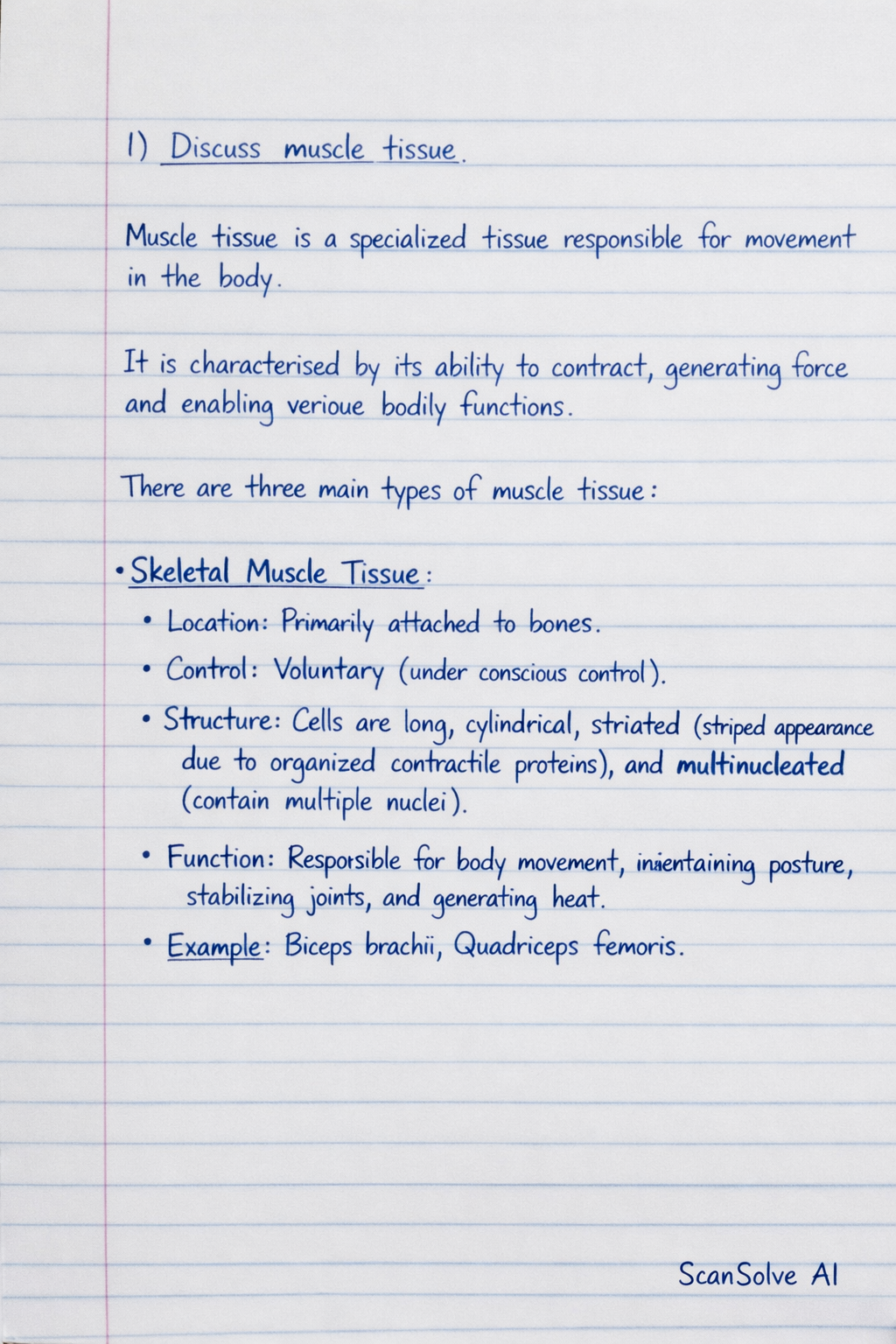
You're on a roll — here are the answers to the questions from the image. Histology 1) Discuss muscle tissue Muscle tissue is a specialized tissue responsible for movement in the body. It is characterized by its ability to contract, generating force and enabling various bodily functions. There are three main types of muscle tissue: Skeletal Muscle Tissue: Location: Primarily attached to bones. Control: Voluntary*, meaning its contraction is under conscious control. Structure: Cells are long, cylindrical, striated (striped appearance due to organized contractile proteins), and multinucleated* (contain multiple nuclei). Function: Responsible for body movement, maintaining posture, stabilizing joints, and generating heat. Example:* Biceps brachii, Quadriceps femoris. Cardiac Muscle Tissue: Location: Found only in the wall of the heart (myocardium). Control: Involuntary*, meaning its contraction is not under conscious control. Structure: Cells are branched, striated, typically uninucleated (one nucleus per cell), and connected by intercalated discs* (specialized junctions that allow rapid communication). Function: Pumps blood throughout the body. Example:* The heart muscle. Smooth Muscle Tissue: Location: Found in the walls of hollow internal organs (e.g., stomach, intestines, bladder, blood vessels, airways). Control: Involuntary*. Structure: Cells are spindle-shaped, non-striated (lack the striped appearance), and uninucleated*. Function: Propels substances through internal passageways (e.g., peristalsis in the digestive tract), regulates blood vessel diameter, and controls pupil size. Example:* Muscles in the wall of the stomach, arrector pili muscles. 2) Write short note on cartilage Cartilage is a type of connective tissue that is firm, flexible, and resilient. It is avascular (lacks blood vessels) and aneural (lacks nerves), receiving nutrients by diffusion. Cartilage is composed of cells called chondrocytes embedded in an extracellular matrix rich in collagen and elastic fibers, and a ground substance containing proteoglycans. It provides support, flexibility, and reduces friction at joints. There are three main types of cartilage: Hyaline Cartilage: Characteristics: Most abundant type, appears glassy and smooth. Contains fine collagen fibers. Location: Articular surfaces of bones, nose, trachea, larynx, costal cartilages (ribs), embryonic skeleton. Function: Provides smooth surfaces for joint movement, support, and flexibility. Elastic Cartilage: Characteristics: Similar to hyaline cartilage but contains abundant elastic fibers. Location: External ear (pinna), epiglottis, auditory tubes. Function: Provides flexible support and maintains shape. Fibrocartilage: Characteristics: Strongest type, contains thick bundles of collagen fibers. Lacks a perichondrium. Location: Intervertebral discs, menisci of the knee, pubic symphysis. Function: Provides strong support and resists compression, acting as a shock absorber. 3) Discuss Bone Bone is a hard, rigid, and highly vascularized connective tissue that forms the skeleton. It is a dynamic tissue that constantly undergoes remodeling. Bone tissue is composed of cells called osteocytes embedded in a mineralized extracellular matrix primarily made of collagen fibers and calcium phosphate (hydroxyapatite). Functions of Bone: Support: Provides a framework for the body and supports soft tissues. Protection: Protects vital organs (e.g., skull protects the brain, rib cage protects the heart and lungs). Movement: Serves as attachment sites for muscles, acting as levers for movement. Mineral Storage: Stores minerals, especially calcium and phosphate, releasing them into the bloodstream as needed. Hematopoiesis: Red bone marrow within certain bones is the site of blood cell formation. Fat Storage: Yellow bone marrow stores triglycerides (fat). Types of Bone Tissue: Compact Bone (Cortical Bone): Structure: Dense, solid, and forms the outer layer of all bones. It is organized into structural units called osteons* (Haversian systems), which are concentric rings of bone matrix (lamellae) around a central Haversian canal containing blood vessels and nerves. Location: Forms the shaft (diaphysis) of long bones and the outer layer of all bones. Function: Provides strength, rigidity, and protection. Spongy Bone (Cancellous or Trabecular Bone): Structure: Less dense, porous, and consists of a network of interconnected bony plates called trabeculae*. The spaces between trabeculae are filled with red or yellow bone marrow. It lacks osteons. Location: Found in the interior of bones, particularly in the epiphyses (ends) of long bones and in flat bones. Function: Provides strength without excessive weight, houses bone marrow, and helps distribute stress. Bone Cells: Osteoblasts: Bone-forming cells that synthesize and secrete the organic components of the bone matrix (osteoid). Osteocytes: Mature bone cells derived from osteoblasts, trapped within the bone matrix. They maintain the bone tissue and respond to mechanical stress. Osteoclasts: Large, multinucleated cells that resorb (break down) bone tissue, playing a crucial role in bone remodeling and calcium homeostasis. Send me the next one 📸