
We read your photo as:
Discuss the approaches and techniques employed in milk sampling, milk testing, and inspection.
ScanSolve AI Answer
Here's a detailed discussion of the approaches and techniques employed in milk sampling, milk testing, and inspection:
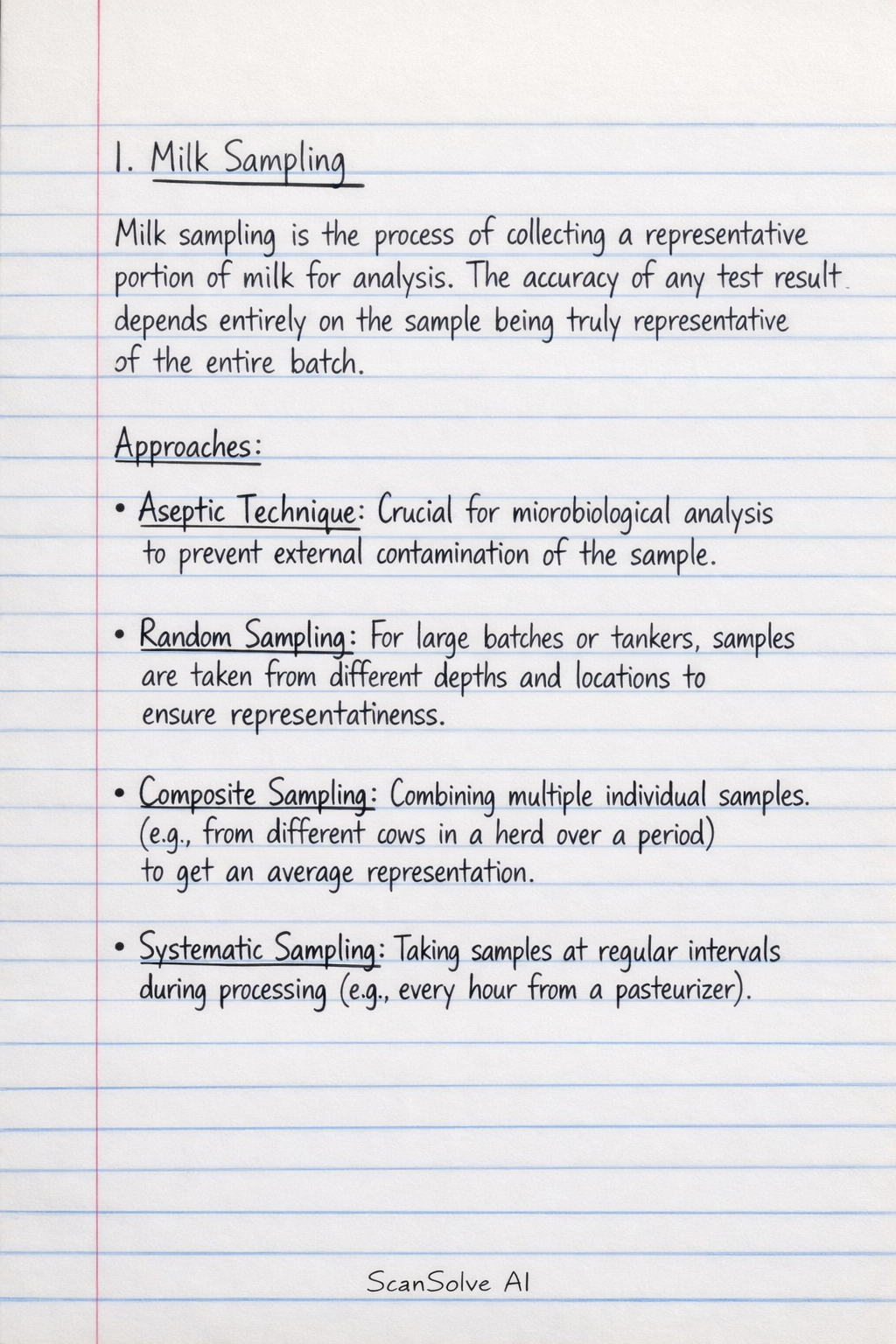
1. Milk Sampling
Milk sampling is the process of collecting a representative portion of milk for analysis. The accuracy of any test result depends entirely on the sample being truly representative of the entire batch.
-
Approaches:
- Aseptic Technique: Crucial for microbiological analysis to prevent external contamination of the sample.
- Random Sampling: For large batches or tankers, samples are taken from different depths and locations to ensure representativeness.
- Composite Sampling: Combining multiple individual samples (e.g., from different cows in a herd over a period) to get an average representation.
- Systematic Sampling: Taking samples at regular intervals during processing (e.g., every hour from a pasteurizer).
-
Techniques:
- Proper Mixing: Before sampling, milk in a bulk tank or container must be thoroughly agitated (stirred) to ensure uniform distribution of fat and other components, as fat tends to separate.
- Sterile Equipment: Use sterile dippers, sampling tubes, or automatic samplers to collect samples, especially for microbiological tests.
- Appropriate Containers: Samples are collected in clean, sterile, leak-proof containers (e.g., plastic bottles or whirl-pak bags) with tight-fitting lids.
- Correct Volume: Collect sufficient volume for all planned tests.
- Labeling: Each sample must be clearly labeled with essential information: date, time, source (farm, tanker, processing line), and any added preservatives.
- Temperature Control: Samples for microbiological or compositional analysis must be kept chilled ( to ) immediately after collection and during transport to the lab to prevent microbial growth and changes in composition.
- Preservatives: For compositional analysis (e.g., fat, protein), chemical preservatives like potassium dichromate or bronopol may be added to inhibit bacterial growth if samples cannot be tested immediately.
2. Milk Testing
Milk testing involves various analytical techniques to assess the quality, safety, and composition of milk.
-
Approaches:
- Rapid Screening Tests: Quick, on-site tests for immediate assessment (e.g., alcohol test for heat stability, pH strips).
- Laboratory-Based Instrumental Analysis: Precise and accurate methods using specialized equipment for detailed compositional and microbiological analysis.
- Sensory Evaluation: Assessing milk's appearance, smell, and taste.
-
Techniques:
- Compositional Tests:
- Fat Content: Babcock test (chemical method using sulfuric acid and centrifugation to separate fat) or Gerber test (similar principle). Modern labs use infrared analyzers (e.g., MilkoScan) for rapid, accurate determination of fat, protein, and lactose.
- Protein Content: Kjeldahl method (measures total nitrogen, then converts to protein) or infrared analysis.
- Lactose Content: Enzymatic methods or infrared analysis.
- Solids-Non-Fat (SNF) and Total Solids: Determined by drying a sample to constant weight (for total solids) or calculated from fat, protein, and lactose values.
- Freezing Point Depression: Measured by a cryoscope to detect added water. Pure milk has a consistent freezing point (approx. to ).
- Density/Specific Gravity: Measured using a lactometer to check for watering down or skimming.
- Microbiological Tests:
- Standard Plate Count (SPC) / Total Bacterial Count (TBC): Involves plating diluted milk samples on agar and counting colonies after incubation to estimate total viable bacteria.
- Coliform Count: Uses selective media to enumerate coliform bacteria, indicating potential fecal contamination.
- Somatic Cell Count (SCC): Measured using automated cell counters (e.g., Fossomatic) or microscopic methods. High SCC indicates mastitis.
- Methylene Blue Reduction Test (MBRT): A rapid test where the time taken for methylene blue dye to decolorize indicates the bacterial load (shorter time = higher bacteria).
- Presence of Pathogens: Specific tests (e.g., PCR, selective media) for pathogens like Salmonella, Listeria, E. coli O157:H7.
- Adulteration and Contaminant Tests:
- Antibiotic Residue Tests: Rapid test kits (e.g., Charm tests) or more sensitive chromatographic methods to detect antibiotic residues.
- Detection of Added Water: Freezing point depression is the primary method.
- Detection of Other Adulterants: Chemical tests for starch, urea, detergents, neutralizers (e.g., sodium bicarbonate).
- Pesticide Residues: Gas chromatography-mass spectrometry (GC-MS) or liquid chromatography-mass spectrometry (LC-MS).
- Compositional Tests:
3. Milk Inspection
Milk inspection involves systematic examination and verification of milk production, collection, processing, and distribution systems to ensure compliance with safety and quality standards. It goes beyond laboratory testing to assess the entire supply chain.
-
Approaches:
- Farm-to-Fork Approach: Comprehensive inspection covering all stages from dairy farm to consumer.
- Risk-Based Inspection: Focusing inspection efforts on areas identified as having higher risks for contamination or quality issues.
- Regulatory Compliance Audits: Checking adherence to national and international food safety regulations and standards (e.g., HACCP, GMP).
- Visual and Sensory Inspection: Initial assessment of milk and facilities.
-
Techniques:
- Farm Level Inspection:
- Animal Health: Checking for signs of disease (especially mastitis), proper veterinary care, and withdrawal periods for treated animals.
- Milking Hygiene: Observing milking practices, cleanliness of udders, hands of milkers, and milking equipment.
- Equipment Sanitation: Inspecting the cleanliness and maintenance of milking machines, pipelines, and bulk tanks.
- Water Quality: Testing the water supply used for cleaning and animal consumption.
- Storage Conditions: Verifying proper cooling and storage temperatures of raw milk on the farm.
- Pest Control: Assessing measures to prevent pests in milking areas and milk storage.
- Collection and Transportation Inspection:
- Tanker Cleanliness: Inspecting the interior and exterior of milk tankers for cleanliness and sanitation.
- Temperature Control: Checking that milk is maintained at appropriate cold temperatures during transport.
- Sealing and Security: Ensuring tankers are properly sealed to prevent tampering or adulteration.
- Driver Hygiene: Assessing the hygiene practices of milk collection personnel.
- Processing Plant Inspection:
- Facility Hygiene: Inspecting the overall cleanliness, design, and maintenance of the processing plant to prevent contamination.
- Good Manufacturing Practices (GMPs): Verifying adherence to established procedures for manufacturing, processing, packaging, and holding food.
- Hazard Analysis and Critical Control Points (HACCP): Auditing the implementation and effectiveness of HACCP plans to identify and control food safety hazards.
- Process Control: Checking critical parameters like pasteurization temperatures and holding times, homogenization pressures, and cooling rates.
- Personnel Hygiene: Observing employee hygiene practices, including handwashing, protective clothing, and health status.
- Waste Management: Assessing proper disposal of waste to prevent contamination.
- Traceability and Record Keeping: Reviewing records for raw material sourcing, processing parameters, quality control tests, and distribution to ensure traceability.
- Product Inspection:
- Labeling Compliance: Checking that product labels accurately reflect ingredients, nutritional information, and meet regulatory requirements.
- Packaging Integrity: Inspecting packaging for damage, leaks, or signs of tampering.
- Shelf-Life Verification: Ensuring products are within their declared shelf life.
- Farm Level Inspection:
Still stuck on this one?
Ask a follow-up, and the answer starts from this question.
More Biology Questions
Handwritten Step-by-Step Solution
Get this as a handwritten image on WhatsApp — like a tutor wrote it for you.
Try on WhatsApp