
We read your photo as:
Discuss the role of extra embryonic membranes in the development of the foetus and describe the different stages involved in the birth of a mammal.
Biology
ScanSolve AI Answer
Step-by-step solution
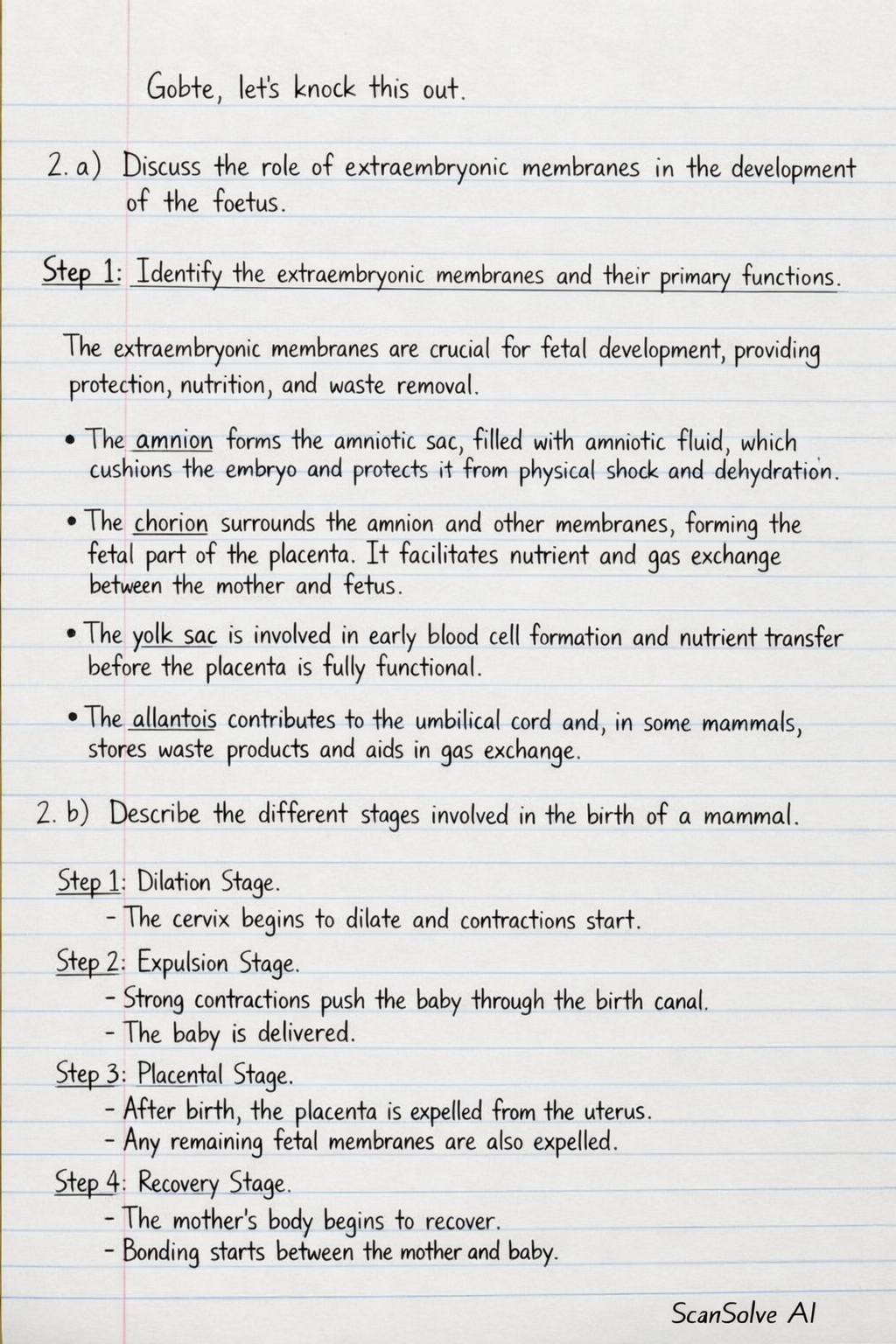
4 steps2. a) Discuss the role of extra embryonic membranes in the development of the foetus.
Identify the extraembryonic membranes and their primary functions.
The extraembryonic membranes are crucial for fetal development, providing protection, nutrition, and waste removal.
- The amnion forms the amniotic sac, filled with amniotic fluid, which cushions the embryo and protects it from physical shock and dehydration.
- The chorion surrounds the amnion and other membranes, forming the fetal part of the placenta. It facilitates nutrient and gas exchange between the mother and fetus.
- The yolk sac is involved in early blood cell formation and nutrient transfer before the placenta is fully functional.
- The allantois contributes to the umbilical cord and, in some mammals, stores waste products and aids in gas exchange.
2. b) Describe the different stages involved in the birth of a mammal.
Outline the three main stages of parturition.
Mammalian birth, or parturition, typically occurs in three stages:
- Stage 1: Dilation of the cervix. This stage involves uterine contractions that gradually push the fetus towards the cervix, causing it to thin and dilate. The amniotic sac may rupture during this stage.
- Stage 2: Expulsion of the fetus. Stronger, more frequent uterine contractions, often aided by abdominal muscle contractions, push the fetus through the birth canal and out of the mother's body.
- Stage 3: Expulsion of the placenta (afterbirth). After the fetus is born, the uterus continues to contract to detach and expel the placenta and other fetal membranes.
2. c) Discuss the role of hormones in birth and lactation in mammals.
Explain the hormonal control of birth.
- Estrogen levels rise towards the end of pregnancy, increasing uterine sensitivity to oxytocin and promoting prostaglandin production.
- Progesterone levels, which maintain pregnancy, decline, removing its inhibitory effect on uterine contractions.
- Oxytocin, released from the posterior pituitary, causes strong uterine contractions during labor.
- Prostaglandins, produced by the uterus, also stimulate uterine contractions and help soften the cervix.
Explain the hormonal control of lactation.
- Prolactin, secreted by the anterior pituitary, is responsible for stimulating milk production in the mammary glands. Its levels rise significantly after birth.
- Oxytocin, released in response to suckling, causes the contraction of myoepithelial cells around the alveoli in the mammary glands, leading to milk ejection (let-down reflex).
Was this helpful?
Still stuck on this one?
Ask a follow-up, and the answer starts from this question.
Got a different question?Ask your own question
More Biology Questions
QExtraembryonic membranes are found during the development of humans but not during the development…QResearch & Presentation TOPICS GROUP 1: Discuss the process involved in: Menstruation Conception…QDescribe the process of early human development, including fertilization, cell division, and the…QDescribe the placenta, umbilical cord, and fetal development stages.QDescribe the functions of the placenta, the structure of the umbilical cord, and the early…
Handwritten Step-by-Step Solution
Get this as a handwritten image on WhatsApp — like a tutor wrote it for you.
Try on WhatsApp